- Animals
- ›Chordates
- ›Vertebrates
- ›Ray-finned Fishes
- ›Spiny-rayed fishes
- ›Gobies, cardinalfishes and allies
- ›Gobies and allies
- ›Mudskippers and Allies
- ›Estuarine Gobies
- ›Awaous
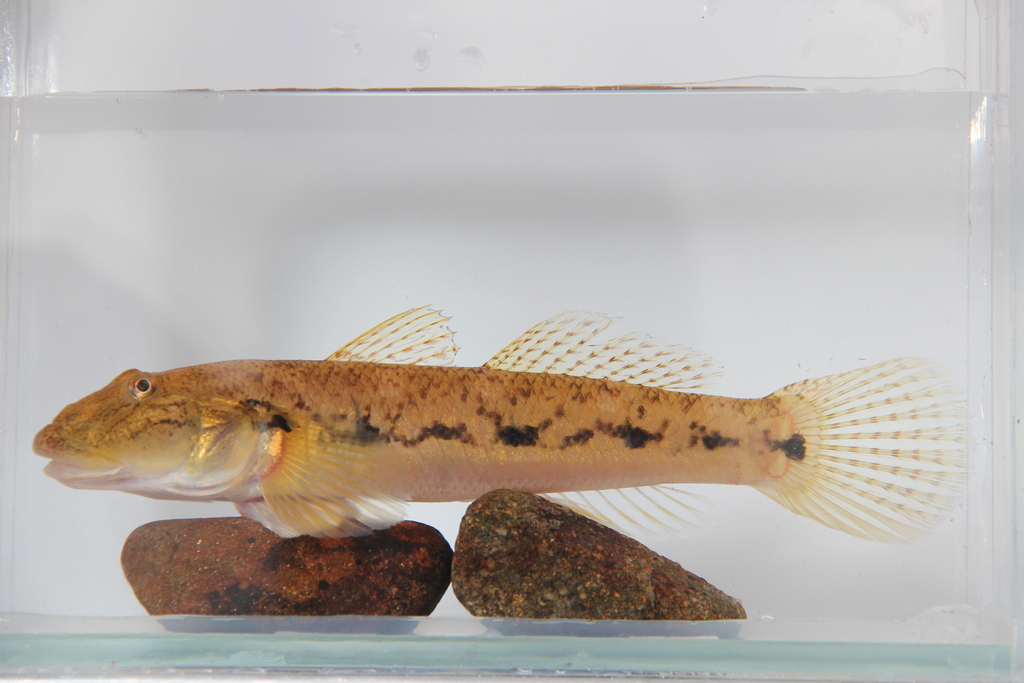
Roman-nose Goby
Awaous acritosus
Awaous acritosus, the Roman nose goby, is a species of goby that is native to fresh water rivers and streams of Queensland, Australia and the Laloki River drainage of New Guinea.
Adults inhabit tropical freshwater streams above the tidal influence, while the larvae may be washed downstream to estuaries or the sea. The species is usually found in clear, or occasionally turbid waters, with gravelly, sandy and muddy bottoms near aquatic vegetation.
From the article Awaous acritosus on Wikipedia (CC BY-SA), quoted section by section
Description
The Roman nose goby is a large pale brownish goby with irregular dark blotches and lines on the head and body, a series of blackish blotches along the midside, and a fine dark line from the eye to the rear of the upper lip. The species has large lips, and a distinctly sloping snout - hence the common name. This species can reach a length of 18 centimetres (7.1 in) SL. The Roman nose goby has been misidentified as Awaous crassilabrus, a species that does not occur in Australia. Indeed, its species name, acritosus is from the Greek akritos, meaning 'confused', in reference to incorrect identity of this species for more than 125 years.
What it does
The Roman nose goby feeds mostly on algae, but also ingests large amounts of sand thereby unintentionally consuming detritus and animal material.
== References ==
Wikipedia: “Diet”
Where it lives
Recorded sightings
—
geo-referenced records in GBIF, from museums, herbaria and field observers.
Drag the globe to turn it. Dots are where records exist, not a range map; darker means more records.
In the stacks
Searching the stacks…
Every page naming Awaous acritosus in the Biodiversity Heritage Library →
This page is assembled live from iNaturalist, GBIF, Wikipedia, the Source Library and the Internet Archive. It is not yet part of the hand-edited codex. iNaturalist taxon 187100.