- Animals
- ›Chordates
- ›Vertebrates
- ›Ray-finned Fishes
- ›Spiny-rayed fishes
- ›Butterflyfishes, Angelfishes, and Allies
- ›Surgeonfishes, Tangs, and Unicornfishes
- ›Ctenochaetus
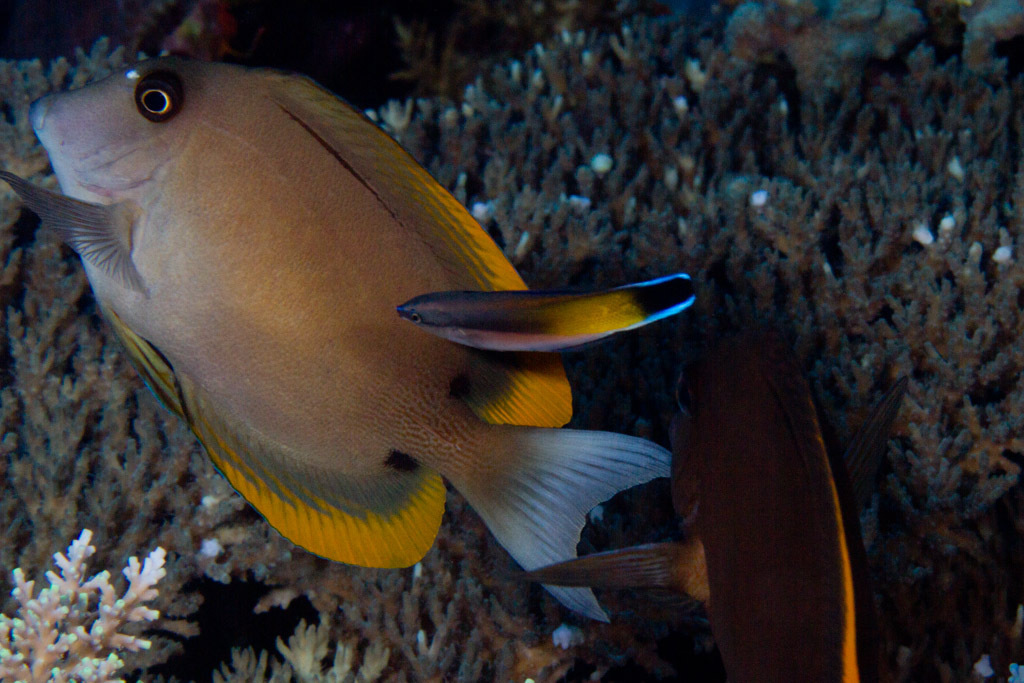
Orange-tip Bristletooth
Ctenochaetus tominiensis
Ctenochaetus tominiensis, the Tomini surgeonfish, Tomini bristletooth, yellowtip bristletooth or orangetip bristletooth, is a species of marine ray-finned fish belonging to the family Acanthuridae which includes the surgeonfishes, unicornfishes and tangs. This fish is found in the western central Pacific Ocean.
From the article Ctenochaetus tominiensis on Wikipedia (CC BY-SA), quoted section by section
Description
Ctenochaetus tominiensis has its dorsal fin supported by 8 spines and 24 or 25 soft rays while the anal fin is supported by 3 spines and 22 or 23 soft rays. The rear ends of the dorsal and anal fins are, uniquely in the genus Ctenochaetus, angular. The lips have warty margins. In juveniles the caudal fin is forked and in adults it is lunate. The maximum published standard length of this fish is 16 cm (6.3 in). The overall colour of the body is yellowish brown with a white caudal fin and broad yellow margins to the dorsal and anal fins.
Range & habitat
Ctenochaetus tominiensis is found in the western central Pacific Ocean from Malaysia and Indonesia east through East Timor, the Philippines, Palau, Micronesia, Papua New Guinea, the Solomon Islands, Tuvalu, Vanuatu and Fiji, south to the Great Barrier Reef. It has been recorded from Tonga. This species is found solitarily or in small aggregations on steep drop offs with dense coral growth in inshorse, sheltered waters at depths between 0 and 45 m (0 and 148 ft).
Wikipedia: “Distribution and habitat”
Where it lives
Recorded sightings
—
geo-referenced records in GBIF, from museums, herbaria and field observers.
Drag the globe to turn it. Dots are where records exist, not a range map; darker means more records.
In the stacks
Searching the stacks…
Every page naming Ctenochaetus tominiensis in the Biodiversity Heritage Library →
This page is assembled live from iNaturalist, GBIF, Wikipedia, the Source Library and the Internet Archive. It is not yet part of the hand-edited codex. iNaturalist taxon 187282.