- Animals
- ›Chordates
- ›Vertebrates
- ›Ray-finned Fishes
- ›Spiny-rayed fishes
- ›Butterflyfishes, Angelfishes, and Allies
- ›Surgeonfishes, Tangs, and Unicornfishes
- ›Naso
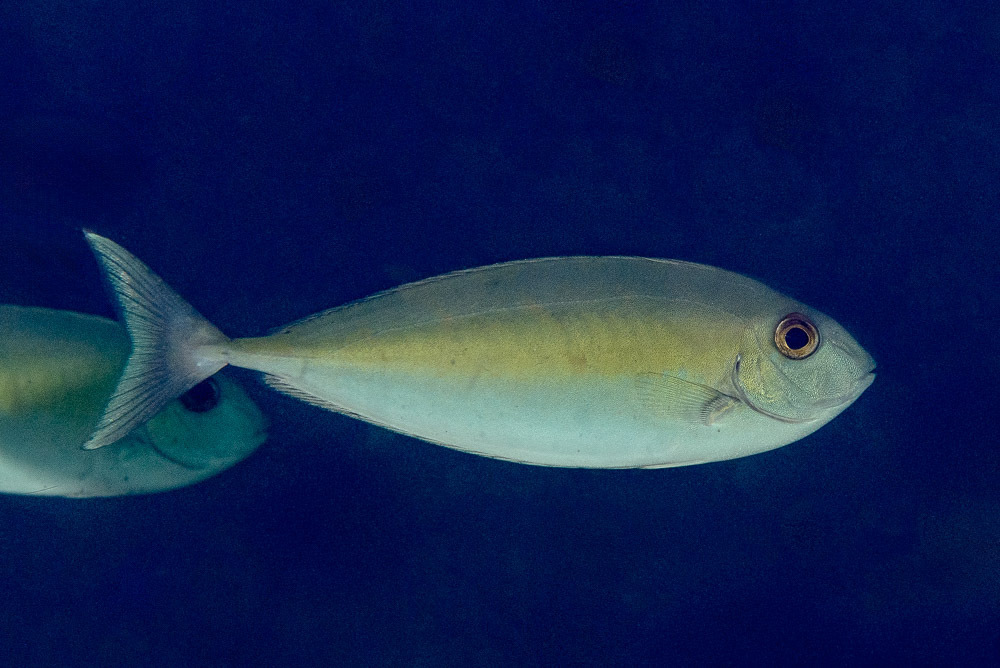
Onespine Unicornfish
Naso thynnoides
Naso thynnoides is a tropical fish found in coral reefs in the Pacific and Indian Oceans. It is commonly known as the oneknife unicornfish, oneknife unicorn, thunny unicornfish, singlespine unicornfish, one-spine unicorn, or barred unicornfish. It is of value in commercial fisheries, and is also used in aquaria.
From the article Naso thynnoides on Wikipedia (CC BY-SA), quoted section by section
Description
Naso thynnoides has its dorsal fin supported by 5 or 6 spines and 28 to 30 soft rays while the anal fin is supported by 2 spines and between 28 and 30 soft rays. This is a relatively slender unicornfish with the standard length being around three times the body's depth. The head does not have any form of protuberance and is smoothly rounded. There is a short, diagonal groove in front of the eye and below the nostrils. There is a single bony plate on each side of the caudal peduncle and this has a small, semicircular keel. The overall colour is grey fading on the underside. There are around 30 bluish horizontal stripes along the back and flanks, breaking into irregular shaped spots on the head. There is an indistinct yellowish horizontal stripe along the flanks. The bony plates and keels on the caudal peduncle are dusky and the caudal fin is bluish grey. This species has a maximum published fork length of 40 cm (16 in).
Range & habitat
Naso thynnoides is found across the Indian Ocean and into the Pacific Ocean. In the Indian Ocean it is found along the eastern coast of Africa from Kenya south to Mozambique, the Comoro Islands, Madagascar, Seychelles, Mascarene Islands, the Maldives, Sri Lanka, Nicobar Islands, Andaman Islands and the Andaman Sea coasts of Myanmar, Thailand and Malaysia through the Malay Archipelago into the Pacific north to the Ryukyu Islands, east to the American Samoa, Johnston Atoll and Tuamoto islands and south to the Great Barrier Reef. This fish is found on steep outward reef and lagoon slopes at depths of between 2 and 40 m (6 ft 7 in and 131 ft 3 in)
Wikipedia: “Distribution and habitat”
In human culture
Naso thynnoides has the specific name thynnoides, which means "tuna-like" which Achille Valenciennes explained in 1835 was an allusion to the more elongated and compressed body of this species, like that of a tuna.
Wikipedia: “Etymology”
Where it lives
Recorded sightings
—
geo-referenced records in GBIF, from museums, herbaria and field observers.
Drag the globe to turn it. Dots are where records exist, not a range map; darker means more records.
In the stacks
Searching the stacks…
Every page naming Naso thynnoides in the Biodiversity Heritage Library →
This page is assembled live from iNaturalist, GBIF, Wikipedia, the Source Library and the Internet Archive. It is not yet part of the hand-edited codex. iNaturalist taxon 187735.