- Animals
- ›Chordates
- ›Vertebrates
- ›Ray-finned Fishes
- ›Spiny-rayed fishes
- ›Butterflyfishes, Angelfishes, and Allies
- ›Grunts
- ›Plectorhinchinae
- ›Plectorhinchus
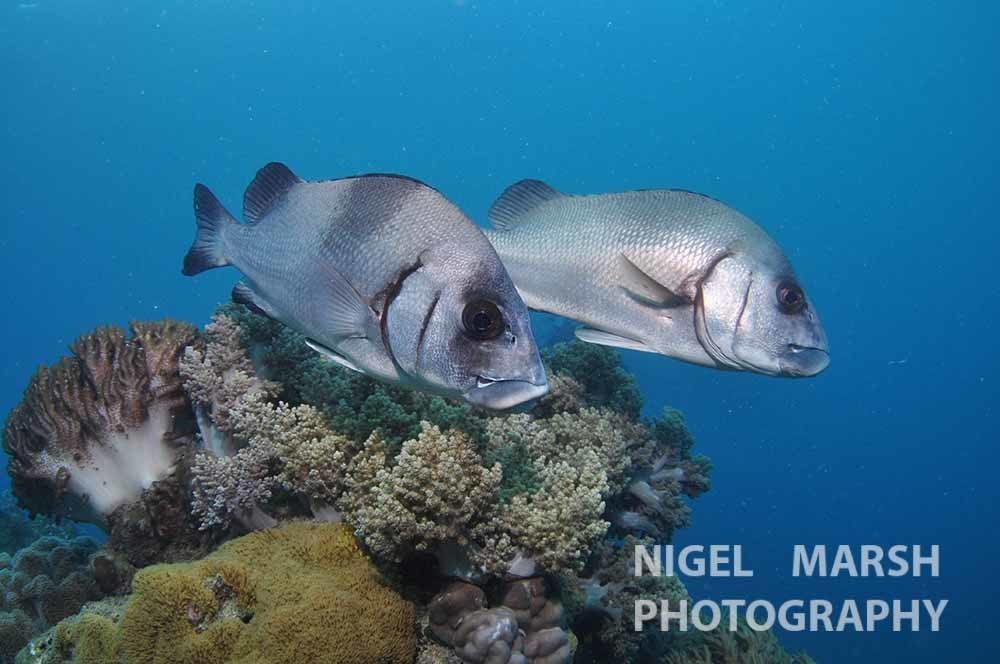
Blubberlip
Plectorhinchus gibbosus
Plectorhinchus gibbosus, commonly known as the Harry hotlips, black sweetlips, brown sweetlips, dusky sweetlips, gibbous sweetlips, hairy hotlips or humpback sweetlips, is a species of marine ray-finned fish, a sweetlips belonging to the subfamily Plectorhinchinae, one of two subfamilies in the family Haemulidae, the grunts. It is native to the Western Pacific and Indian Oceans.
From the article Plectorhinchus gibbosus on Wikipedia (CC BY-SA), quoted section by section
Description
Plectorhinchus gibbosus has fleshy lips which become grossly swollen with age, it has 6 pores on its chin but has no median pit. The dorsal fin contains 14 spines and 15–16 soft rays while the anal fin has 3 spines and 7–8 soft rays. The overall colour is silvery-grey to brownish with dark edges to the scales, a dusky face, a thin dark bar on the anterior of the operculum which has a black rear margin. The soft rayed part of the dorsal fin, anal fin and caudal fin are dusky. The juveniles are brownish in colour with a pink or transparent caudal fin and mimic fallen leaves by drifting with the body oriented with their sides parallel to the surface. This species attains a maximum total length of 75 cm (30 in).
Range & habitat
Plectorhinchus gibbosus has a wide Indo-Pacific distribution. It is found along the eastern coast of Africa from Kenya to South Africa and along the southern coast of Asia into the Pacific as far east as Polynesia, north as far as the Ryukyu Islands of southern Japan and south to Australia. In Australia its range extends from the Ningaloo Reef in Western Australia along the northern coasts and south on the eastern coast as far as Flinders Island in Tasmania, as well as Lord Howe Island and Norfolk Island in the Tasman Sea. It is also found off the Indian Ocean islands of Socotra, Seychelles, Madagascar and the western Mascarenes.
Wikipedia: “Distribution”
Where it lives
Recorded sightings
—
geo-referenced records in GBIF, from museums, herbaria and field observers.
Drag the globe to turn it. Dots are where records exist, not a range map; darker means more records.
In the stacks
Searching the stacks…
Every page naming Plectorhinchus gibbosus in the Biodiversity Heritage Library →
This page is assembled live from iNaturalist, GBIF, Wikipedia, the Source Library and the Internet Archive. It is not yet part of the hand-edited codex. iNaturalist taxon 188071.