- Animals
- ›Chordates
- ›Vertebrates
- ›Ray-finned Fishes
- ›Spiny-rayed fishes
- ›Mackerels, Tunas, Butterfishes, and Allies
- ›Scombroidei
- ›Mackerels, Tunas, and Bonitos
- ›Scombrinae
- ›Scomberomorus
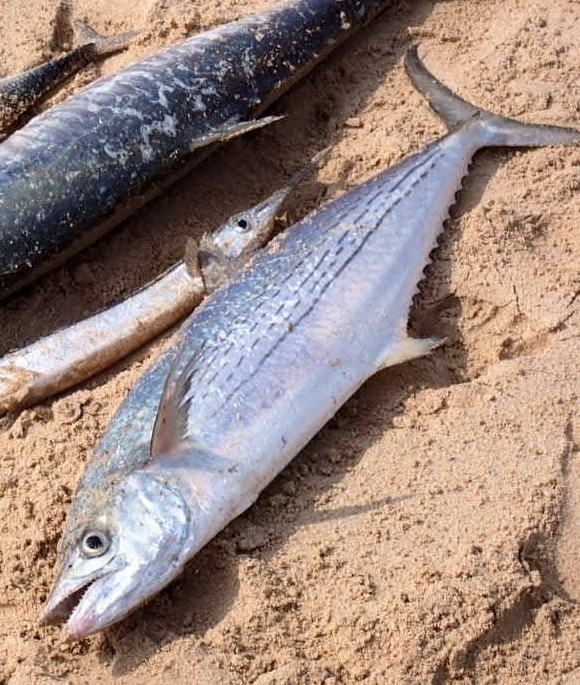
Streaked Seerfish
Scomberomorus lineolatus
The streaked Spanish mackerel (Scomberomorus lineolatus), also known as the queen mackerel, streaked seer, or streaked seerfish, is a species of Spanish mackerel found in the Indian Ocean.
It is also known by other names, such as hazard (French), sawara, and carite (Spanish), although these names may also be used to describe other Spanish mackerel. It is an important quarry species for fisheries where it occurs.
From the article Streaked Spanish mackerel on Wikipedia (CC BY-SA), quoted section by section
Description
Like other fish in Scomberomorus, it has a streamlined, elongated, body, a deeply forked tail, and no swim bladder. The body is a darker blue-grey on the back, and becomes silver near the belly. The anterior of the first dorsal fin is black, and the finlets and other fins are grey. It has small scales and sharp teeth, effective for preying on fish. Compared to all other species of Spanish mackerel, it possesses a unique short-lined pigment pattern, making it easier to identify. S. lineolatus can reach up to 98 cm (39 in) and weigh 4.1 kg (9.0 lb). The oldest recorded specimen was 7 years old.
Range & habitat
The streaked seerfish is found off Asian coasts from the west coast of India, especially along the Maharashtra and Gujarat coasts (Northeastern coast of India), and Sri Lanka to Eastern Java, and does not extend east of Wallace's Line. It is also found in the Gulf of Thailand and southern areas of the South China Sea.
Wikipedia: “Range”
In human culture
S. lineolatus feeds almost exclusively on fish from Sardinella (sardines) and Anchoviella (anchovies). It lives a pelagic-neritic lifestyle, usually staying near the continental shelf. The fish usually spawns between January and July. They usually mature between one and two years of age, when they are between 40 and 52 cm (16 and 20 in). Males mature a bit sooner than females.
Wikipedia: “Natural history”
Where it lives
Recorded sightings
—
geo-referenced records in GBIF, from museums, herbaria and field observers.
Drag the globe to turn it. Dots are where records exist, not a range map; darker means more records.
In the stacks
Searching the stacks…
Every page naming Scomberomorus lineolatus in the Biodiversity Heritage Library →
This page is assembled live from iNaturalist, GBIF, Wikipedia, the Source Library and the Internet Archive. It is not yet part of the hand-edited codex. iNaturalist taxon 188364.