- Animals
- ›Chordates
- ›Vertebrates
- ›Ray-finned Fishes
- ›Carps, Characins, Catfishes and Allies
- ›Catfishes
- ›Siluroidei
- ›Squeakers
- ›Mochokinae
- ›Synodontis
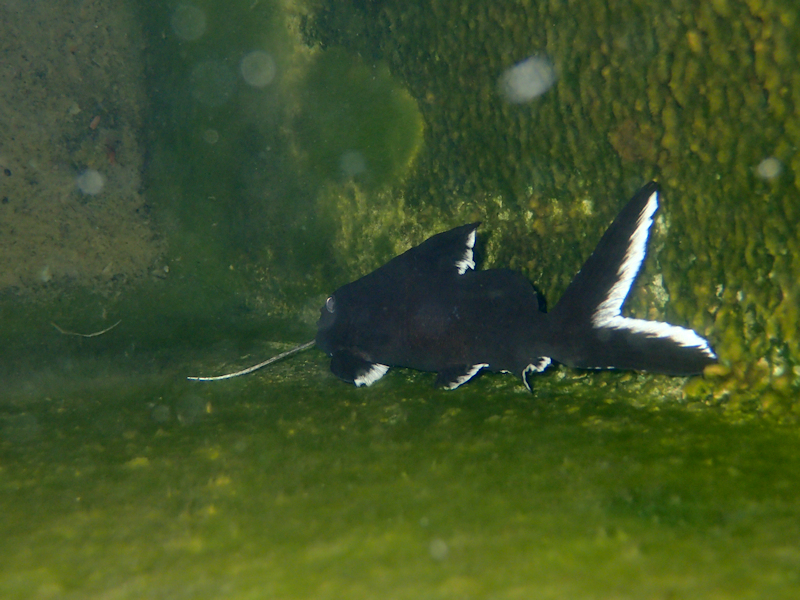
Synodontis granulosus
Synodontis granulosus is a species of upside-down catfish endemic to the Democratic Republic of the Congo, Burundi, Zambia, and Tanzania, where it is only known from Lake Tanganyika. It was first described by Belgian-British zoologist George Albert Boulenger in 1900, from specimens collected at multiple points along the shore of Lake Tanganyika. The species name comes from the Latin word "granulum", meaning of grain, and refers to the granular papillae present on the skin of the fish's body.
From the article Synodontis granulosus on Wikipedia (CC BY-SA), quoted section by section
Description
Like all members of the genus Synodontis, S. granulosus has a strong, bony head capsule that extends back as far as the first spine of the dorsal fin. The head is about 3⁄10 of the standard length of the fish. The head contains a distinct narrow, bony, external protrusion called a humeral process. The shape and size of the humeral process help to identify the species. In S. granulosus, the humeral process is narrow, long, and rough in appearance, with a distinct ridge on the bottom edge. The top edge is concave and the end is sharply pointed. It is about 2⁄3 of the length of the head. The diameter of the eye is about 1⁄7 of the length of the head. The fish has three pairs of barbels. The maxillary barbels are located on the upper jaw, and two pairs of mandibular barbels are on the lower jaw. The maxillary barbel has a narrow membrane attached near the base and is straight without any branches. It extends at least as far as the base of the pectoral fin, slightly longer than the length of the head and 3⁄10 of the standard length of the body. The outer pair of mandibular barbels extends just short of the pectoral girdle, about 7⁄10 of the length of the head, and contains four to five branches without secondary branches. …
Range & habitat
In the wild, the species is endemic to Lake Tanganyika, which has an observed temperature range of 22 to 26 °C (72 to 79 °F), an approximate pH of 8.5 – 9, and a dH range of 4-15. The fish inhabits the littoral to benthic zones in the lake, over shell, sand, and mud bottoms, and has been found at depths of up to 130 metres (430 ft), but most commonly between 20 and 40 metres (66 and 131 ft). The reproductive habits of most of the species of Synodontis are not known, beyond some instances of obtaining egg counts from gravid females. Spawning likely occurs during the flooding season between July and October, and pairs swim in unison during spawning. As a whole, species of Synodontis are omnivores, consuming insect larvae, algae, gastropods, bivalves, sponges, crustaceans, and the eggs of other fishes. The growth rate is rapid in the first year, then slows down as the fish age.
Wikipedia: “Habitat and behavior”
Where it lives
Recorded sightings
—
geo-referenced records in GBIF, from museums, herbaria and field observers.
Drag the globe to turn it. Dots are where records exist, not a range map; darker means more records.
In the stacks
Searching the stacks…
Every page naming Synodontis granulosus in the Biodiversity Heritage Library →
This page is assembled live from iNaturalist, GBIF, Wikipedia, the Source Library and the Internet Archive. It is not yet part of the hand-edited codex. iNaturalist taxon 188512.