- Animals
- ›Chordates
- ›Vertebrates
- ›Birds
- ›Parrots
- ›Old World Parrots
- ›Long-tailed Parrots and allies
- ›Psittacula
On eBird ↗
Derbyan Parakeet
Live sightings near you, the range map, bar charts of when it is seen, and Macaulay Library photos and recordings.
Derbyan Parakeet
Psittacula derbiana
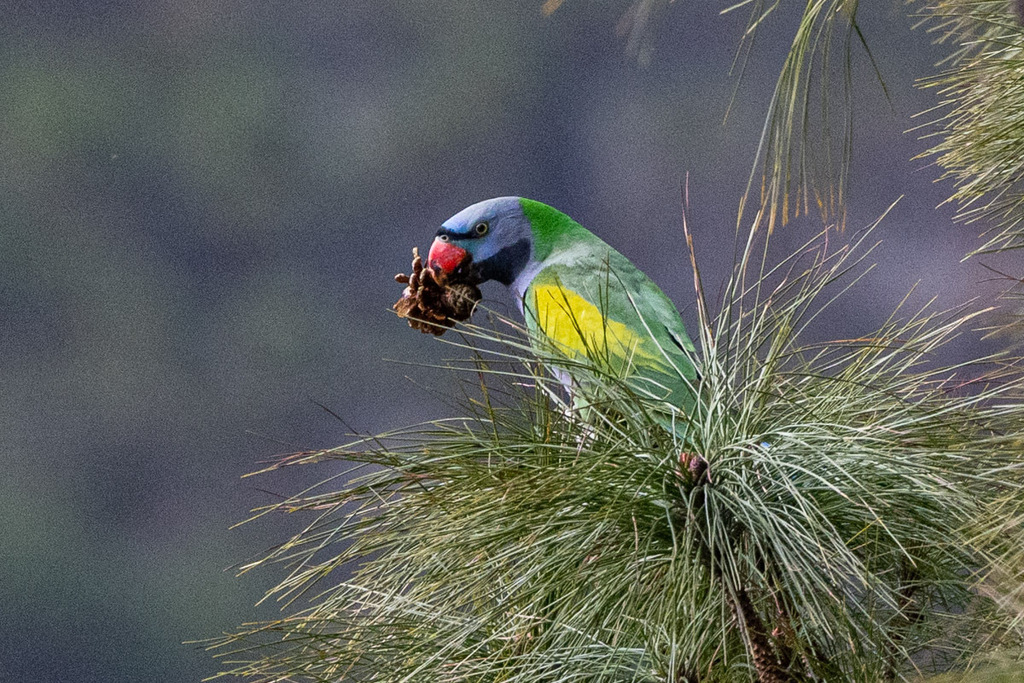
Lord Derby's parakeet (Psittacula derbiana), also known as Derbyan parakeet, is a parrot species, which is confined to a small pocket of moist evergreen forest in the hills and mountains of the Indian states of Arunachal Pradesh and Assam, and adjoining parts of Tibet, Sichuan and Yunnan in China. The species suffers from cutting of old trees (important for nesting sites) and poaching for the illegal wildlife trade. In 2011, its status was updated from least concern to near threatened on the IUCN Red List. The adult male and female are easily distinguished because they have different beak colours and slightly different plumage.
The name of this bird commemorates Edward Stanley, 13th Earl of Derby.
From the article Lord Derby's parakeet on Wikipedia (CC BY-SA), quoted section by section
Description
Lord Derby's parakeets are 45–50 cm (18–20 in) in length and are sexually dimorphic. They have a mostly green plumage over their dorsal surface (i.e. from behind), black lores and lower cheeks, a bluish-purple crown and pale yellow eyes. The throat, breast, abdomen and under-wing coverts are greyish blue to lavender. The thighs and vent area are yellowish green with blue edging on some of the feathers. The tail feathers are shades of green, some edged with blue. Male birds have a red upper mandible with a yellow tip, while the lower mandible is black. The females have an all-black beak. Immature Lord Derby's parakeets are duller in colour than the adults. Juvenile birds have green crowns, orange-red upper and lower mandible (beak), and their irises are dark and do not lighten until they reach maturity between two and three years of age.
What it does
Breeding season usually begins between April and June. The female lays a clutch of two to four eggs (36.1 mm × 27.7 mm [1.42 in × 1.09 in]) in nest holes of trees. The young hatch after an incubation period of about 23 days and will fledge after 8 to 9 weeks.
Wikipedia: “Reproduction”
Listen
Looking for field recordings…
Where it lives
Recorded sightings
—
geo-referenced records in GBIF, from museums, herbaria and field observers.
Drag the globe to turn it. Dots are where records exist, not a range map; darker means more records.
In the stacks
Searching the stacks…
Every page naming Psittacula derbiana in the Biodiversity Heritage Library →
This page is assembled live from iNaturalist, GBIF, Wikipedia, the Source Library and the Internet Archive. It is not yet part of the hand-edited codex. iNaturalist taxon 18903.