- Animals
- ›Chordates
- ›Vertebrates
- ›Birds
- ›Parrots
- ›Old World Parrots
- ›Broad-tailed Parrots and Allies
- ›Platycercus
On eBird ↗
Northern Rosella
Live sightings near you, the range map, bar charts of when it is seen, and Macaulay Library photos and recordings.
Northern Rosella
Platycercus venustus
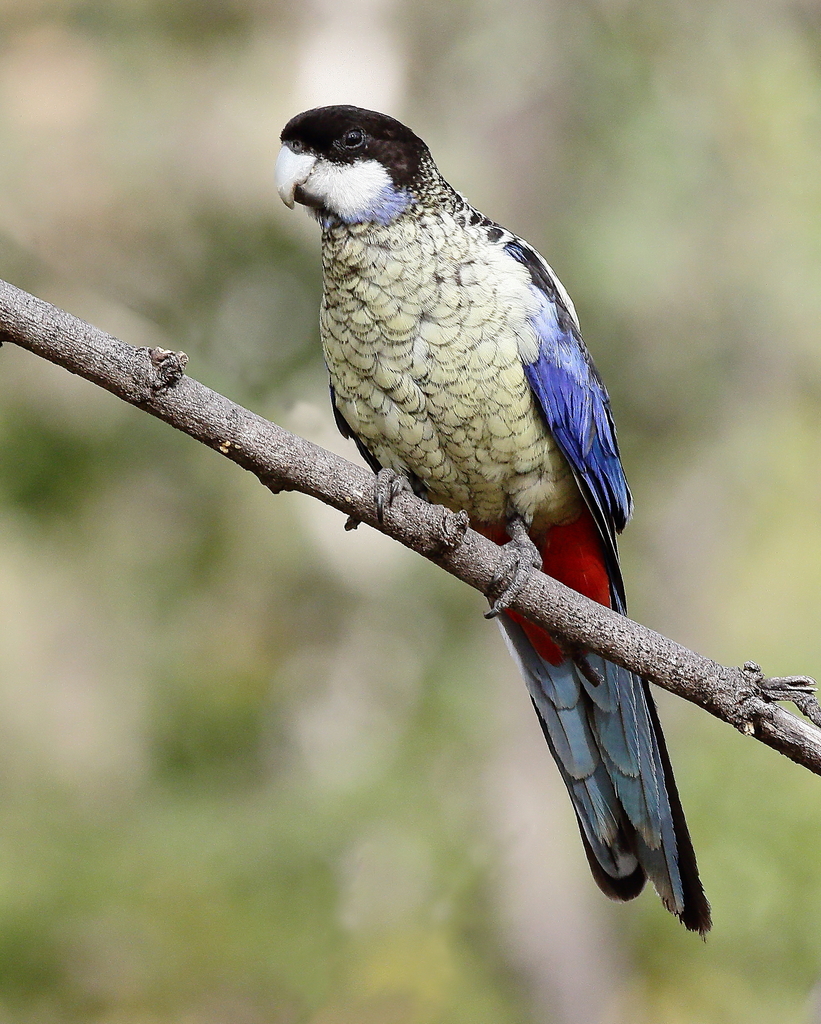
The northern rosella (Platycercus venustus), formerly known as Brown's rosella or the smutty rosella, is a species of parrot native to northern Australia, ranging from the Gulf of Carpentaria and Arnhem Land to the Kimberley. It was described by Heinrich Kuhl in 1820, and two subspecies are recognised. The species is unusually coloured for a rosella, with a dark head and neck with pale cheeks—predominantly white in the subspecies from the Northern Territory and blue in the Western Australian subspecies hillii. The northern rosella's mantle and scapulars are black with fine yellow scallops, while its back, rump and underparts are pale yellow with fine black scallops. The long tail is blue-green, and the wings are black and blue-violet. The sexes have similar plumage, while females and younger birds are generally duller with occasional spots of red.
Found in woodland and open savanna country, the northern rosella is predominantly herbivorous, consuming seeds, particularly of grasses and eucalypts, as well as flowers and berries, but it may also eat insects. Nesting takes place in tree hollows. Although uncommon, the northern rosella is rated as least concern on the International Union for Conservation of Nature (IUCN)'s Red List of Threatened Species.
From the article Northern rosella on Wikipedia (CC BY-SA), quoted section by section
Description
Smaller than all rosella species except the western rosella, the adult northern rosella weighs 90 to 110 g (3.2 to 3.9 oz) and is 29 to 32 cm (11 to 13 in) long. It has broad wings with a wingspan of around 44 cm (17 in), and a long tail with twelve feathers. The sexes are almost indistinguishable, though some adult females have duller plumage and are more likely to have some red feathers on the head and breast. The adult bird has a black forehead, crown, lores, ear coverts, upper neck and nape, a whitish throat and large cheek-patches, which are mainly white with violet lower borders in the nominate subspecies, and more blue with a narrow white upper segment in subspecies hillii. The feathers of the lower neck, mantle and scapulars are black narrowly fringed with yellow, giving a scalloped appearance, while the feathers of the back, rump, upper tail coverts and underparts are pale yellow with black borders and concealed grey bases. Those of the breast have very dark grey bases, occasionally tinged with red. The undertail covert feathers are red with black fringes. The feathers on the upper leg are pale yellow tinged with blue. The central rectrices of the long tail are dark green changing to dark blue at the tips, while the other feathers are dark blue with two bands of pale blue and white tips. The undertail is pale blue with a white tip. …
Range & habitat
The northern rosella is found across northern Australia. In Western Australia, it is found across the Kimberley south to the 18th parallel, around Derby, Windjana Gorge National Park, the northern Wunaamin Miliwundi Ranges, Springvale Station and Warmun, with vagrants reported at Halls Creek and Fitzroy Crossing. In the Northern Territory it is found from Victoria River north to the Tiwi Islands and east into western Arnhem Land, and across northern Arnhem Land through Milingimbi Island and the Wessel Islands to the Gove Peninsula. It is absent from central Arnhem Land, but is found further east around the western and southern coastline of the Gulf of Carpentaria, south to Borroloola and across the border into western Queensland as far as the Nicholson River. The northern rosella lives in grassy open forests and woodlands, including deciduous eucalypt savanna woodlands. Typical trees include species of Eucalyptus, such as Darwin stringybark (Eucalyptus tetrodonta), Melaleuca, Callitris and Acacia. More specific habitats include vegetation along small creeks and gorges, sandstone outcrops and escarpments, as well as some forested offshore islands. The northern rosella is occasionally found in mangroves or public green spaces in suburban Darwin. It avoids dense forest.
Wikipedia: “Distribution and habitat”
What it does
Not a gregarious bird, the northern rosella is generally found alone or in pairs, although several birds perch together in the same tree. Sometimes they are encountered in larger troops—usually 6 to 8 birds, but in rare instances up to 15 individuals. It is shyer than other rosellas, and flees to the upper tree canopy if disturbed. It is a quieter and less vocal species than other rosellas, and its call repertoire has been little studied. It exhibits a sharp and short chit-chut chit-chut contact call in flight; while perched it makes a three-note whistle on ascending scale or metallic piping sounds. Soft chattering can be heard while feeding, and sometimes when squabbling at the beginning of breeding season.
Breeding. Nesting occurs in tree hollows in the Southern Hemisphere winter, often in eucalypts located near water. The clutch is anywhere from two to five white matte or slightly glossy eggs, measuring roughly 26 x 21 mm (1 x 0.8 in). The female incubates the eggs alone, over a period of 19 or 20 days. Newly hatched chicks are covered with long white down and are largely helpless (nidicolous). They may remain in the nest for seven weeks after hatching and are fed by both parents. Fledglings remain with their parents for a year or more, often feeding together in small family groups.
Feeding. …
Wikipedia: “Behaviour”
In human culture
Most northern rosellas in captivity in Australia are the nominate subspecies, but there are blue-cheeked specimens that are either subspecies hillii or intermediate. Its attractive colours make it a desirable species to keep. In captivity in the Northern Hemisphere, the northern rosella has been reported to breed in the same calendar months as it does in its Southern Hemisphere native range. As it breeds early in the season, clutches laid in cooler months of cooler Australian states may fail. Breeders have attempted to use sprinklers in enclosures to induce pairs to breed at other times.
Wikipedia: “Aviculture”
Listen
Looking for field recordings…
Where it lives
Recorded sightings
—
geo-referenced records in GBIF, from museums, herbaria and field observers.
Drag the globe to turn it. Dots are where records exist, not a range map; darker means more records.
In the stacks
Searching the stacks…
Every page naming Platycercus venustus in the Biodiversity Heritage Library →
This page is assembled live from iNaturalist, GBIF, Wikipedia, the Source Library and the Internet Archive. It is not yet part of the hand-edited codex. iNaturalist taxon 18916.