- Animals
- ›Chordates
- ›Vertebrates
- ›Birds
- ›Parrots
- ›Old World Parrots
- ›Broad-tailed Parrots and Allies
- ›Platycercus
On eBird ↗
Western Rosella
Live sightings near you, the range map, bar charts of when it is seen, and Macaulay Library photos and recordings.
Western Rosella
Platycercus icterotis
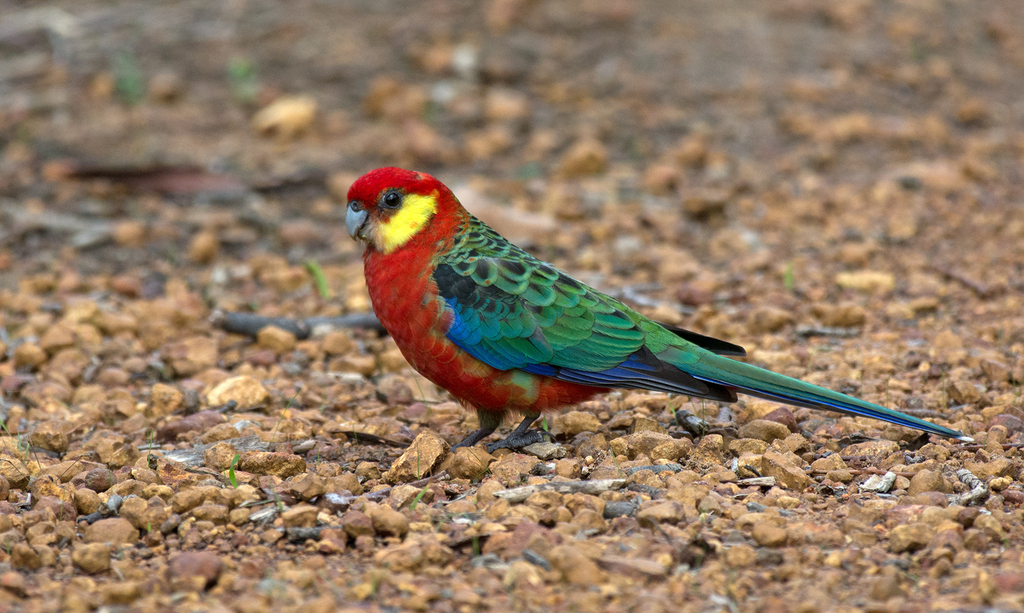
The western rosella (Platycercus icterotis), or moyadong, is a species of parrot endemic to southwestern Australia. The head and underparts are bright red, and the back is mottled black; a yellow patch at the cheek distinguishes it from others of the genus Platycercus. Adults of the species exhibit sexual dimorphism with the females duller overall; juveniles lack the striking colours of mature birds and the characteristic patterning is not as easily distinguished. Their communication call is a softly delivered pink-pink sound, and much of their behaviour is comparatively unobtrusive. Their habitat is in eucalypt forests and woodlands, where they often remain unobserved until they appear to feed on seeds at nearby cleared areas.
Individuals form mating pairs and generally remain in one locality, although they will venture out to join small groups at plentiful sources of food. The western rosella is predominantly herbivorous, its diet consisting mostly of seeds of grasses and other plants, although nectar and insect larvae are sometimes eaten. The damage attributed to the species at introduced fruit and grain crops saw them declared as a pest and permitted by the state to be killed or captured. They are more placid and sociable than rosellas of other Australian regions from which they are geographically isolated and have become internationally popular as an aviary bird. Their history in aviculture begins with two 1830 lithographs of live specimens in England by Edward Lear. Successful breeding in captivity began there during the early 20th century.
From the article Western rosella on Wikipedia (CC BY-SA), quoted section by section
Description
The smallest species of its genus, the adult western rosella weighs 60 to 70 g (2.1 to 2.5 oz) and is 25 to 30 cm (9.8 to 11.8 in) long. It has broad wings with a 35 to 41 cm (14 to 16 in) wingspan and a long tail that is on average 13 cm (5.1 in), equally half the measurement of its total length. It is the only species of the genus that exhibits marked differences in the coloration of the sexes —the red of the plumage is more scarlet in male P. icterotis. Females are less striking in their colouring, the more subdued red plumage being flecked with green and a smaller dull yellow patch at the cheek. The adult male has a predominantly red head and neck, with a yellow cheek patch—bright yellow in the nominate subspecies and pale cream in subspecies xanthogenys. The red feathers are fringed with black when new. The back has indistinct black feathers mottled with red, green, and buff variation, being scalloped with these colours at the feather's edges. When folded, the wing is green, becoming black with green margins on the shoulder, with a narrow dark blue shoulder patch and blue-edged dark primary coverts. The blue of the flight feathers and coverts at the underwing is apparent when taking to the air. The upper tail coverts and rump are green tending to olive, perhaps with a red margin. …
Range & habitat
The western rosella is endemic to the southwest of Australia, isolated from sister species of the north and east of the country. Moderately common, it is usually sedentary, frequenting forest and many other types of wooded country or kwongan. It also occurs in farmland or at other feeding opportunities, and is most often observed at sites cleared of vegetation. The captive occurrence in Australia and several other continents began before 1830 in England.
The two subspecies are geographically adjacent—P. icterotis xanthogenys at the wheatbelt region, inland to the north and east of the range and P. icterotis icterotis occurring at coastal areas in the south and west. The inland boundary of the species' range extends from the area between the lower part of the Swan River and the Arrowsmith River at the western coast. From there it passes to the east and south before Southern Cross, the Fraser Range, Esperance, Stirling Ranges and Kojonup. The line of demarcation between the inland and coastal subspecies begins east of King George Sound and lies to the northwest via Mount Barker and the Kojonup region toward the Bannister River. The species is less common on the Swan Coastal Plain than in southern areas of the wheatbelt, where it is more frequently observed around Narrogin and Katanning at remnant wandoo woodland, They occur throughout the conservation area at Dryandra Woodland. …
Wikipedia: “Distribution and habitat”
What it does
The western rosella usually socialises in pairs, but congregates in groups of twenty or so to forage when the season or opportunity permits; numbers in a flock are occasionally recorded up to twenty-six. The birds are discreet in their behaviours—more so than other rosellas—and will remain unobserved when feeding on the ground beneath the understory of a woodland or sheltering during the day in the dense foliage of trees. The usual tendency of individuals is to remain sedentary, although birds may venture out to abundant sources of seed. Individuals feeding in the open are not usually disturbed by human presence and can be approached quite closely. They appear to move with ease as they walk, and in their undulating flight, when the wing is drawn to their side. Their flight is more 'buoyant' than the laden efforts of the other larger species of the genus.
Breeding. The breeding habits of the western rosella have not been well-studied; females enter nesting hollows from July, with males doing so from mid-August. Eggs are laid from late August to late September and hatch late September to late October. Young birds fledge (leave the nest) late October to mid-November. …
Wikipedia: “Behaviour”
Listen
Looking for field recordings…
Where it lives
Recorded sightings
—
geo-referenced records in GBIF, from museums, herbaria and field observers.
Drag the globe to turn it. Dots are where records exist, not a range map; darker means more records.
In the stacks
Searching the stacks…
Every page naming Platycercus icterotis in the Biodiversity Heritage Library →
This page is assembled live from iNaturalist, GBIF, Wikipedia, the Source Library and the Internet Archive. It is not yet part of the hand-edited codex. iNaturalist taxon 18918.