- Animals
- ›Chordates
- ›Vertebrates
- ›Birds
- ›Parrots
- ›Old World Parrots
- ›Broad-tailed Parrots and Allies
- ›Cyanoramphus
On eBird ↗
Antipodes Parakeet
Live sightings near you, the range map, bar charts of when it is seen, and Macaulay Library photos and recordings.
Antipodes Parakeet
Cyanoramphus unicolor
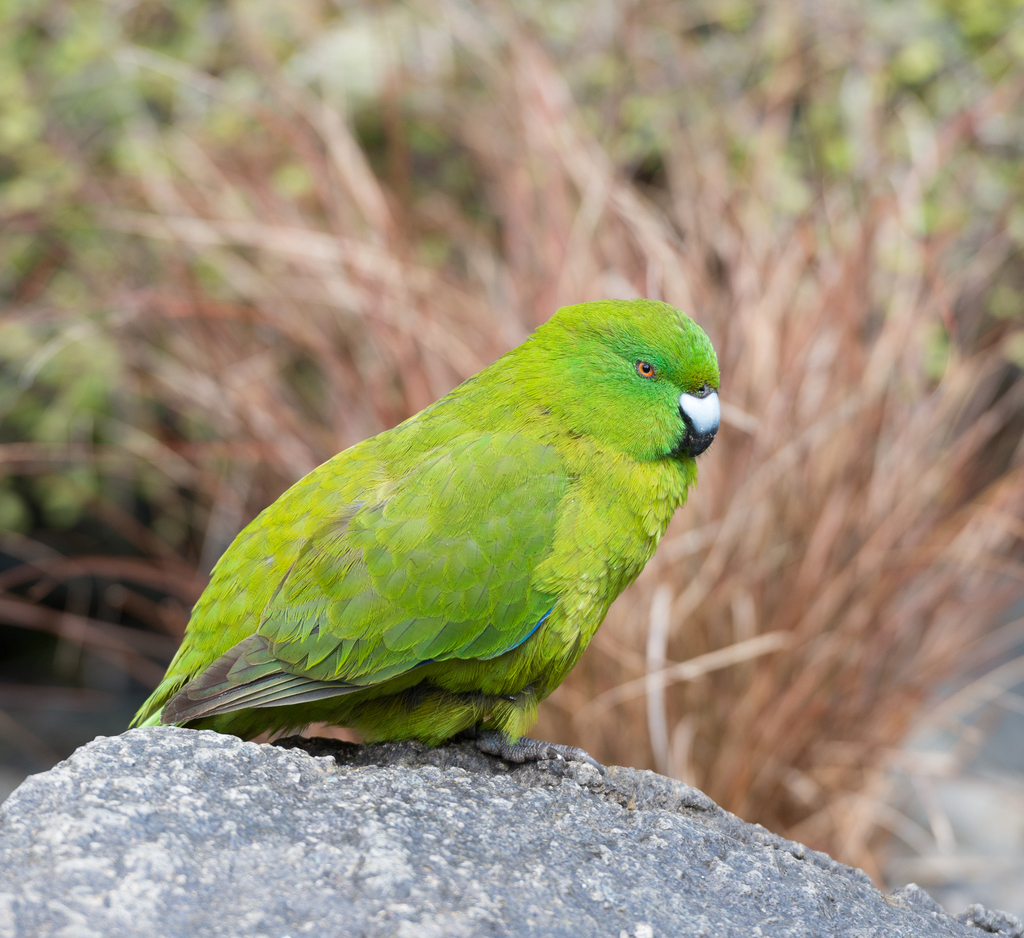
The Antipodes parakeet or Antipodes Island parakeet (Cyanoramphus unicolor) is a parrot in the family Psittaculidae that is endemic to the Antipodes Islands of New Zealand. It is one of two parrot species found on the islands, and one of only five ground-dwelling parrots in the world. They are long-living birds that may live up to 10 years of age, but the introduction of mice that compete with them for food was a threat to their survival on the Antipodes Islands until the mice were successfully eradicated from the Islands in 2016 (confirmed 2018). Unusually for parrots, they sometimes prey upon other birds, a trait shared by another New Zealand parrot, the kea.
From the article Antipodes parakeet on Wikipedia (CC BY-SA), quoted section by section
Description
It is the largest species in the genus Cyanoramphus at 30 cm (12 in) long. and makes a penetrating kok-kok-kok-kok noise.
Range & habitat
The Antipodes parakeet is endemic to the Antipodes Islands of New Zealand. They are common on the main Antipodes Island, but are less common on smaller islands in the group such as Bollons Island. They live in very small numbers on Leeward Island, where they only live in a 0.1 km2 (0.039 sq mi) region of the island. The Antipodes parakeet lives on the 0.1 km2 (0.039 sq mi) Archway Island, as well.
Wikipedia: “Distribution and habitat”
What it does
These parakeets eat leaves, buds, grass, and tussock stalks, as well as sometimes feeding on seeds and flowers, and sometimes scavenge dead seabirds. The Antipodes parakeet also preys on grey-backed storm petrels, entering burrows to kill incubating adults, even digging at the entrance if it is too small. Antipodes parakeets spend much of their time on the ground and in very small groups, in pairs, or alone. They are inquisitive, territorial, and mischievous. Their nest is in a tunnel 2 m beneath fibrous peat away from the wind.
Wikipedia: “Behaviour and ecology”
Listen
Looking for field recordings…
Where it lives
Recorded sightings
—
geo-referenced records in GBIF, from museums, herbaria and field observers.
Drag the globe to turn it. Dots are where records exist, not a range map; darker means more records.
In the stacks
Searching the stacks…
Every page naming Cyanoramphus unicolor in the Biodiversity Heritage Library →
This page is assembled live from iNaturalist, GBIF, Wikipedia, the Source Library and the Internet Archive. It is not yet part of the hand-edited codex. iNaturalist taxon 18931.