On eBird ↗
Indigo Macaw
Live sightings near you, the range map, bar charts of when it is seen, and Macaulay Library photos and recordings.
Indigo Macaw
Anodorhynchus leari
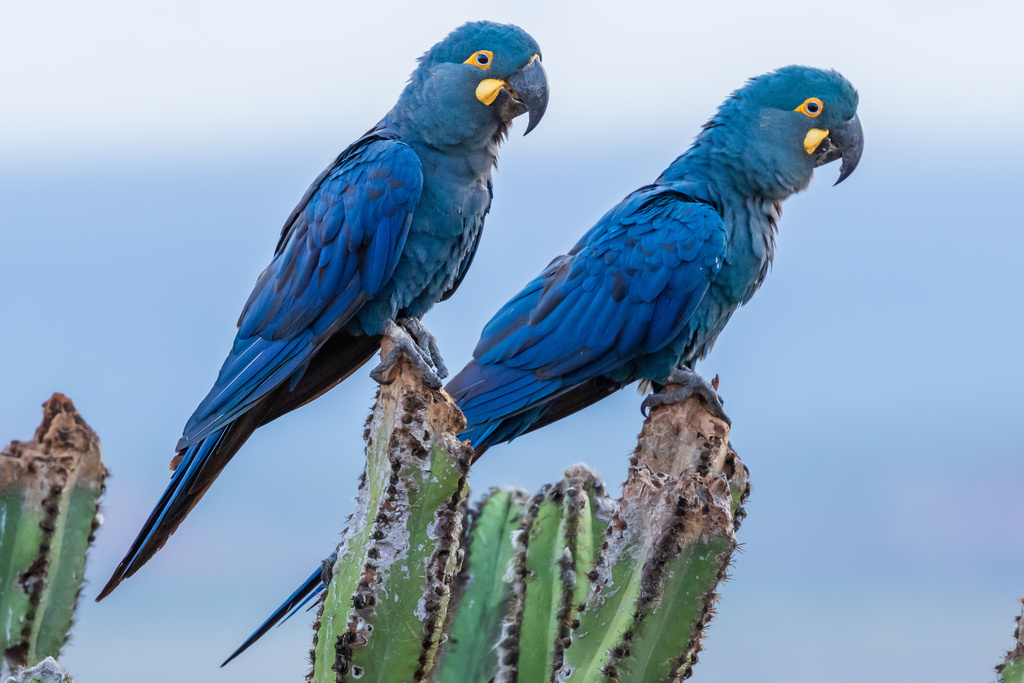
Lear's macaw (Anodorhynchus leari), also known as the indigo macaw, is a large all-blue Brazilian parrot, a member of a large group of neotropical parrots known as macaws. It was first described by Charles Lucien Bonaparte in 1856. Lear's macaw is 70–75 cm (27+1⁄2–29+1⁄2 in) long and weighs around 950 g (2 lb 2 oz). It is coloured almost completely blue, with a yellow patch of skin at the base of the heavy, black bill.
Although there are records of the macaw from Britain from the early 1830s, this bird was only generally recognised as an independent species in the late 1970s. It is rare with a highly restricted native range, which was only discovered in 1978, although intensive conservation efforts have increased the world population about thirtyfold in the first two decades of the 21st century. It inhabits a dry desert-like shrubby environment known as caatinga, and roosts and nests in cavities in sandstone cliffs. It mostly feeds on the nuts of the palm species Syagrus coronata, as well as raiding maize from local farmers. Its ecology also appears linked to cattle ranching.
From the article Lear's macaw on Wikipedia (CC BY-SA), quoted section by section
Description
Lear's macaw is 70–75 cm (27+1⁄2–29+1⁄2 in) long and weighs around 950 g (2 lb 2 oz). The body, tail, and wings are dark metallic blue with a faint, often barely visible, tinge of green, and the head is a slightly paler shade. It has an area of pale-yellow skin adjacent to the base of its beak, and orange-yellow eye rings. It has a large, blackish beak and dark grey feet.
Lear's macaw is similar to the larger hyacinth macaw and the slightly smaller glaucous macaw. The hyacinth macaw can be distinguished by its darker plumage, lack of greenish tinge, and a differently shaped patch of yellow skin adjacent to the base of the bill. The glaucous macaw is paler and has a more greyish head.
Range & habitat
For a century and a half after it had been described, the species was only known from sporadic occurrences in the bird trade, and the whereabouts of the wild population was unknown. A wild population was eventually discovered in 1978 by ornithologist Helmut Sick in Bahia in the interior northeast of Brazil. Until this discovery the birds were thought to be simply a variant form of the closely related hyacinth macaw. Lear's macaw roosts on sandstone cliffs, which were formed by streams cutting through outcrops. It is known from two colonies at locations known as Toca Velha and Serra Branca, south of the Raso da Catarina plateau in northeast Bahia. In 1995, a roosting site holding 22 birds was located at Sento Sé/Campo Formoso, 200 km (120 mi) to the west. From these roosts, the macaws travel throughout the region (the municipalities of Campo Formoso, Canudos, Euclides da Cunha, Jeremoabo, Monte Santo, Novo Triunfo, Paulo Afonso, Santa Brígida and Sento Sé), relying on stands of licury palm to find much of their sustenance. This palm stand habitat is thought to have once stretched over 250,000 km2 (97,000 sq mi) in Brazil, but has been much reduced due to clearance for agriculture. …
Wikipedia: “Distribution and habitat”
What it does
The primary diet of Lear's macaw are the nuts (as many as 350 per day) of the palm Syagrus coronata, locally known as licuri, but the seeds of Melanoxylon, Jatropha mollissima, Dioclea, Spondias tuberosa, Schinopsis brasiliensis and Zea mays are also eaten, as well as the flowers of Agave. The macaw usually forages in groups. They preferentially feed on the palms where they grow in groves, mixed together with taller trees. At least thirty confirmed feeding localities are known throughout the range. A tall tree is selected by the flock as base to carefully inspect the feeding area. First a pair descends to the level of the palms to assess the suitability, the pair then returns to base, and then the entire flock descends to decide if it is worth staying around. If it is, then the macaws generally feed directly at the site, tearing the fibrous pulp off the fruit to obtain the extremely hard and thick-shelled nut. The pulp is discarded. The heavy bills appear to have evolved specifically to crack open the palm nuts with a chisel-shaped edge, being precisely of the correct size and shape. Upon occasion the birds maw fly off to a better perch to consume the nut, sometimes even carrying a branchlet with a few fruit. …
Wikipedia: “Feeding”
In human culture
One of the earliest records (and one of very few at all) of a Lear's macaw in a public zoo was a dramatic display of "the four blues" including Lear's, glaucous, hyacinth, and Spix's macaws in 1900 at the Berlin Zoo. According to the World Parrot Trust, the Lear's macaw is currently extremely rare in captivity and may live for 60 years, whereas the Animal Ageing and Longevity Database cites the maximum recorded longevity for a captive Lear's macaw at 38.3 years. It is recommended that this parrot be kept in an enclosure of 15 metres (49 ft) in length.
Wikipedia: “Aviculture”
Listen
Looking for field recordings…
Where it lives
Recorded sightings
—
geo-referenced records in GBIF, from museums, herbaria and field observers.
Drag the globe to turn it. Dots are where records exist, not a range map; darker means more records.
In the stacks
Searching the stacks…
Every page naming Anodorhynchus leari in the Biodiversity Heritage Library →
This page is assembled live from iNaturalist, GBIF, Wikipedia, the Source Library and the Internet Archive. It is not yet part of the hand-edited codex. iNaturalist taxon 18937.