- Animals
- ›Chordates
- ›Vertebrates
- ›Birds
- ›Parrots
- ›Old World Parrots
- ›Long-tailed Parrots and allies
- ›Prioniturus
On eBird ↗
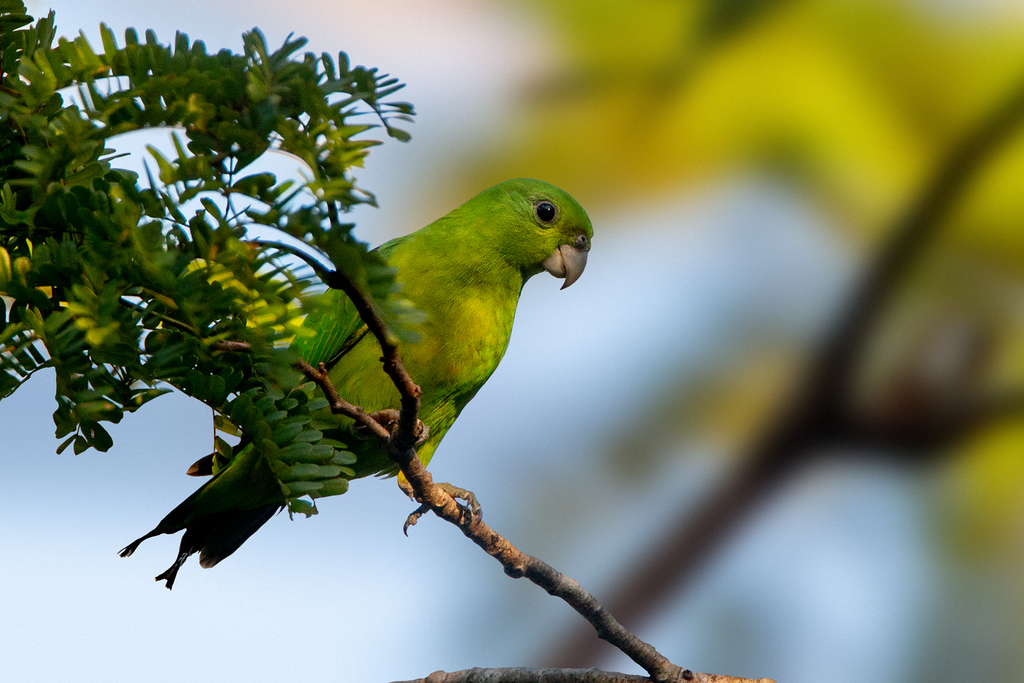
Green Racquet-tail
Live sightings near you, the range map, bar charts of when it is seen, and Macaulay Library photos and recordings.
Green Racquet-tail
Prioniturus luconensis
The green racket-tail (Prioniturus luconensis) is an endemic parrot of the Philippines where it is found on Luzon and Marinduque. This species was once common, but is rapidly declining and is currently classified as endangered due to lowland deforestation and capture for cage-bird trade. The population is now estimated to be just 300 - 800 mature individuals and is continuing to decline with many local extinctions in its former range.
It is illegal to hunt, capture, or keep Green racket-tails and any other wild bird in the Philippines under Philippine Law RA 9147.
From the article Green racket-tail on Wikipedia (CC BY-SA), quoted section by section
Description
This is a species of an all green parrot found only in the lowland forests of Luzon. The tail has two central tail feathers that end with racquets. They are sexually dimorphic. Males are entirely yellow-green, with paler underparts and head. The two central tail feathers are elongated with bare shafts and terminated with black rackets. Females are generally darker and less yellowish, while the bare tail shafts are shorter. Juveniles do not have rackets at the tail. It is the smallest of all the racquet-tails with a total length of about 29 centimetres (11 in). This species is monotypic.
Wikipedia: “Description and taxonomy”
Range & habitat
Green racket-tails can be found in the canopy of tropical lowland rainforests in elevations of up to 700 metres (2,300 ft) where it mainly prefers primary forest but is also seen in secondary forest and forest. They have also been recorded visiting cultivations to feed on crops. It is listed as Endangered with the population estimated at 300 - 800 mature individuals remaining, as of 2024. It has gone locally extinct in many of its former sites and is feared extinct on Marinduque. Its main threat is trapping for the cage-bird trade. Local extinctions as a direct result of forest loss are very likely. In 1988, forest cover was just 3% on Marinduque and 24% on Luzon with the remaining forest continuing to be threatened by both legal and illegal logging. mining, road construction, slash-and-burn or kaingin. In its stronghold in Subic has experienced increased illegal logging and deforestation continues in Maria Aurora Memorial Natural Park. Interspecific competition is also a threat as they have been replaced by the commoner Blue-crowned racket-tail in Quezon National Forest Park. It is currently known from two protected areas Bataan National Park and the Northern Sierra Madre Natural Park. It receives nominal protection in the Maria Aurora Memorial Natural Park. …
Wikipedia: “Habitat and conservation status”
What it does
Feeds on fruit, particularly bananas, flowers and seeds of growing corn, and rice. Like all other Racket-tails, they are cavity nesters. According to poachers, chicks are often poached in the month of May.
Wikipedia: “Behaviour and ecology”
Listen
Looking for field recordings…
Where it lives
Recorded sightings
—
geo-referenced records in GBIF, from museums, herbaria and field observers.
Drag the globe to turn it. Dots are where records exist, not a range map; darker means more records.
In the stacks
Searching the stacks…
Every page naming Prioniturus luconensis in the Biodiversity Heritage Library →
This page is assembled live from iNaturalist, GBIF, Wikipedia, the Source Library and the Internet Archive. It is not yet part of the hand-edited codex. iNaturalist taxon 18955.