On eBird ↗
Hispaniolan Amazon
Live sightings near you, the range map, bar charts of when it is seen, and Macaulay Library photos and recordings.
Hispaniolan Amazon
Amazona ventralis
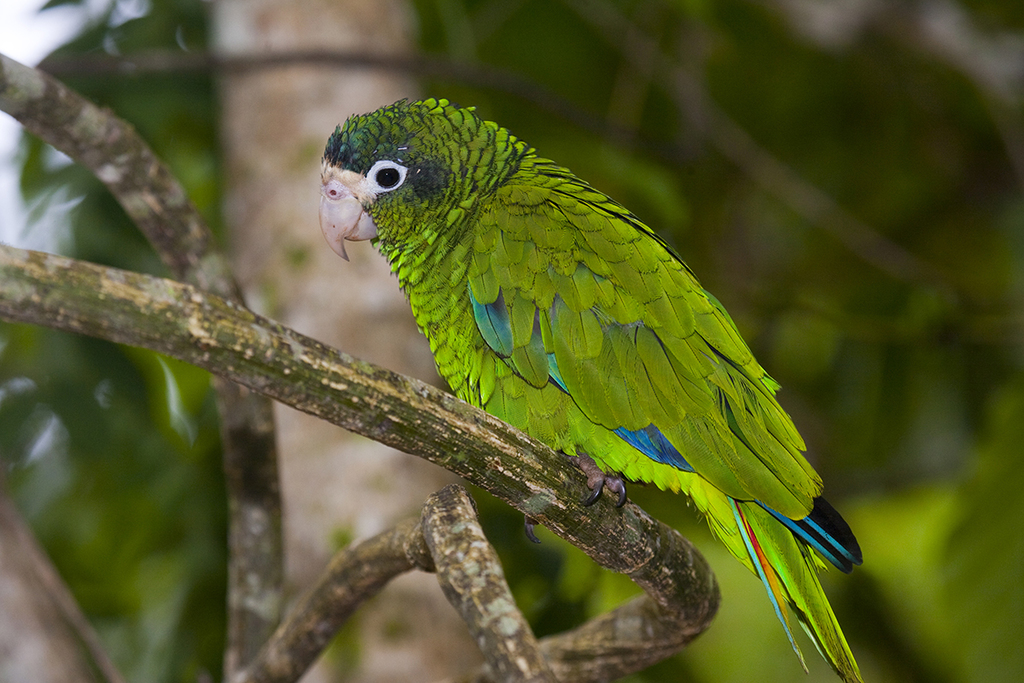
The Hispaniolan parrot (Amazona ventralis), also known as Hispaniolan amazon, is a species of psittaciform bird of the family Psittacidae endemic to Hispaniola, which includes the Dominican Republic and Haiti. Its white forehead, light beak, white eye-ring, blue ear patch, and maroon belly patch are the main features that differentiate it from other amazons. Its body measures about 28 centimeters in length. A typical adult weighs 250g (8.75 oz).
This species was widespread in Hispaniola, but it suffered a significant decline during the twentieth century. Its range was mainly limited to inland mountains in the 1930s and is becoming more typical in metropolitan cities such as Santo Domingo.
From the article Hispaniolan amazon on Wikipedia (CC BY-SA), quoted section by section
Description
They have bright green feathers with blue edges on most of them. They feature black ear coverts, some blue patches on the cheeks and crown, some red patches under the chin, and a noticeable white forehead and area surrounding the eyes. Additionally, they have red feathers on their abdomens, blue wind coverts, green outer web edges, yellowish green underfur, a green tail with yellow tips on the upper side, red outer tail feathers at the base, a horn-colored bill, and brown eyes with pale feet. Their bodies measure approximately 28 centimeters long. A typical adult weights 250g (8.75 oz), and they have a large, robust beak.
Ecology. They inhabit a variety of wooded environments around 1,500 meters above sea level, from arid savanna palm groves, pine forests, and humid mountain forests. They frequently forage on cultivated lands, such as banana plantations and cornfields. They are found at all elevations in forests, groves, and thickets, wherever there are suitable fruits and seeds. Populations have been limited to forest reserves and national parks such as Jaragua, Cotubanamá, and Los Haitises. They consume seeds or fruits of Caesalpinia, Psidium and Ficus.
Population. The population is estimated to be around 10,000-19,999 individuals. This equates to 6,667-13,333 mature individuals, rounded here to 6,000-15,000 mature individuals.
Breeding. …
Listen
Looking for field recordings…
Where it lives
Recorded sightings
—
geo-referenced records in GBIF, from museums, herbaria and field observers.
Drag the globe to turn it. Dots are where records exist, not a range map; darker means more records.
In the stacks
Searching the stacks…
Every page naming Amazona ventralis in the Biodiversity Heritage Library →
This page is assembled live from iNaturalist, GBIF, Wikipedia, the Source Library and the Internet Archive. It is not yet part of the hand-edited codex. iNaturalist taxon 18983.