On eBird ↗
Kawall's Amazon
Live sightings near you, the range map, bar charts of when it is seen, and Macaulay Library photos and recordings.
Kawall's Amazon
Amazona kawalli
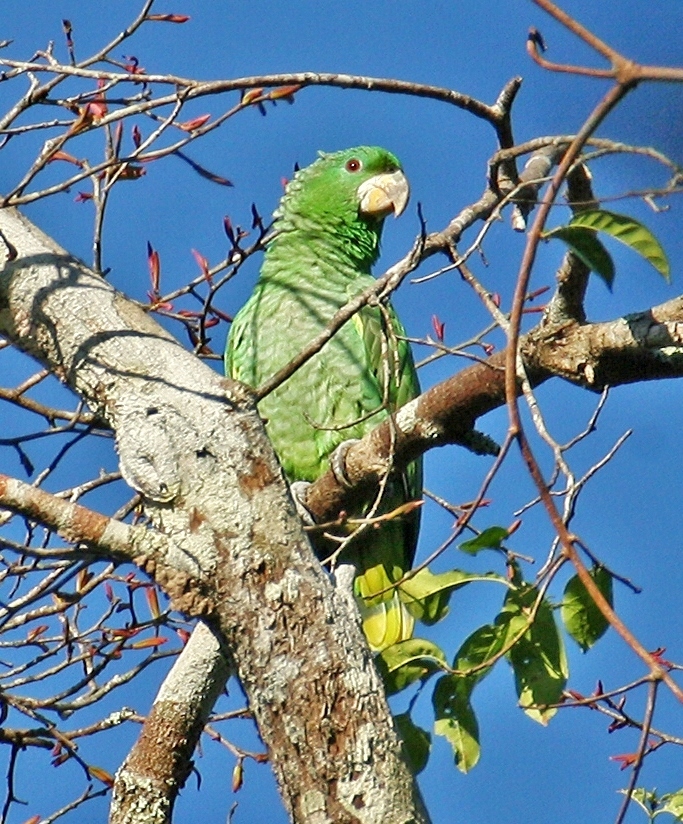
Kawall's amazon (Amazona kawalli), also known as the white-faced amazon, white-cheeked amazon or Kawall's parrot, is a relatively large species of parrot in the family Psittacidae. It is endemic to the south-central Amazon. After not having been recorded in the wild for around 70 years, the species was rediscovered in the 1980s.
From the article Kawall's amazon on Wikipedia (CC BY-SA), quoted section by section
Description
The species is medium-sized for a parrot, reaching a length of 35–36 cm (13.8–14.2 in). The plumage is mostly green, with a narrow white strip at the base of the bill, narrow white eye-ring, and some blue and red present on the outermost flight feathers. Although it resembles the mealy amazon, Kawall's amazon can easily be recognised by its white patch of skin at the base of the bill, relatively small gray ocular ring (may fade to white in captivity), red near the base of the tail, overall brighter green hue and voice.
Range & habitat
Kawall's amazon has been reported from the Amazon basin of Brazil in Amazonas and Pará. A possible wider distribution, or the existence of isolated populations, is suggested by the existence of a previously misidentified specimen labelled 'Colombia', and a captive bird found on the edge of Amazonas National Park. The species inhabits lowland rainforest and shows a preference for permanently flooded woodlands and riverine forest edges.
Wikipedia: “Distribution and habitat”
What it does
Kawall's amazon has been observed feeding on tree seeds, palm fruits, flowers, and young leaves. It nests in tree cavities, and while it may search out suitable nesting cavities in the dry season, appears to restrict the actual nesting to periods when the forest is flooded.
Wikipedia: “Ecology”
Listen
Looking for field recordings…
Where it lives
Recorded sightings
—
geo-referenced records in GBIF, from museums, herbaria and field observers.
Drag the globe to turn it. Dots are where records exist, not a range map; darker means more records.
In the stacks
Searching the stacks…
Every page naming Amazona kawalli in the Biodiversity Heritage Library →
This page is assembled live from iNaturalist, GBIF, Wikipedia, the Source Library and the Internet Archive. It is not yet part of the hand-edited codex. iNaturalist taxon 18999.