On eBird ↗
Imperial Amazon
Live sightings near you, the range map, bar charts of when it is seen, and Macaulay Library photos and recordings.
Imperial Amazon
Amazona imperialis
The imperial amazon (Amazona imperialis) or Dominican amazon, also known as the sisserou or sisserou parrot, is a parrot found only on the Caribbean island of Dominica. It has been designated as the national bird of Dominica, and features on the national flag of Dominica. The species is critically endangered. In 2019, it was estimated there were only about 50 mature individuals left in the wild.
From the article Imperial amazon on Wikipedia (CC BY-SA), quoted section by section
Description
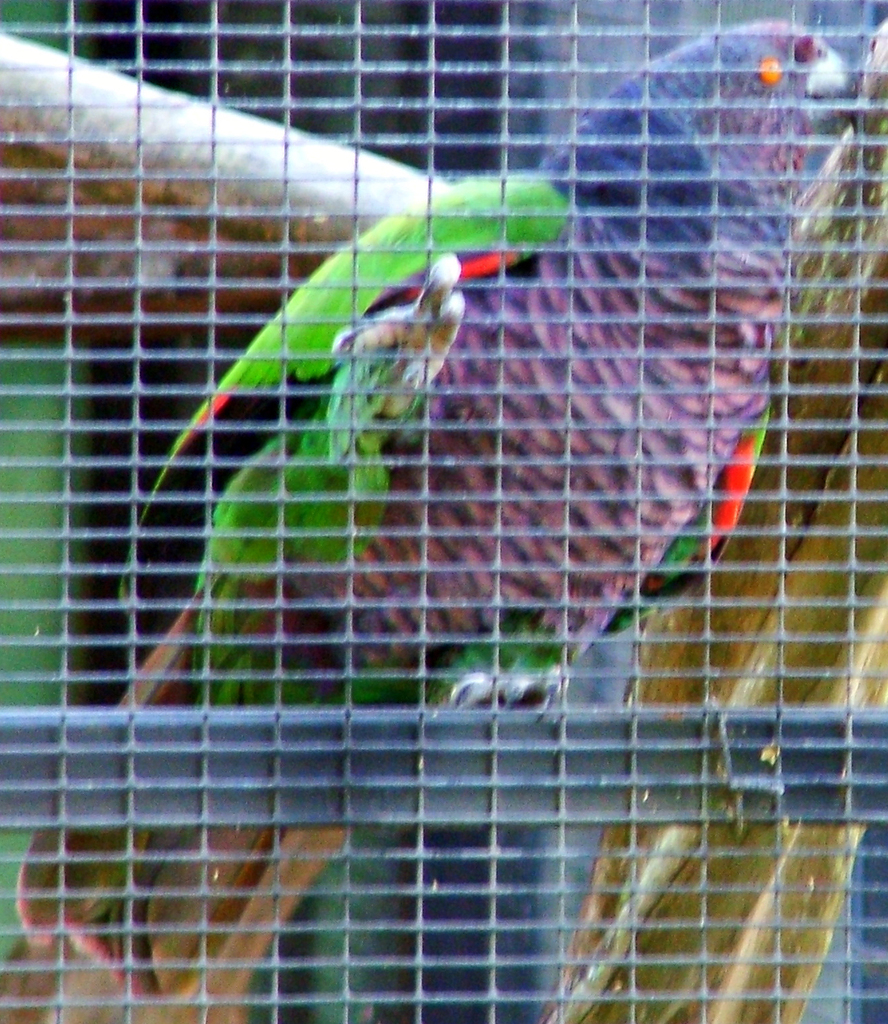
The imperial amazon measures an average of 48 cm (19 in) in length. With males weighing an average of 900 g (32 oz) and females 650 g (23 oz), the species is large for its genus. Being of the family Psittacidae, the sisserou has zygodactyl feet and a thick, hooked bill with a muscular tongue. This bill is fashioned in such a way that, using its hinged mandibles and tongue, the sisserou can easily move food around in its mouth. Males and females have identical plumage: the chest is a dark shade of purple, and the upper parts and feathers are a dark shade of green, with black-edged feather tips. The eye-ring is dark brown, with the eye being a mix of orange and red. Juvenile appearance does not differ much, with a higher occurrence of green plumage and strictly brown eyes.
Range & habitat
The imperial amazon is endemic to the Caribbean island nation of Dominica in the Lesser Antilles where it inhabits mountain forest areas above 2,100 ft (625 m). It is the island's national bird and also appears on the country's flag. The species frequently occurs in the Morne Diablotins in northern Dominica, especially the upper Picard River Valley on the northwest side of the mountain. A small population has been reintroduced in the Morne Trois Pitons National Park. Imperial amazons are found primarily in mountain rainforest, sometimes in elfin forest. They occur mostly at elevations of 600–1300 m above sea level. However, there have been reports of them at 150 to 300 meters in elevation because of food storage or foraging preferences.
Wikipedia: “Distribution and habitat”
What it does
The call of the sisserou resides in the higher frequencies, a loud and even "squeaky" mix between shriek, squawk, and trill. They are shy, difficult to approach, and usually travel in groups of three or fewer. They sometimes flock together with red-necked amazons. They are good climbers and strong flyers with powerful wings. They prefer to perch on the tops of trees. They are difficult to detect, as they are well camouflaged by their plumage.
Breeding. Between February and April, nesting occurs and the female will lay a clutch of two white eggs in a deep cavity inside a rainforest tree, returning to the same tree year after year. For 26–28 days, the female will incubate the eggs. During fledging, which occurs between June and early September, both parents will take care of and feed the chicks until they are fully feathered and ready to leave the nest. The chicks use typical "begging calls" when hungry, to which either parent will respond with food. Usually only one chick survives to fledging and, typically, sisserou pairs fledge a single chick every other year; however, there have been documented exceptions. These parrots mate for life and are extremely faithful to each other. They might seek another mate only after a mate dies. However, the bird may grieve to death rather than find a new mate.
Feeding. …
Wikipedia: “Behavior”
Listen
Looking for field recordings…
Where it lives
Recorded sightings
—
geo-referenced records in GBIF, from museums, herbaria and field observers.
Drag the globe to turn it. Dots are where records exist, not a range map; darker means more records.
In the stacks
Searching the stacks…
Every page naming Amazona imperialis in the Biodiversity Heritage Library →
This page is assembled live from iNaturalist, GBIF, Wikipedia, the Source Library and the Internet Archive. It is not yet part of the hand-edited codex. iNaturalist taxon 19001.