On eBird ↗
Red-chested Cuckoo
Live sightings near you, the range map, bar charts of when it is seen, and Macaulay Library photos and recordings.
Red-chested Cuckoo
Cuculus solitarius
The red-chested cuckoo (Cuculus solitarius) is a species of cuckoo in the family Cuculidae. It is a medium-sized bird found in Africa, south of the Sahara. In Afrikaans, it is known as "Piet-my-vrou", after its call.
From the article Red-chested cuckoo on Wikipedia (CC BY-SA), quoted section by section
Description
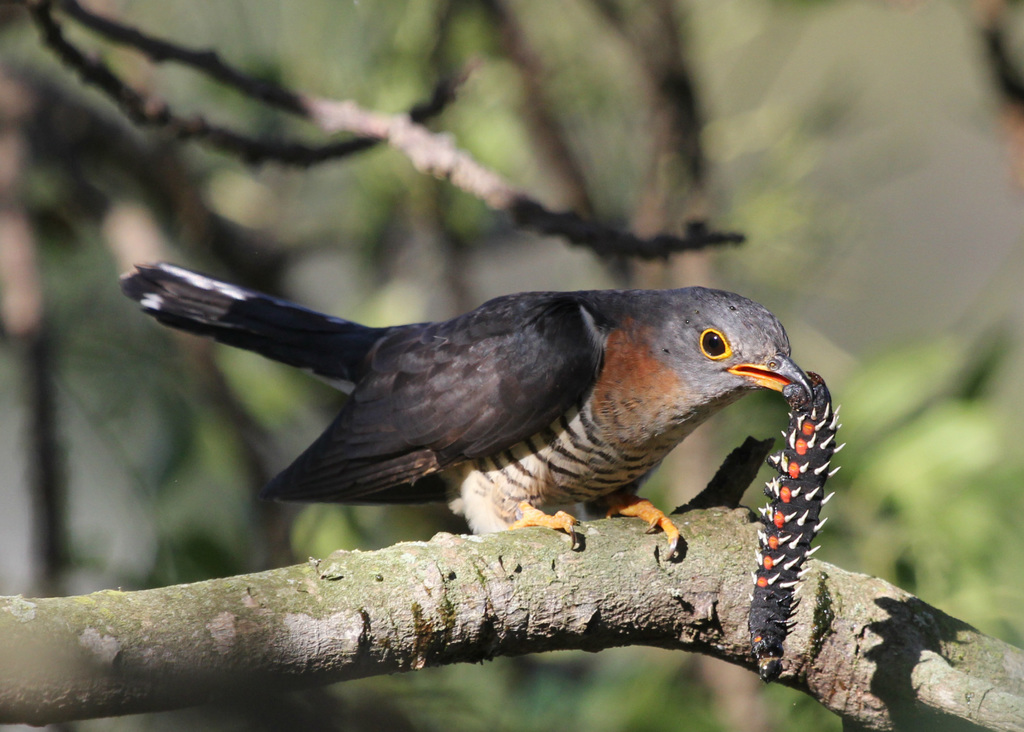
The red-chested cuckoo is a medium-size cuckoo about 31 cm (12.2 in) in length. The male has slate-grey upper parts, pale grey throat and sides of head and dark grey tail tipped with white. The breast is rufous or cinnamon, often with barring, and the belly is creamy-white or pale buff. The female is similar but the colour of the breast is duller and with variable amounts of barring.
Range & habitat
It is found in Angola, Benin, Botswana, Burundi, Cameroon, Central African Republic, Chad, Republic of the Congo, Democratic Republic of the Congo, Ivory Coast, Equatorial Guinea, Eswatini, Ethiopia, Gabon, Gambia, Ghana, Guinea, Guinea-Bissau, Kenya, Lesotho, Liberia, Malawi, Mali, Mozambique, Namibia, Nigeria, Rwanda, Senegal, Sierra Leone, Somalia, South Africa, Sudan, Tanzania, Togo, Uganda, Zambia, and Zimbabwe. In Southern Africa it is a common breeding migrant, found throughout the area except for the drier west. The preferred habitats for the red-chested cuckoo are woodlands. The red-chested cuckoo is normally seen by itself rather than in the company of birds of the same species.
Wikipedia: “Distribution and habitat”
What it does
It is usually solitary and highly vocal and lives on forests and plantations. It eats insects including hairy caterpillars, spiders, centipedes, millipedes, slugs, snails, small vertebrates and berries. The red-chested cuckoo takes on more than a single mate (it is polygamous). Like other cuckoos, the red-chested cuckoo lays its eggs in other birds' nests, leaving the parasitized birds to care for the cuckoo chicks, which they do, believing it is their own offspring (brood parasitism). About fifteen different species of small bird are victimized, but the most common hosts are the Cape robin-chat (Cossypha caffra), the Cape wagtail (Motacilla capensis) and the white-throated robin-chat (Cossypha humeralis). The surrogate family then raise the chick. The bird lays eggs which are brown in colour and number between 20 eggs per season in different nests.
Wikipedia: “Behavior”
Listen
Looking for field recordings…
Where it lives
Recorded sightings
—
geo-referenced records in GBIF, from museums, herbaria and field observers.
Drag the globe to turn it. Dots are where records exist, not a range map; darker means more records.
In the stacks
Searching the stacks…
Every page naming Cuculus solitarius in the Biodiversity Heritage Library →
This page is assembled live from iNaturalist, GBIF, Wikipedia, the Source Library and the Internet Archive. It is not yet part of the hand-edited codex. iNaturalist taxon 1903.