On eBird ↗
Yellow-fronted Parrot
Live sightings near you, the range map, bar charts of when it is seen, and Macaulay Library photos and recordings.
Yellow-fronted Parrot
Poicephalus flavifrons
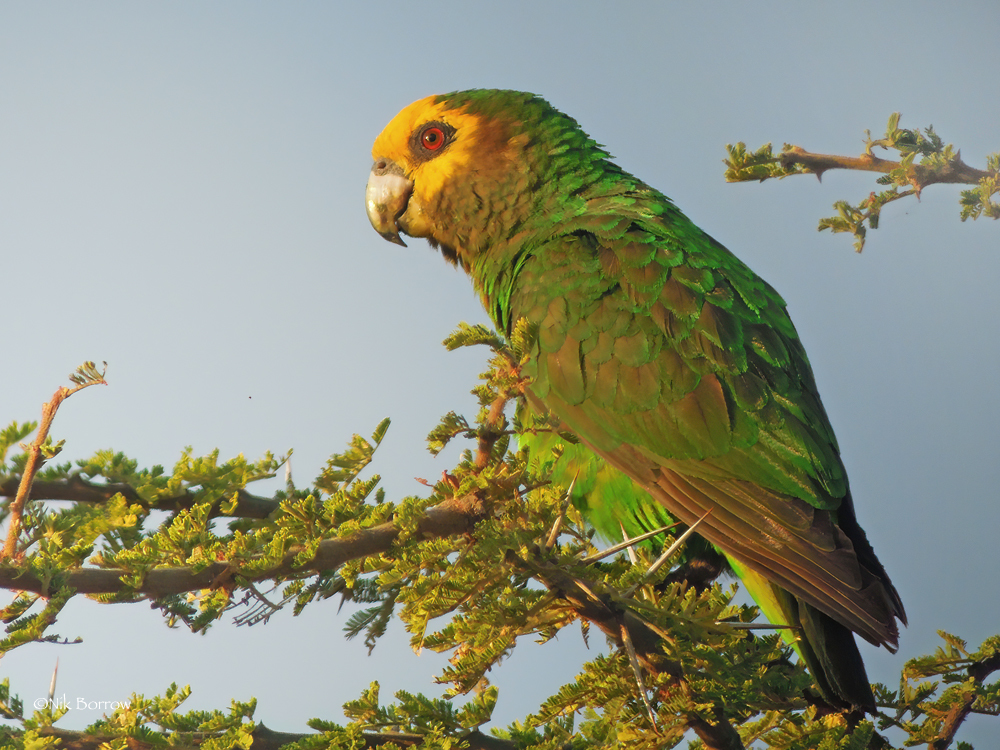
The yellow-fronted parrot (Poicephalus flavifrons) is a parrot endemic to the Ethiopian Highlands. It is a mostly green with a yellow head. Relatively little is known about this bird.
From the article Yellow-fronted parrot on Wikipedia (CC BY-SA), quoted section by section
Description
The yellow-fronted parrot is about 28 centimetres (11 in) long and is mostly green with the upper parts being a darker green, the tail being olive-brown, and the legs a dark grey-brown. The face is orange-yellow. When two subspecies are recognized, the nominate is believed to have yellow to its head and face, while in P. f. aurantiiceps some of the yellow is replaced with orange. The upper beak is brownish-grey and the lower beak is bone coloured, the irises are orange-red, and bare eye-rings and cere are grey. Male and female adults have identical external appearance. Juveniles are duller than the adults with a mostly grey head, brown irises, and only a small amount of yellow on the front of the face including on the forehead.
Range & habitat
This parrot is endemic to the Ethiopian Highlands at about 1,000–3,000 metres (3,300–9,800 ft) above sea level. When two subspecies are recognized, the nominate is found in the highlands around Lake Tana and also in central Ethiopia, and P. f. aurantiiceps is found in southwestern Ethiopia. It lives in forest habitats, unlike most other Poicephalus parrots apart from the Cape and red-fronted parrot superspecies complex.
Wikipedia: “Range”
In human culture
The yellow-fronted parrot was unknown in aviculture until recently. The first thoroughly documented and published successful captive breeding of the Yellow-fronted Parrot (Poicephalus flavifrons) was achieved in 2012 by Daniel Jedlička, a Czech aviculturist. The breeding and subsequent observations were documented in specialist avicultural journals in the United Kingdom, Germany, the Netherlands, Australia, France and the Czech Republic. These publications describe reproductive behaviour, nesting, egg incubation, parental care, chick development and long-term observations in captivity. An editorial note published in the Czech journal Exota in 2024 states that the 2012 breeding represented the first successful captive breeding of the species under human care.
Wikipedia: “Aviculture”
Listen
Looking for field recordings…
Where it lives
Recorded sightings
—
geo-referenced records in GBIF, from museums, herbaria and field observers.
Drag the globe to turn it. Dots are where records exist, not a range map; darker means more records.
In the stacks
Searching the stacks…
Every page naming Poicephalus flavifrons in the Biodiversity Heritage Library →
This page is assembled live from iNaturalist, GBIF, Wikipedia, the Source Library and the Internet Archive. It is not yet part of the hand-edited codex. iNaturalist taxon 19049.