On eBird ↗
Green-rumped Parrotlet
Live sightings near you, the range map, bar charts of when it is seen, and Macaulay Library photos and recordings.
Green-rumped Parrotlet
Forpus passerinus
The green-rumped parrotlet (Forpus passerinus), also known as the green-rumped parakeet, is a species of parrot in the family Psittacidae that is found in northeastern South America and the Caribbean island of Trinidad. The green-rumped parrotlet occurs from northern Venezuela eastwards to the lower Amazon in Brazil, Also
Suriname and has been introduced to Curaçao, Jamaica and Barbados. It prefers semi-open lowland areas and is also sometimes present in city parks. There are five subspecies.
From the article Green-rumped parrotlet on Wikipedia (CC BY-SA), quoted section by section
Description
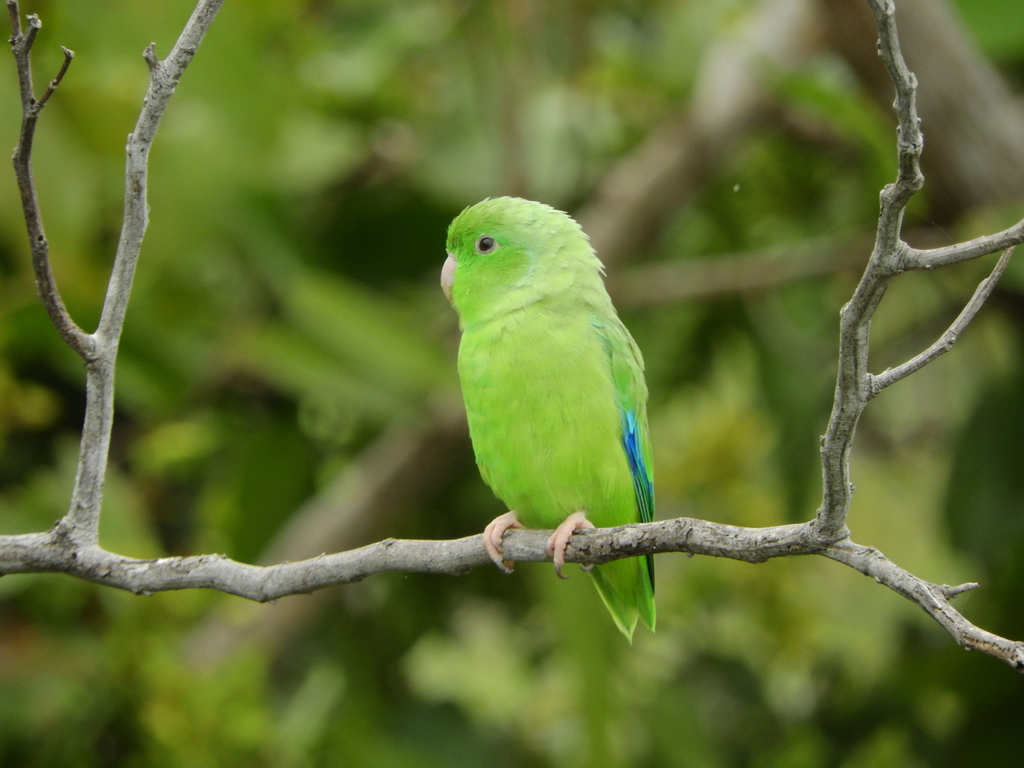
The green-rumped parrotlet is 12 cm (4.7 in) long and weighs 20–28 g (0.71–0.99 oz). The plumage mainly bright green with duller/grayer napes. The eyes are dark brown and beaks and feet are light peach. Green-rumped parrotlets exhibit sexual dimorphism: males have purplish-blue primaries, secondaries, and coverts, with bright turquoise feathers on the leading edges of their wings; females lack blue but have more yellow-green on the head. Like all parrots, green-rumped parrotlets exhibit zygodactyly, meaning two toes face forward and two face backward. Juveniles look like adults. The male of subspecies F. p. cyanophanes has more extensive purple-blue markings that form an obvious patch on the closed wing. The male of F. p. viridissimus has darker purple-blue markings on the secondaries. The male of F. p. cyanochlorus has darker purple-blue markings than the nominate species; the female is brighter yellow-green. The male of F. p. deliciosus compared to the nominate has the back and rump that is brighter emerald green that is tinted with pale blue; the primaries and secondaries pale blue with purple-blue near feather shafts. The forehead of the female is more yellow.
Range & habitat
Green-rumped parrotlets are found in tropical South America, from the Caribbean regions of Colombia, Venezuela and Trinidad south and east to the Guianas and Brazil on the lower Amazon River. It has been introduced in Jamaica, Curaçao, Barbados and Tobago, and was not recorded on Trinidad prior to 1916. Along with the lilac-tailed parrotlet (Touit batavicus), they are the only parrotlet species to occur in the West Indies. Green-rumped parrotlets are fairly common in open, semi-arid habitat and are found residing in dry scrubland, deciduous woodland, gallery forest, farmland, forest edges, and deforested areas throughout their range. While they are non-migratory, they may wander locally to locate sources of food. They are not found at altitudes greater than 1,800 metres (5,900 ft) above sea level.
Wikipedia: “Distribution and habitat”
What it does
Green-rumped parrotlets form strong pair bonds and rarely switch mates, but typically only breed with the same individual for 1–2 seasons. Widowed parrotlets will often take a new mate, and 48% of the new stepparents adopt the offspring. Stepfather parrotlets in particular nest with their new mates, attaining earlier ages at first breeding than competitors (stepmother-widower pair sample sizes were too small to produce results, at only 15 pairs). Therefore, adoption appears to be sexually selected. However, so is infanticide by stepfathers. Almost half of wild females attempt a second brood during their breeding season. Green-rumped parrotlets breed during the rainy season (May–November), though each subspecies tends to breed during different months. They typically make their nests in unlined tree cavities, holes found in arboreal termite nests, or in cavities in wooden fence posts. Intense competition over limited nest sites has selected for marauding non-breeding pairs that attempt to usurp occupied nests and evict the abandoned offspring. The female lays 5–6 small white eggs over a period of 9–16 days. The female usually initiates incubation after the first egg is laid, leading to asynchronous hatching which begins 18–22 days after the start of incubation. Depending on the clutch size, hatching concludes 2–14 days after the first egg hatches. …
Wikipedia: “Reproduction”
In human culture
Green-rumped parrotlets are bred in captivity and kept as pets, though they are less common than some other Forpus species. Imports of wild green-rumped parrotlets into the United States are prohibited under the Wild Bird Conservation Act and international trade is limited by other laws, so aviculture is dependent on existing captive populations.
Wikipedia: “Aviculture”
Listen
Looking for field recordings…
Where it lives
Recorded sightings
—
geo-referenced records in GBIF, from museums, herbaria and field observers.
Drag the globe to turn it. Dots are where records exist, not a range map; darker means more records.
In the stacks
Searching the stacks…
Every page naming Forpus passerinus in the Biodiversity Heritage Library →
This page is assembled live from iNaturalist, GBIF, Wikipedia, the Source Library and the Internet Archive. It is not yet part of the hand-edited codex. iNaturalist taxon 19065.