On eBird ↗
Pacific Parrotlet
Live sightings near you, the range map, bar charts of when it is seen, and Macaulay Library photos and recordings.
Pacific Parrotlet
Forpus coelestis
The Pacific parrotlet (Forpus coelestis), also known as Lesson's parrotlet or the celestial parrotlet, is a species of small parrot in the family Psittacidae, native to Ecuador and Peru. Its natural habitats are subtropical or tropical dry forests, subtropical or tropical moist lowland forests, subtropical or tropical dry shrubland, and heavily degraded former forest.
From the article Pacific parrotlet on Wikipedia (CC BY-SA), quoted section by section
Description
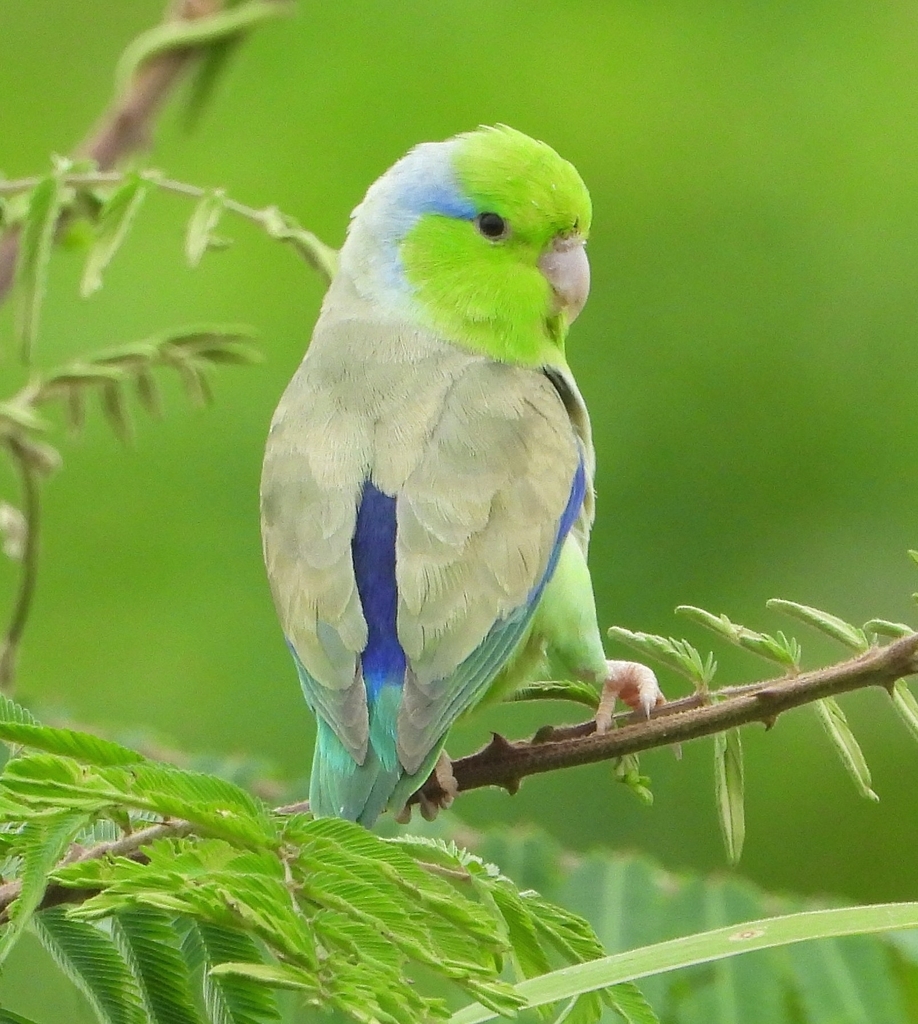
The Pacific parrotlet (Forpus coelestis) is a small green parrot originating in South America. A typical specimen is 11–14 centimetres (4.3–5.5 in) long and typically weighs 30 grams or more. Wild Pacific parrotlets are green with a dusty grey cast over the body, a bright green mask and a pinkish beak. Legs and feet are pinkish-grey. Pacific parrotlets are sexually dimorphic: males possess shades of blue on their wings. Blue can vary in intensity from a bright cobalt blue to a pale, almost lavender shade of blue on American birds; the blue is almost non-existent on marbled birds, only being visible on the underside of the wing right on the joint. Male parrotlets also have blue streaks behind the eyes which is often referred to as "eyeshadow;" as well as blue rumps. Female parrotlets have no blue on the wings whatsoever but can have blue eye streaks as well as a blue rump.
Parrotlets are often referred to as pocket parrots because of their size; but they are known for their larger-than-life personalities and feisty attitudes. They are solitary birds in captivity due to their aggressive behavior towards other birds when confined, so it is not suggested to house one with conspecifics unless ample space is available. …
Range & habitat
Wild Pacific parrotlets are native to western Ecuador and northwestern Peru. Most common in dry habitats such as the desert and deciduous forest, but have spread into humid areas in response to deforestation. Pacific parrotlets have also been reported in the middle Marañón valley. In 2014 a small flock of Pacific parrotlets was reported near the Rio Mataje in Nariño, southwestern Colombia. They are abundant across their range; populations are relatively undisturbed by human activity. Pacific parrotlets are found living in flocks from 40 to 50, on the borders of W lowlands and foothills, woodlands, shrubby clearings, gardens, parks, and crops (Restall & Freile, 2019, p. 208). Pacific parrotlets typically live in subtropical or tropical dry forest, subtropical or tropical moist lowland forest, subtropical or tropical dry shrubland, and heavily degraded former forest. Pacific parrotlets are non-migratory, meaning they stay in the same area year-round.
Wikipedia: “Distribution and habitat”
What it does
Pacific parrotlets are very protective of their eggs and chicks. Each clutch has 4–6 white eggs, which are incubated for an average of 18 days. In the wild they nest in tree cavities or on fence posts. They have also been observed to nest in abandoned nests of necklaced spinetails and pale-legged horneros.
Wikipedia: “Reproduction”
In human culture
This species is not very common in pet stores and is valued by breeders. Its normal price range is $250 all the way up to US$1200. Since 1930 the U.S. has had an established breeding population in captivity, before CITES laws preventing importing wildlife from foreign countries. In the wild, the average lifespan for Pacific parrotlets is 10.4 years. Captive Pacific parrotlets can exceed this age with good care, proper breeding, and regular veterinary examinations, although individuals may have shorter or longer life spans due to poor breeding practices. Pacific parrotlets, like many larger parrot species, can learn to "speak", or mimic, though their "voices" are not as clear as larger birds. Their vocabulary is relatively limited compared to larger parrots, although they have been known to learn a few words and phrases.
The species is well known among parrotlet breeders and owners as being feisty and curious despite their small size.
== References ==
Wikipedia: “Aviculture”
Listen
Looking for field recordings…
Where it lives
Recorded sightings
—
geo-referenced records in GBIF, from museums, herbaria and field observers.
Drag the globe to turn it. Dots are where records exist, not a range map; darker means more records.
In the stacks
Searching the stacks…
Every page naming Forpus coelestis in the Biodiversity Heritage Library →
This page is assembled live from iNaturalist, GBIF, Wikipedia, the Source Library and the Internet Archive. It is not yet part of the hand-edited codex. iNaturalist taxon 19066.