On eBird ↗
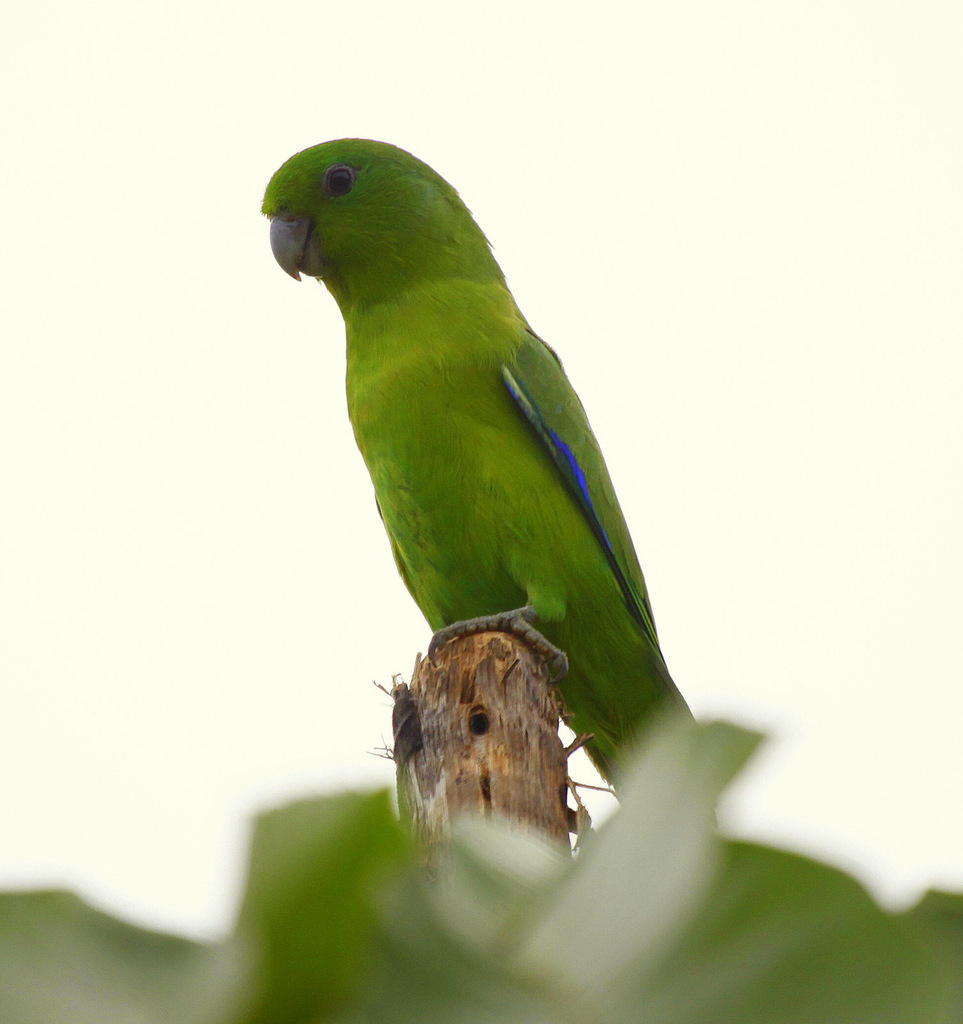
Cobalt-rumped Parrotlet
Live sightings near you, the range map, bar charts of when it is seen, and Macaulay Library photos and recordings.
Cobalt-rumped Parrotlet
Forpus xanthopterygius
The cobalt-rumped parrotlet (Forpus xanthopterygius) or blue-winged parrotlet is a species of parrot in the family Psittacidae.
There are two subspecies: Salvadori's cobalt-rumped parrotlet (F. x. flavescens) and Hellmayr's cobalt-rumped parrotlet (F. x. flavissimus).
From the article Cobalt-rumped parrotlet on Wikipedia (CC BY-SA), quoted section by section
Range & habitat
Cobalt-rumped parrotlets are found in much of central and northern South America. Their range is split by each subspecies, as described above. It is generally common and widespread, though more localized in the Amazon Basin. Cobalt-rumped parrotlets are mainly found in lowlands. They occur in dry and riparian woodlands, cerrado, caatinga, palm groves, semi-arid scrubland, savanna, and pastures. Cobalt-rumped parrotlets tend to avoid densely forested areas. They are not found at altitudes above 1,200 metres (3,900 ft). Cobalt-rumped parrotlets are generally non-migratory; however, populations in Argentina move locally according to the flowering seasons of various plant species in their diet. Populations in the Brazilian Atlantic Forest are altitudinal migrants.
Wikipedia: “Distribution and habitat”
What it does
Cobalt-rumped parrotlets' breeding season is May to August, but occupied nests have been observed in July, January, and March in different areas of the birds' range. Females lay 3-7 small, white, roughly spherical eggs. Some cobalt-rumped parrotlets have been observed to scrape rufous hornero nests (made of clay) with their beaks. Though the reason for this is not entirely clear, nests created by rufous horneros have been used by cobalt-rumped parrotlets to raise their broods, which has led to the suggestion that the parrotlets are "taste-testing" the nest material to determine whether it is suitable, according to unknown standards, for their needs. However, similar studies of other Forpus species have concluded that clay-licking provides important minerals to the birds that otherwise would not be accessible.
Wikipedia: “Reproduction”
Listen
Looking for field recordings…
Where it lives
Recorded sightings
—
geo-referenced records in GBIF, from museums, herbaria and field observers.
Drag the globe to turn it. Dots are where records exist, not a range map; darker means more records.
In the stacks
Searching the stacks…
Every page naming Forpus xanthopterygius in the Biodiversity Heritage Library →
This page is assembled live from iNaturalist, GBIF, Wikipedia, the Source Library and the Internet Archive. It is not yet part of the hand-edited codex. iNaturalist taxon 19069.