- Animals
- ›Chordates
- ›Vertebrates
- ›Birds
- ›Parrots
- ›Old World Parrots
- ›Lovebirds and Hanging Parrots
- ›Agapornis
On eBird ↗
Black-collared Lovebird
Live sightings near you, the range map, bar charts of when it is seen, and Macaulay Library photos and recordings.
Black-collared Lovebird
Agapornis swindernianus
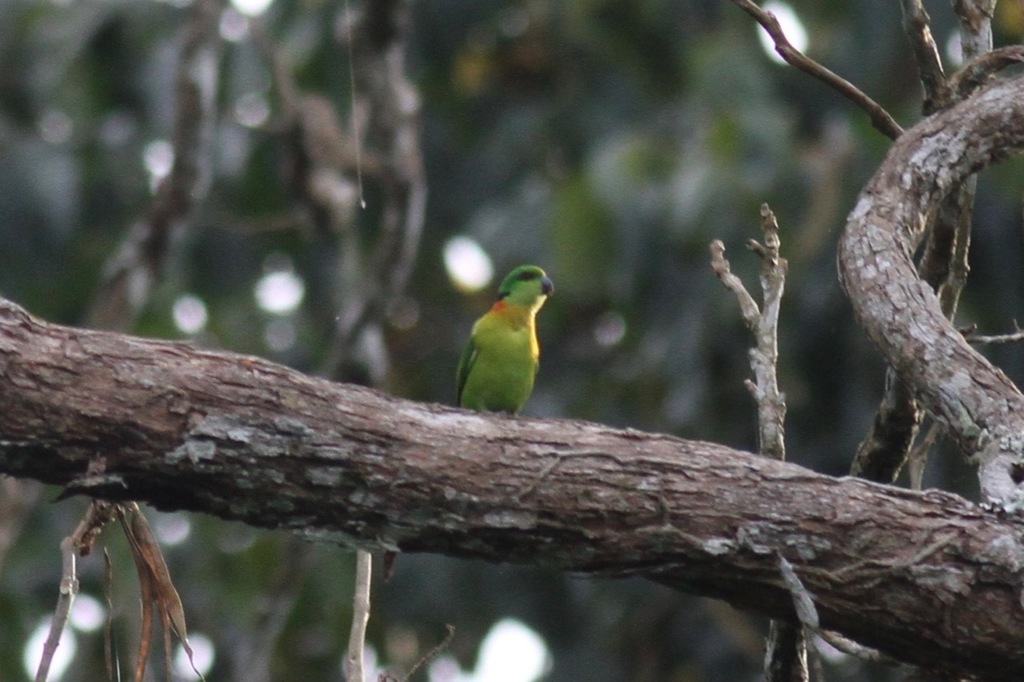
The black-collared lovebird (Agapornis swindernianus) also known as Swindern's lovebird is a small, 13.5 cm (5 inch) long, African parrot in the genus Agapornis and belongs to the Agapornithinae subfamily. The black-collared lovebird is widespread across the African tropical closed rainforest. It is a mostly green parrot with black band on the back of its neck, and a dark greyish-black bill. Both sexes are similar. It is rarely kept in captivity because of its dietary requirement for a native fig.
From the article Black-collared lovebird on Wikipedia (CC BY-SA), quoted section by section
Description
It is a mostly green parrot with black-collared nape, brownish red chest, greyish black bill, yellow iris and grey feet. Both sexes are similar. More specifically, the head is mostly green, with a yellow neck and a narrow black hind collar. Its bottom is a royal dark blue, and the rest of its upper body is dark green. The Agapornis swindernianus has soft black feathers and orange-red markings on its outer tail feathers. The two sexes are similar in their coloring. The young birds do not have the distinct black collar. The Dutch professor Theodore van Swinderen from the University of Groningen named the black-collared lovebird in 1820. The bird gets its name from the 'collar', identifiable from black feathers around its neck that resembles a collared shape. The zenkeri extension of the species contains a blood-orange stripe underneath its distinct collar.
Range & habitat
The black-collared lovebird is distributed across a wide range in African tropical closed rainforest. It inhabits the forests of Cameroon, Central African Republic, the Republic of Congo, the Democratic Republic of Congo, Côte d'Ivoire, Equatorial Guinea, Gabon, Ghana, Liberia and Uganda. They hide high in the forest canopy and are characterized as being very shy.The black-collared lovebird lives mainly in mature and secondary subtropic lowlands. These birds prefer a close-to-sea-level environment where they are not met with mountains or hills. They also enjoy gallery forests, or an environment of trees along a body of water. The black-collared lovebirds particularly favor fig trees and areas cleared of brush. Found commonly in primary forest trees or rarely in secondary growth, depending on the foliage level.
Wikipedia: “Distribution and habitat”
What it does
The Agapornis swindernianus diet relies on fig seeds, African fruits Rauwolfia, Harungana, and Macaranga, and maize from the forest ground. They are known to forage for oil palm at dawn in small flocks and feed on seeds and berries; insects, including caterpillars and beetle larvae. Although the Agapornis swindernianus will feed on food found on the ground level they are mostly spotted in tree tops above the canopies making them very difficult birds to spot.
Wikipedia: “Diet and foraging”
In human culture
Black-collared lovebirds are rarely kept in captivity or as pets. They require certain native fig seed or fig flesh as a basis of their daily diet, and without these vital dietary necessities they do not normally thrive or breed well in captivity.
Wikipedia: “Aviculture”
Listen
Looking for field recordings…
Where it lives
Recorded sightings
—
geo-referenced records in GBIF, from museums, herbaria and field observers.
Drag the globe to turn it. Dots are where records exist, not a range map; darker means more records.
In the stacks
Searching the stacks…
Every page naming Agapornis swindernianus in the Biodiversity Heritage Library →
This page is assembled live from iNaturalist, GBIF, Wikipedia, the Source Library and the Internet Archive. It is not yet part of the hand-edited codex. iNaturalist taxon 19071.