- Animals
- ›Chordates
- ›Vertebrates
- ›Birds
- ›Parrots
- ›Old World Parrots
- ›Lovebirds and Hanging Parrots
- ›Agapornis
On eBird ↗
Lilian's Lovebird
Live sightings near you, the range map, bar charts of when it is seen, and Macaulay Library photos and recordings.
Lilian's Lovebird
Agapornis lilianae
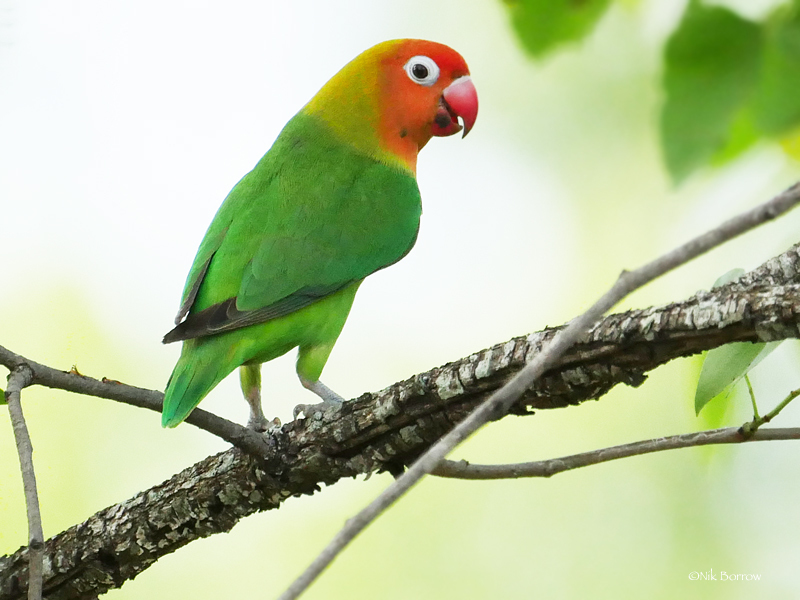
The Lilian's lovebird (Agapornis lilianae), also known as Nyasa lovebird, is a small African parrot species of the lovebird genus. It is mainly green and has orange on its upper chest and head. It is 13 cm (5 inches) long and is the smallest parrot on mainland Africa. In captivity, it is uncommon and difficult to breed.
From the article Lilian's lovebird on Wikipedia (CC BY-SA), quoted section by section
Description
The Lilian's lovebird is 13 cm (5 inches) long and is mainly green with white eyerings. It has orange on its head, neck and upper chest and has a green rump. Male and female are identical in external appearance. The Lilian's lovebird is often mistaken for the slightly larger Fischer's lovebird, which has an olive-green hood and a blue rump. It is also broadly similar to the rosy-faced lovebird, which has more clearly demarcated orange colouration, and lacks a white eyering.
Food and feeding. Lilian's lovebirds feed on grass seeds, millet, wild rice, flowers, and the seeds and fruit of other species.
Breeding. The breeding season for Lilian's lovebirds is from January to March and in June and July. They make a roofed nest in tree crevices. In captivity the clutch consists of three to eight white eggs, which are incubated for about 22 days, and the chicks leave the nest after about 44 days from hatching.
Range & habitat
Lilian's lovebirds are endemic to Malawi, Mozambique, Tanzania, Zambia, and Zimbabwe. In 2004 its numbers in the wild were estimated to be less than 20,000 individuals. It currently inhabits Liwonde National Park (LNP) and a few cluster groups occur in the surrounding forests outside LNP. Its distribution is rapidly becoming restricted to LNP because their feeding and breeding habitats are being exploited over for agricultural purposes. The extent of habitat loss outside LNP has not been determined scientifically although remaining habitat outside the LNP are fragmented Miombo Forest Reserves.
Wikipedia: “Distribution and habitat”
In human culture
Lilian's lovebirds are a difficult species to rear in captivity. Many breeders worldwide struggle to breed the species.
Wikipedia: “Aviculture”
Listen
Looking for field recordings…
Where it lives
Recorded sightings
—
geo-referenced records in GBIF, from museums, herbaria and field observers.
Drag the globe to turn it. Dots are where records exist, not a range map; darker means more records.
In the stacks
Searching the stacks…
Every page naming Agapornis lilianae in the Biodiversity Heritage Library →
This page is assembled live from iNaturalist, GBIF, Wikipedia, the Source Library and the Internet Archive. It is not yet part of the hand-edited codex. iNaturalist taxon 19073.