- Animals
- ›Chordates
- ›Vertebrates
- ›Birds
- ›Parrots
- ›Old World Parrots
- ›Lovebirds and Hanging Parrots
- ›Agapornis
On eBird ↗
Black-winged Lovebird
Live sightings near you, the range map, bar charts of when it is seen, and Macaulay Library photos and recordings.
Black-winged Lovebird
Agapornis taranta
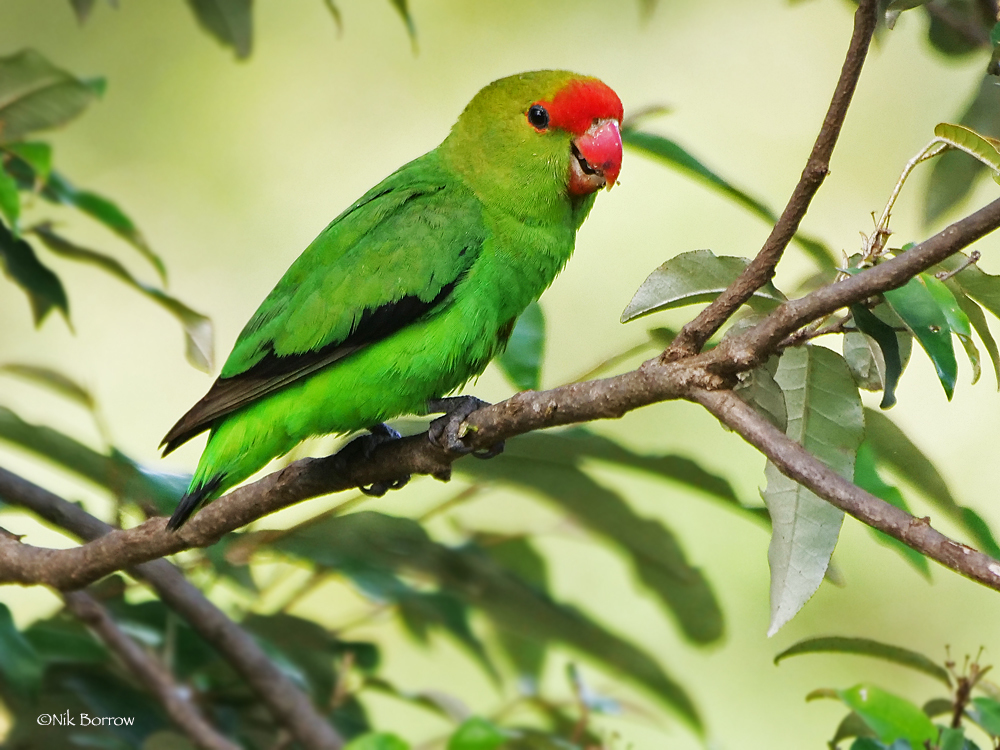
The black-winged lovebird (Agapornis taranta) also known as Abyssinian lovebird is a mainly green bird of the parrot family. At about 16.5 cm (6.5 inches) long, it is the largest of the lovebird genus, a group of small parrots. The adult male is easily identified by its red forehead, and the adult female by its all green head. They are native to Eritrea and Ethiopia, and they are uncommon as pets.
From the article Black-winged lovebird on Wikipedia (CC BY-SA), quoted section by section
Description
The black-winged lovebird, with a length of about 16–16.5 cm (6.3–6.5 inches), is the largest species of lovebird. It is sexually dimorphic, as are the red-headed lovebird and grey-headed lovebird. The dimorphism becomes apparent in juvenile birds after their first molt at about eight or nine months of age. Both the male and female black-winged lovebird are mostly green, and only the adult male black-winged lovebird has a red forehead and a ring of red feathers around its eyes. The tail is black tipped and feathers below the tail show a yellowish colour. The rump and feathers above the tail are light green. In the male, feathers under the wing are typically black, and in the female the feathers under the wing are typically greenish or brownish black. Both sexes have a red beak and gray feet.
Range & habitat
The natural distribution for the black-winged lovebird is typically from southern Eritrea to southwestern Ethiopia, and they normally live in either high plains or mountainous regions.
Wikipedia: “Habitat”
What it does
Sunflower seeds, corn, apples and mission figs are typical of an Abyssinian lovebird diet.
Wikipedia: “Food and feeding”
In human culture
In aviculture the black-winged lovebird has not become well established as a breeding bird, although it can tolerate cold weather. Breeding in aviculture is on a small scale, so it is an uncommon pet.
Wikipedia: “Aviculture”
Listen
Looking for field recordings…
Where it lives
Recorded sightings
—
geo-referenced records in GBIF, from museums, herbaria and field observers.
Drag the globe to turn it. Dots are where records exist, not a range map; darker means more records.
In the stacks
Searching the stacks…
Every page naming Agapornis taranta in the Biodiversity Heritage Library →
This page is assembled live from iNaturalist, GBIF, Wikipedia, the Source Library and the Internet Archive. It is not yet part of the hand-edited codex. iNaturalist taxon 19074.