- Animals
- ›Chordates
- ›Vertebrates
- ›Birds
- ›Parrots
- ›Old World Parrots
- ›Lovebirds and Hanging Parrots
- ›Agapornis
On eBird ↗
Black-cheeked Lovebird
Live sightings near you, the range map, bar charts of when it is seen, and Macaulay Library photos and recordings.
Black-cheeked Lovebird
Agapornis nigrigenis
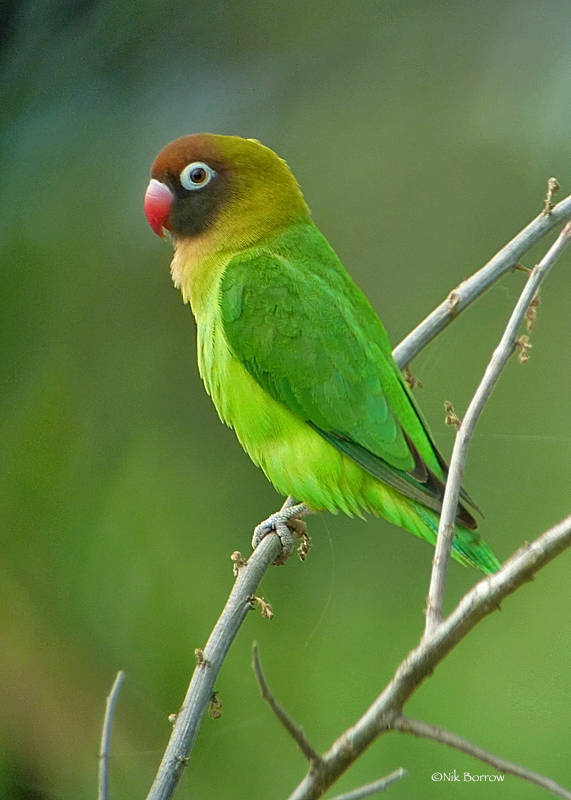
The black-cheeked lovebird (Agapornis nigrigenis) is a small parrot species of the lovebird genus. It is mainly green and has a brown head, red beak, and white eyerings. It is endemic in a relatively small range in southwest Zambia, where it is vulnerable to habitat loss.
From the article Black-cheeked lovebird on Wikipedia (CC BY-SA), quoted section by section
Description
The black-cheeked lovebird is 14 cm (5.5 in) in length, with mostly green plumage, reddish-brown forehead and forecrown, brownish-black cheeks and throat, orange bib below the throat which fades to yellowish-green, white eye-rings and grey feet. Adult have bright red beaks, while juveniles of the species are similar but with a more orange bill. Vocalizations are loud, piercing shrieks, which sound like the calls of other lovebirds.
Range & habitat
The black-cheeked lovebird inhabits deciduous woodland, where permanent supplies of surface water exist, as it needs daily access to water. In the dry season, these birds may congregate in large flocks of up to 800 or more. They are found in Zambia and may occur in Zimbabwe, Botswana and Namibia.
Wikipedia: “Distribution and habitat”
What it does
The black-cheeked lovebird feeds mainly at ground-level on annual grass seeds, but also on other vegetable matter and insect larvae, and on corn, sorghum, and millet.
Wikipedia: “Diet”
In human culture
The black-cheeked lovebird is relatively easy to breed in aviculture, but there was little interest in breeding them during the first half of the twentieth century at a time when imports were numerous. Now they are uncommon in aviculture and uncommon as pets.
== References ==
Wikipedia: “Aviculture”
Listen
Looking for field recordings…
Where it lives
Recorded sightings
—
geo-referenced records in GBIF, from museums, herbaria and field observers.
Drag the globe to turn it. Dots are where records exist, not a range map; darker means more records.
In the stacks
Searching the stacks…
Every page naming Agapornis nigrigenis in the Biodiversity Heritage Library →
This page is assembled live from iNaturalist, GBIF, Wikipedia, the Source Library and the Internet Archive. It is not yet part of the hand-edited codex. iNaturalist taxon 19077.