- Animals
- ›Chordates
- ›Vertebrates
- ›Birds
- ›Parrots
- ›Old World Parrots
- ›Broad-tailed Parrots and Allies
- ›Pezoporus
On eBird ↗
Ground Parrot
Live sightings near you, the range map, bar charts of when it is seen, and Macaulay Library photos and recordings.
Ground Parrot
Pezoporus wallicus
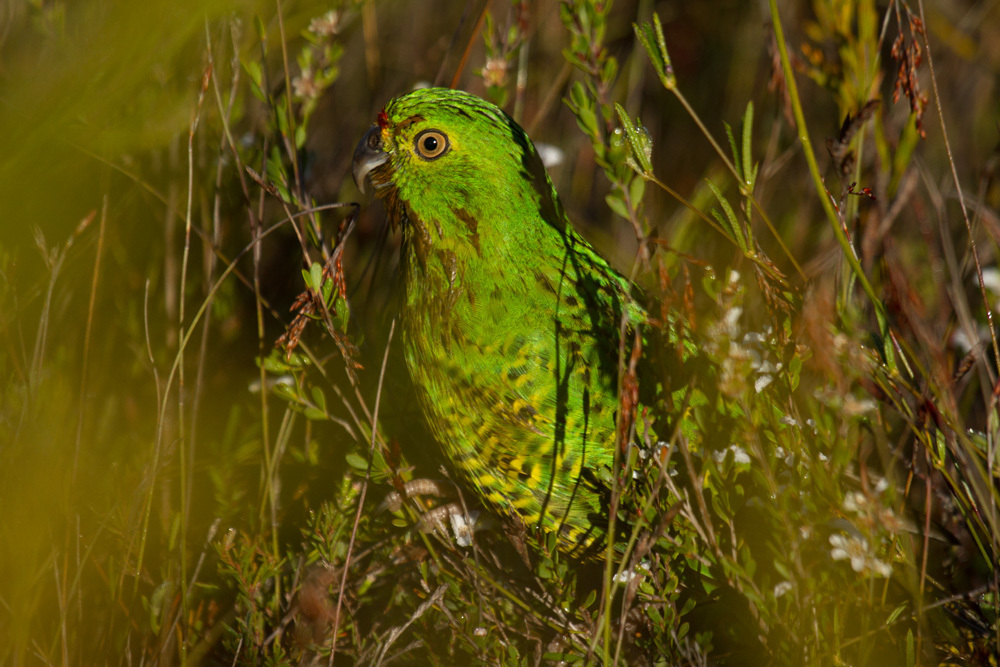
The ground parrot (Pezoporus wallicus) is a parrot endemic to Australia. It is one of only four ground-dwelling parrots in the world, the others being the closely related night parrot (Pezoporus occidentalis), the Antipodes parakeet (Cyanoramphus unicolor), and the flightless kākāpō (Strigops habroptilus) from New Zealand.
The colouration of the two Pezoporus species and the kākāpō is similar – yellowish green with darker barring, somewhat reminiscent of the head and back of the wild-type budgerigar.
From the article Ground parrot on Wikipedia (CC BY-SA), quoted section by section
Description
The ground parrot is a medium-sized parrot, growing up to 30 cm long and weighing approximately 80 grams. It is distinctive, with grass green plumage, black streaking on the head and hindneck, prominent pale-yellow wing bars and black and yellow barring on the abdomen, thighs and under-tail coverts. The irises are pale yellow, the bill is dark grey and the feet and legs are flesh-pink. They have a distinguishing bright red band above the cere. Males and females appear alike. Juveniles can be differentiated from adults in that they are slightly smaller, have duller yellow-olive plumage, absent red bands and thicker, bolder markings on the head and breast. When newly fledged, irises are dark grey-brown to brown in colour. The eastern and Tasmanian subspecies (wallicus and leachi) differ from the western subspecies (flaviventris) in that they have thicker and more prominent black markings on the head, neck and belly.
Range & habitat
This species is endemic to Australia. Each subspecies occurs within its own geographically separated distribution. Subspecies wallicus, the eastern ground parrot, occurs in fragmented populations in coastal areas of south-eastern Queensland, New South Wales and Victoria. It is distributed as far north as near Fraser or K'gari Island, and as far south as Portland. It was formerly present in South Australia, but has since gone regionally extinct. The eastern ground parrot occurs mainly in dry or moist coastal heathland or sedgeland with a dense foliage cover and a high density of favoured food plants. Subspecies flaviventris, the western ground parrot, only occurs in two disjunct populations in southern Western Australia, one in Fitzgerald River National Park, the other in Cape Arid National Park and Nuytsland Nature Reserve. It inhabits low, dry or swampy heathland near the coast, usually in areas that have been unburnt for long periods of time. Subspecies leachi, the Tasmanian ground parrot, is endemic to Tasmania, which hosts the largest population of the species as a whole. The Tasmanian ground parrot population is suspected to consist of more than 100,000 birds.
Wikipedia: “Distribution and habitat”
Listen
Looking for field recordings…
Where it lives
Recorded sightings
—
geo-referenced records in GBIF, from museums, herbaria and field observers.
Drag the globe to turn it. Dots are where records exist, not a range map; darker means more records.
In the stacks
Searching the stacks…
Every page naming Pezoporus wallicus in the Biodiversity Heritage Library →
This page is assembled live from iNaturalist, GBIF, Wikipedia, the Source Library and the Internet Archive. It is not yet part of the hand-edited codex. iNaturalist taxon 19111.