- Animals
- ›Chordates
- ›Vertebrates
- ›Birds
- ›Parrots
- ›Old World Parrots
- ›Lories, Lorikeets, Budgerigar and Fig-Parrots
- ›Trichoglossus
On eBird ↗
Pohnpei Lorikeet
Live sightings near you, the range map, bar charts of when it is seen, and Macaulay Library photos and recordings.
Pohnpei Lorikeet
Trichoglossus rubiginosus
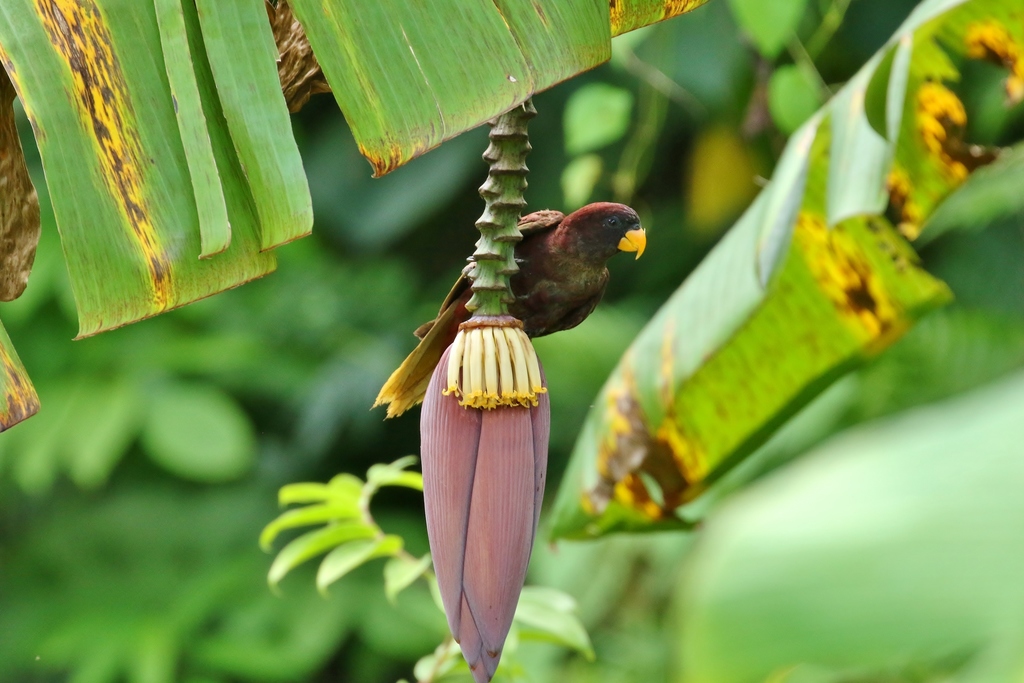
The Pohnpei lorikeet (Trichoglossus rubiginosus), known as serehd in Pohnpeian, is a monotypic species of parrot in the family Psittaculidae. It is endemic to the island of Pohnpei and the nearby Ahnd Atoll in Micronesia. Historically the species also occurred on Namoluk Atoll near Chuuk, and the species may once have had a wider distribution throughout Micronesia than it does today.
From the article Pohnpei lorikeet on Wikipedia (CC BY-SA), quoted section by section
Description
The Pohnpei lorikeet is 24 cm (9.4 in) long and weights around 80 g (2.8 oz). Its plumage is mainly reddish-maroon with vague approximately transverse striations of darker maroon. The head a slightly darker maroon. The flight feathers and tail are olive-yellow. Its legs are grey. The male has an orange beak and yellow-orange irises, while the female has a yellow beak and light grey irises. The juveniles have brown beaks and brown irises.
Range & habitat
Its natural habitat is tropical moist lowland forests and plantations. The diet is composed of nectar and pollen from coconuts and also fruit and insect larvae. It nests in a hole in a tree, laying a single egg. The species is common and not considered threatened.
Wikipedia: “Habitat and behaviour”
In human culture
The "Designation of State Bird Act" established the Pohnpei lorikeet as the state bird of Pohnpei, and simultaneously protected the bird from being hunted or killed; those disobeying the law can be fined or imprisoned.
Listen
Looking for field recordings…
Where it lives
Recorded sightings
—
geo-referenced records in GBIF, from museums, herbaria and field observers.
Drag the globe to turn it. Dots are where records exist, not a range map; darker means more records.
In the stacks
Searching the stacks…
Every page naming Trichoglossus rubiginosus in the Biodiversity Heritage Library →
This page is assembled live from iNaturalist, GBIF, Wikipedia, the Source Library and the Internet Archive. It is not yet part of the hand-edited codex. iNaturalist taxon 19117.