- Animals
- ›Chordates
- ›Vertebrates
- ›Birds
- ›Parrots
- ›Old World Parrots
- ›Lories, Lorikeets, Budgerigar and Fig-Parrots
- ›Trichoglossus
On eBird ↗
Olive-headed Lorikeet
Live sightings near you, the range map, bar charts of when it is seen, and Macaulay Library photos and recordings.
Olive-headed Lorikeet
Trichoglossus euteles
The olive-headed lorikeet (Trichoglossus euteles), also called the perfect lorikeet, is a species of parrot in the family Psittaculidae.
It is found in forest, woodland and cultivated areas on Timor and smaller nearby islands.
From the article Olive-headed lorikeet on Wikipedia (CC BY-SA), quoted section by section
Description
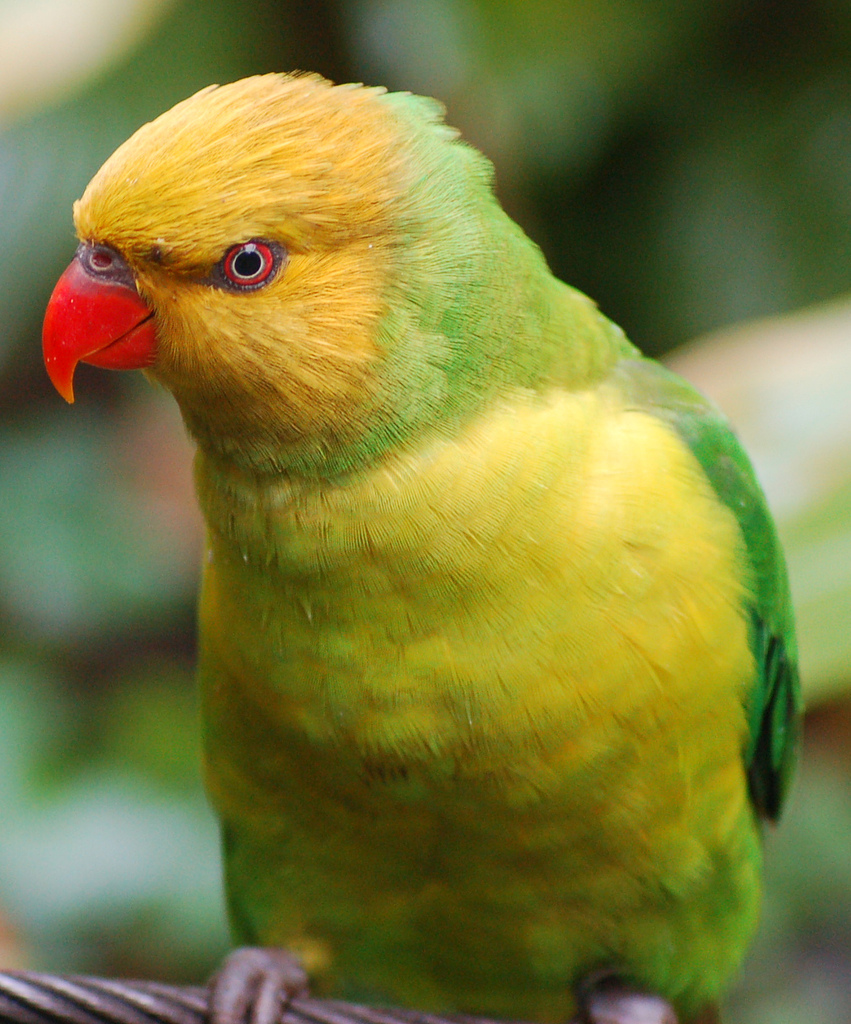
The olive-headed lorikeet is a mainly green parrot about 24 cm (9.5 in) long. It has an olive coloured head which is demarcated by a green collar. Its beak is orange-red, its irises are red, and its legs are grey. The male and female have an identical external appearance. Juveniles have a slightly greener head, a brown beak, and brown irises.
Range & habitat
Adonara and Lembata are medium to large volcanic islands located off the eastern tip of Flores, in East Nusa Tenggara (Lesser Sundas), Indonesia. The olive-headed lorikeet is endemic to the Lesser Sundas therefore they have a restricted range. It prefers to live in rainforests and closed canopy forests. Their habitat are primary montane forest, secondary growth and savanna woodland at roughly 1000–2300 m.
Wikipedia: “Habitat and Distribution”
What it does
Lorikeets are extremely aggressive toward individuals of their own species as well as those of other species, both in the wild and in captivity. This aggression is most evident when it comes to food, perches, and nest sites. The olive-headed lorikeet performs elaborate ranges of visual threat displays during hostile interactions, like other parrots of the genus Trichoglossus.
Vocalizations. It is said that calls are repetitive, long and wheezy; also rapid, buzzy trilling notes and muted series of harsh, longer squeaks, twitters and whistles. They primarily produce sharp, high-pitched sounds expressed as "kreet!" or "kurrk," but also emits a softer, lisping "tsleet!" along with various muted, grating tones.
Diet. In captivity, at least forty percent of the diet should consist of either commercial or homemade nectar, which can be made from lactose-free baby cereal, honey, malt extract, or molasses, mixed with filtered water and made fresh once or twice a day. Other fruit and vegetable options include carrots, fresh corn on the cob, frozen sweetcorn, Swiss chard, lettuce, dandelion, sowthistle, and chickweed, dried figs soaked in water for a few hours, spray millet, a small amount of soaked or sprouted sunflower seed, and/or oats. In the wild, they feed on pollen, nectar, fruits, seeds and insects and their larvae.
Reproduction. There is no information from the wild. …
Wikipedia: “Behaviour”
In human culture
Like the rainbow lorikeet, this species of lorikeet is popular in aviculture. It is present on the 2007 inventory of non-native (exotic) bird species known to be in Australia.
Wikipedia: “Aviculture”
Listen
Looking for field recordings…
Where it lives
Recorded sightings
—
geo-referenced records in GBIF, from museums, herbaria and field observers.
Drag the globe to turn it. Dots are where records exist, not a range map; darker means more records.
In the stacks
Searching the stacks…
Every page naming Trichoglossus euteles in the Biodiversity Heritage Library →
This page is assembled live from iNaturalist, GBIF, Wikipedia, the Source Library and the Internet Archive. It is not yet part of the hand-edited codex. iNaturalist taxon 19125.