On eBird ↗
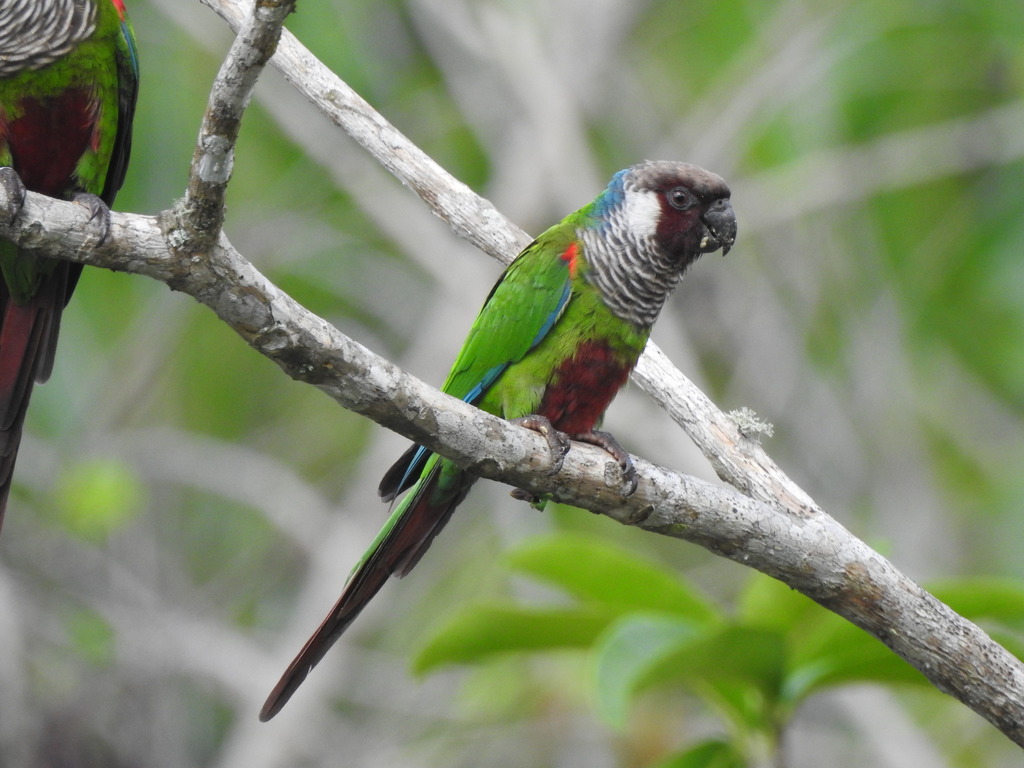
Maroon-faced Parakeet
Live sightings near you, the range map, bar charts of when it is seen, and Macaulay Library photos and recordings.
Maroon-faced Parakeet
Pyrrhura leucotis
The white-eared parakeet or maroon-faced parakeet (Pyrrhura leucotis) is a small parrot belonging to the genus Pyrrhura. As here defined, it is endemic to Atlantic Forest in eastern Brazil. The Venezuelan, grey-breasted and Pfrimer's parakeets were formerly classed as subspecies of this bird but are increasingly treated as separate species.
From the article White-eared parakeet on Wikipedia (CC BY-SA), quoted section by section
Description
The white-eared parakeet is 23 to 25 cm (9.1 to 9.8 in) long. The sexes are the same. Adults have a light brown crown, a bluish forehead and hindneck, a maroon face, and whitish ear coverts. Their upperparts are mostly green with a reddish rump. Their chin, throat, and the sides of their neck are green with light buff scaling. The center of their belly is brownish red and the rest of their underparts are green. Their wing is mostly green with a red shoulder and blue flight feathers. Their tail is brownish red with a duller underside. Immatures are similar to adults.
Range & habitat
The white-eared parakeet is found in eastern Brazil where it occurs from Bahia south to Rio de Janeiro state. It inhabits the interior and edges of tropical evergreen forest, clearings with scattered trees, and also shaded cacao plantations. In elevation it ranges from sea level to about 600 m (2,000 ft).
Wikipedia: “Distribution and habitat”
What it does
The white-eared parakeet feeds primarily on seeds and fruits but also includes berries, nuts, and possibly insects and flowers in its diet.
Wikipedia: “Feeding”
Listen
Looking for field recordings…
Where it lives
Recorded sightings
—
geo-referenced records in GBIF, from museums, herbaria and field observers.
Drag the globe to turn it. Dots are where records exist, not a range map; darker means more records.
In the stacks
Searching the stacks…
Every page naming Pyrrhura leucotis in the Biodiversity Heritage Library →
This page is assembled live from iNaturalist, GBIF, Wikipedia, the Source Library and the Internet Archive. It is not yet part of the hand-edited codex. iNaturalist taxon 19144.