On eBird ↗
Santa Marta Parakeet
Live sightings near you, the range map, bar charts of when it is seen, and Macaulay Library photos and recordings.
Santa Marta Parakeet
Pyrrhura viridicata
The Santa Marta parakeet (Pyrrhura viridicata) is an Endangered species of bird in subfamily Arinae of the family Psittacidae, the African and New World parrots. It is endemic to Colombia.
From the article Santa Marta parakeet on Wikipedia (CC BY-SA), quoted section by section
Description
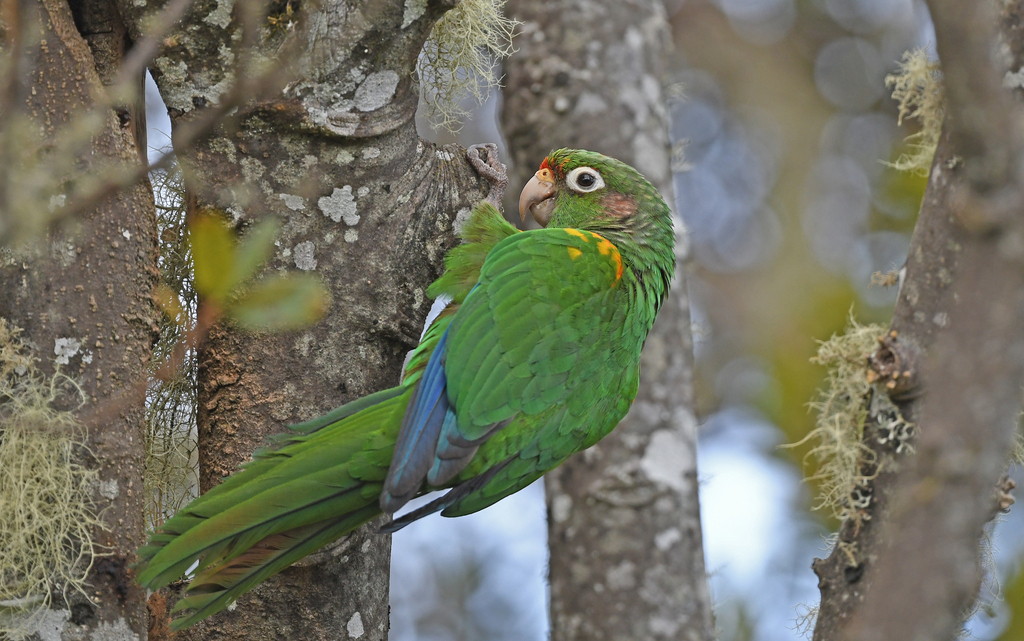
The Santa Marta parakeet is 23 to 25 cm (9.1 to 9.8 in) long. The sexes are the same. Adults have a mostly green head with a red forehead and brownish ear coverts. Their upperparts are green. Their breast and upper belly have a scarlet "belt" and the rest of their underparts are green. Their wing is mostly green with yellow to orange upperwing and underwing coverts; their primaries are blue. Their tail is dull reddish. Immature birds are similar to adults but without the red belt on their underside.
Range & habitat
The Santa Marta parakeet is found only in the Sierra Nevada de Santa Marta, an isolated mountain range in northern Colombia. Though it apparently was previously found on all sides of the range, it now appears to occur only along the north and northwestern slopes. It primarily inhabits humid pre-montane and montane forest, mostly in areas that receive at least 2,000 mm (79 in) of annual rainfall. It also less frequently occurs in secondary forest and cultivated areas. In elevation it ranges between 2,000 and 3,500 m (6,600 and 11,500 ft).
Wikipedia: “Distribution and habitat”
What it does
The Santa Marta parakeet feeds on a variety of fruits and seeds, with the fruit of Croton bogotanus providing a major part of its diet. It also feeds on flowers, leaves, and lichens. It forages in flocks of up to about 20 individuals. Its diet varies over time with the changing abundance of its food, and it appears to use a wider variety of resources when its preferred food is not available. This behavior is interpreted to indicate some ecological flexibility.
Breeding. In a completely natural setting, the Santa Marta parakeet nests only in dead wax palms (Ceroxylon ceriferum); it also uses nest boxes placed in or near the forest. Most of the data on its breeding biology comes from monitoring nest boxes. The species has two breeding season peaks, between December and May and between June and October. The second season is thought to be a response to competition for nest cavities from larger parrot species. The clutch ranges from three to seven eggs with a mean of 4.5. The incubation period is 22 to 28 days and fledging occurs up to 45 days after hatch. The Santa Marta parakeet exhibits cooperative breeding.
Vocalization. The Santa Marta parakeet "uses screeching calls during flight".
Wikipedia: “Feeding”
Listen
Looking for field recordings…
Where it lives
Recorded sightings
—
geo-referenced records in GBIF, from museums, herbaria and field observers.
Drag the globe to turn it. Dots are where records exist, not a range map; darker means more records.
In the stacks
Searching the stacks…
Every page naming Pyrrhura viridicata in the Biodiversity Heritage Library →
This page is assembled live from iNaturalist, GBIF, Wikipedia, the Source Library and the Internet Archive. It is not yet part of the hand-edited codex. iNaturalist taxon 19155.