- Animals
- ›Chordates
- ›Vertebrates
- ›Birds
- ›Parrots
- ›Old World Parrots
- ›Long-tailed Parrots and allies
- ›Mascarinus
On eBird ↗
Mascarene Parrot
Live sightings near you, the range map, bar charts of when it is seen, and Macaulay Library photos and recordings.
Mascarene Parrot
Mascarinus mascarinus
The Mascarene parrot or mascarin (Mascarinus mascarinus) is an extinct species of parrot that was endemic to the Mascarene island of Réunion in the western Indian Ocean. The taxonomic relationships of this species have been subject to debate; it has historically been grouped with either the Psittaculini parrots or the vasa parrots, with the latest genetic study favouring the former group.
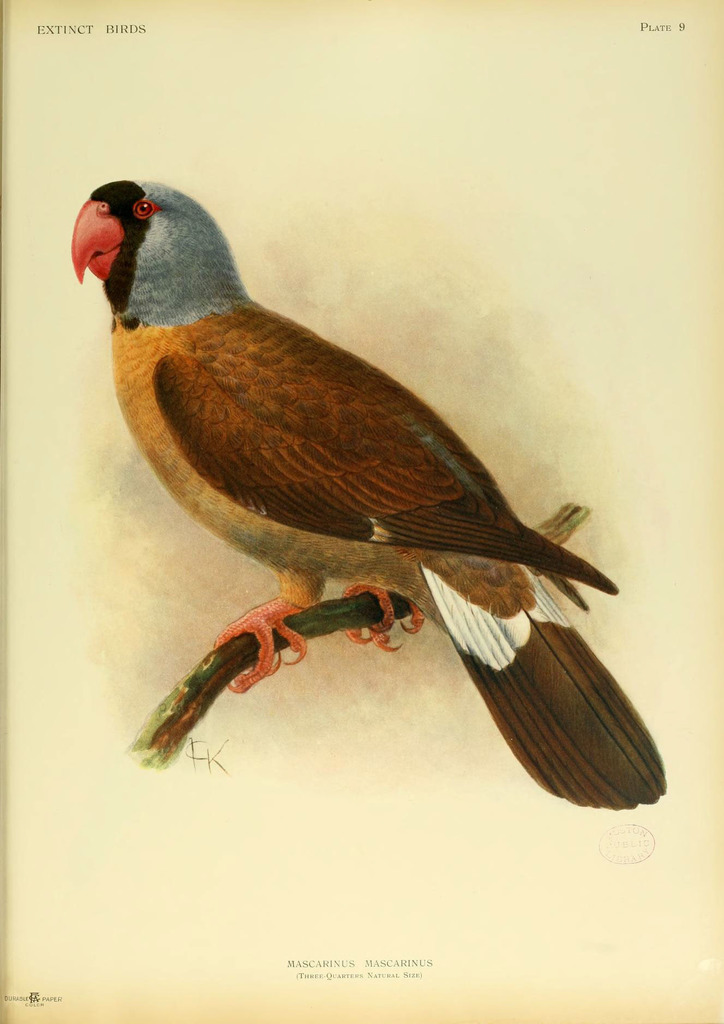
The Mascarene parrot was 35 cm (14 in) in length with a large red bill and long, rounded tail feathers. Its legs were red, and it had naked red skin around the eyes and nostrils. It had a black facial mask and partially white tail feathers, but the colouration of the body, wings and head in the living bird is unclear. Descriptions from life indicate the body and head were ash grey, and the white part of the tail had two dark central feathers. In contrast, stuffed specimens and old descriptions based on them indicate that the body was brown and the head bluish. This may be due to the specimens having changed colour as a result of ageing and exposure to light. Very little is known about the bird in life.
From the article Mascarene parrot on Wikipedia (CC BY-SA), quoted section by section
Description
The Mascarene parrot was 35 cm (14 in) in length. The wing was 211 mm (8.3 in), the tail 144–152 mm (5.7–6.0 in), the culmen 32–36 mm (1.3–1.4 in), and the tarsus 22–24 mm (0.87–0.94 in). It had a large red bill and moderately long, rounded tail feathers. It had a black velvet-like facial mask on the front part of the head. There are several discrepancies in how the colour of the body, wings, tail feathers and the head have historically been described and depicted. In 1674, Dubois described live specimens as being "petit-gris" which is the colour of the dark phase of the red squirrel. According to Hume, this colour is a dark blackish grey or brown. In 1760, Brisson published the following description based on a captive bird (which may have been the specimen now preserved in Paris):
Upperparts of head and neck clear (ash) grey. Back, rump, underparts of neck, breast, belly, sides, legs, scapular feathers, upper coverts of tail very-dark (ash) grey. Wing feathers of the same colour. The tail is composed of 12 feathers: the two median ones are also very-dark (ash) grey. All the lateral ones are of the same colour, except that they have a little white at their base. The eyes are surrounded by a naked skin, bright red. Pupil black, iris red. The base of the superior half of the beak is also surrounded by a red naked skin in which the nostrils are placed. Beak similarly red. …
What it does
Very little is known about the Mascarene parrot in life. Since several specimens were kept alive in captivity, it was probably not a specialised feeder. That the Vienna specimen was partially white may have been the result of food deficiency during a long period in captivity; the clipped primary wing feathers indicate it was caged. Little was known about parrot-diet in the 1700s, and the Vienna specimen may not have received enough of the amino acid tyrosine through its food, which it would have needed for melanin synthesis. In other parrots, this would have resulted in orange instead of white colour in the affected feathers, due to the presence of the pigment psittacin, but Coracopsis parrots and the Mascarene parrot are the only parrots that lack this pigment. The specimen has also been described as "partially albinistic" at times, though true albinism (lack of the enzyme tyrosinase) can by definition never only be partial.
In 1705, the French cartographer Jean Feuilley gave a description of the parrots of Réunion and their ecology which indicates that they fattened themselves seasonally:
There are several sorts of parrot, of different sizes and colours. Some are the size of a hen, grey, the beak red [Mascarene parrot]; others the same colour the size of a pigeon [Mascarene grey parakeet], and yet others, smaller, are green [Réunion parakeet]. …
Wikipedia: “Behaviour and ecology”
Listen
Looking for field recordings…
Where it lives
Recorded sightings
—
geo-referenced records in GBIF, from museums, herbaria and field observers.
Drag the globe to turn it. Dots are where records exist, not a range map; darker means more records.
In the stacks
Searching the stacks…
Every page naming Mascarinus mascarinus in the Biodiversity Heritage Library →
This page is assembled live from iNaturalist, GBIF, Wikipedia, the Source Library and the Internet Archive. It is not yet part of the hand-edited codex. iNaturalist taxon 19217.