- Animals
- ›Chordates
- ›Vertebrates
- ›Birds
- ›Parrots
- ›Old World Parrots
- ›Long-tailed Parrots and allies
- ›Polytelis
On eBird ↗
Superb Parrot
Live sightings near you, the range map, bar charts of when it is seen, and Macaulay Library photos and recordings.
Superb Parrot
Polytelis swainsonii
The superb parrot (Polytelis swainsonii), also known as Barraband's parrot, Barraband's parakeet, or green leek parrot, is a parrot native to south-eastern Australia. It is a dimorphic species and one of three species in the genus Polytelis.
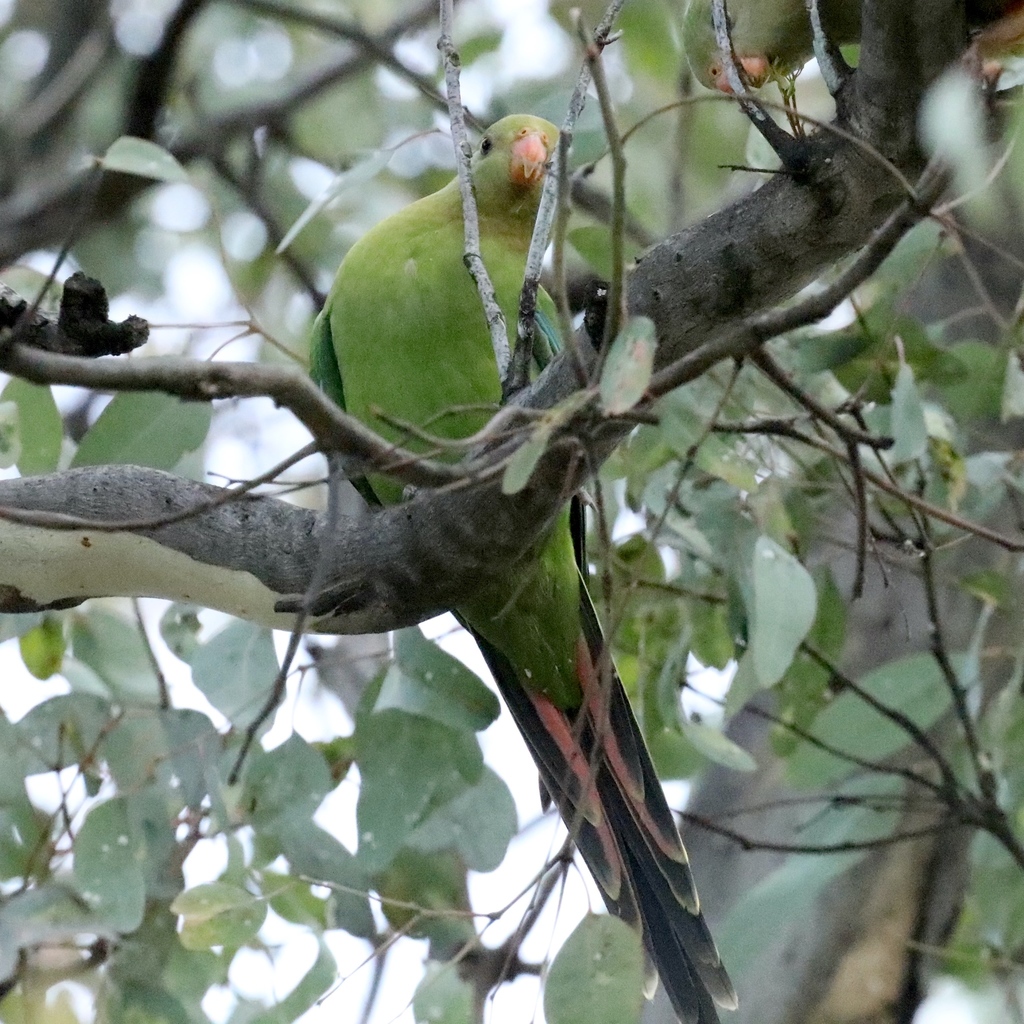
The superb parrot is mostly bright green with darker flight feathers and is about 40 cm (16 in) long with a long pointed tail. Adult males have continuous yellow foreheads and throats, with a red horizontal band across the border of the throat.
From the article Superb parrot on Wikipedia (CC BY-SA), quoted section by section
Description
The superb parrot is medium-sized, bright green, approximately 40 cm (16 in) long, and has long tail feathers, a yellow-green neck, and yellow-orange irises. The adult male has a scarlet band on its upper chest and a bright yellow face and throat. The adult female has a pale blue-green face, greyish-green throat, a variable tinged russet-pink fore-throat, and orange thighs. Juveniles have brown irises and otherwise resemble females. The male has adult coloured plumage at the age of about one year.
Range & habitat
An Australian endemic, the superb parrot is restricted to the dry (sclerophyll) woodlands of New South Wales and Victoria. There is estimated to be at least 10,000 individuals in the wild.
Important Bird Areas. BirdLife International has identified the following sites as being important for superb parrot conservation:
Barmah-Millewa Murrumbidgee Red Gums South-west Slopes of NSW
Wikipedia: “Distribution and habitat”
What it does
It nests on hollow limb or a hole in a tree. During breeding season, small flocks of males often forage for food alone. Pairs may nest in a loose colonial system of as many as 6 pairs, so females are in the neighborhood at this time. The diet consists mainly of eucalypt flowers, fruits, nectar and pollen. It consumes seeds and green heads of the yellow box (Eucalyptus melliodora).
Wikipedia: “Behaviour”
Listen
Looking for field recordings…
Where it lives
Recorded sightings
—
geo-referenced records in GBIF, from museums, herbaria and field observers.
Drag the globe to turn it. Dots are where records exist, not a range map; darker means more records.
In the stacks
Searching the stacks…
Every page naming Polytelis swainsonii in the Biodiversity Heritage Library →
This page is assembled live from iNaturalist, GBIF, Wikipedia, the Source Library and the Internet Archive. It is not yet part of the hand-edited codex. iNaturalist taxon 19252.