- Animals
- ›Chordates
- ›Vertebrates
- ›Birds
- ›Parrots
- ›Old World Parrots
- ›Lories, Lorikeets, Budgerigar and Fig-Parrots
- ›Cyclopsitta
On eBird ↗
Double-eyed Fig-Parrot
Live sightings near you, the range map, bar charts of when it is seen, and Macaulay Library photos and recordings.
Double-eyed Fig Parrot
Cyclopsitta diophthalma
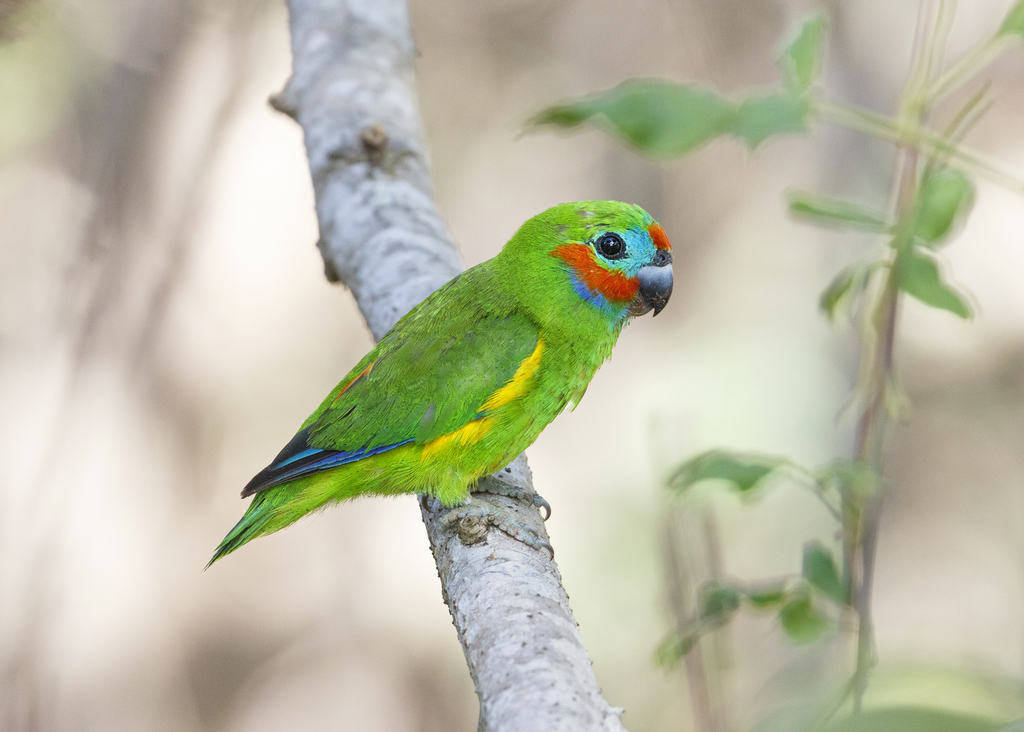
The double-eyed fig parrot (Cyclopsitta diophthalma), also known as the blue-faced fig parrot, red-faced fig parrot, dwarf fig parrot, and the two-eyed fig parrot, primarily inhabits forests on New Guinea and nearby islands, but is also found in isolated communities along the tropical Australian coast, east of the Great Dividing Range. With an average total length of about 14 cm (5+1⁄2 in), it is the smallest parrot in Australia.
Most subspecies of the double-eyed fig parrot are sexually dimorphic, with males having more red (less silvery and blue) to the face than the females. It is predominantly green with a very short tail, a disproportionately large head and bill, and red and blue facial markings. Its name is derived from a blue spot on the lores, which in New Guinean birds is roughly the same size as the eyes.
From the article Double-eyed fig parrot on Wikipedia (CC BY-SA), quoted section by section
What it does
The double-eyed fig parrot generally forages for figs, berries, seeds, nectar, and the grubs of wood-boring insects. This foraging is done in pairs or in a flock of only a few individuals. It tends to fly in a quick and direct manner. It produces a short and shrill call. Unlike many other parrots which generally use existing holes in trees for nests, double-eyed fig parrots excavate their own nest cavities, usually in a rotten tree. Double-eyed fig parrots utter high-pitched, clipped, two or three note zzzt-zzzt or zeet-zeet calls, unlike the rolling or trilling screeches typical of lorikeets. These calls are mostly made in flight, but sometimes when perched. When engrossed in feeding, it may also make a variety of softer, chattering noises. Eight subspecies of the double-eyed fig parrot are described. Cyclopsitta diophthalma coxeni, C. d. macleayana, and C. d. marshalli are restricted to Australia, and the other five are restricted to New Guinea and associated islands.
Wikipedia: “Behaviour”
Listen
Looking for field recordings…
Where it lives
Recorded sightings
—
geo-referenced records in GBIF, from museums, herbaria and field observers.
Drag the globe to turn it. Dots are where records exist, not a range map; darker means more records.
In the stacks
Searching the stacks…
Every page naming Cyclopsitta diophthalma in the Biodiversity Heritage Library →
This page is assembled live from iNaturalist, GBIF, Wikipedia, the Source Library and the Internet Archive. It is not yet part of the hand-edited codex. iNaturalist taxon 19275.