- Animals
- ›Chordates
- ›Vertebrates
- ›Birds
- ›Parrots
- ›Old World Parrots
- ›Broad-tailed Parrots and Allies
- ›Lathamus
On eBird ↗
Swift Parrot
Live sightings near you, the range map, bar charts of when it is seen, and Macaulay Library photos and recordings.
Swift Parrot
Lathamus discolor
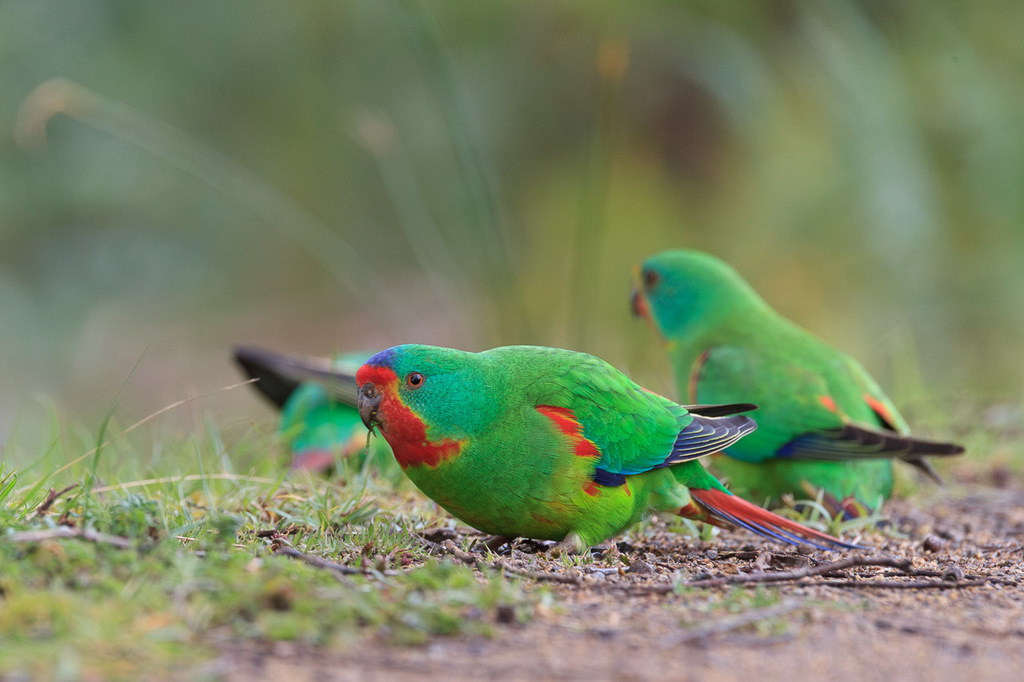
The swift parrot (Lathamus discolor), also known by the palawa kani name swift waylitja, is a species of broad-tailed parrot, found only in southeastern Australia. The species breeds in Tasmania during the summer and migrates north to southeastern mainland Australia from Griffith-Warialda in New South Wales and west to Adelaide in the winter. It is a nomadic migrant, and it settles in an area only when there is food available. The Swift Parrot was voted 2023 Bird of the Year in The Guardian Australia and BirdLife Australia's biennial poll.
The species is critically endangered, and the severe predation by introduced sugar gliders (Petaurus breviceps) on breeding females and nests in some locations has demonstrated an unexpected but potentially serious new threat. Genetic evidence for the effective population size suggests that the minimum potential population size is now around 300–500 individual swift parrots. This supports the results of earlier studies that use demographic information about swift parrots to predict that the species could be extinct by 2031.
From the article Swift parrot on Wikipedia (CC BY-SA), quoted section by section
Description
The swift parrot is about 25 centimetres (10 in) long and has long pointed wings and long tapering tail feathers. It is mainly green with bluish crown and red on the face above and below the beak. The adult female is slightly duller, and the juvenile has a dark brown iris and a pale orange bill. The forehead to throat is crimson and there is also crimson patch at the top, edge of the wing. They are noisy, always active and showy, and are very fast with their direct flight.
Range & habitat
Genetic evidence has shown that the swift parrot is a single, genetically mixed and nomadic population that moves around the landscape each year. Because they are nomadic, swift parrots can occur across a very large potential area, but settlement at a given location depends on the local availability of food. However, in the Tasmanian breeding range, swift parrots need both food and suitable nesting sites to occur in close proximity in order to nest at a given site. The swift parrot migrates each year across Bass Strait between Tasmania and the mainland of Australia. They arrive in Tasmania during September and return to south-eastern Australia during March and April. They can be found as far north as south-eastern Queensland and as far west as Adelaide in South Australia, although recent sightings have been restricted to the south-eastern part of the state. Because swift parrots are nomadic migrants, their occurrence at any one location are difficult to predict. Although they will repeatedly return to the same locations, local occurrence may only happen intermittently depending on whether or not food (flowering trees) is available in a given year.
Important Bird Areas. …
Wikipedia: “Distribution”
What it does
Swift parrots are primarily nectar feeders, preferring nectar from flowering Eucalyptus spp. In Tasmania, their settlement of breeding habitat is regulated by the occurrence of flowering in their two main food trees Eucalyptus globulus and Eucalyptus ovata. In the winter, their habitat use is broader, with foraging occurring on a range of flowering Eucalyptus spp. across southeastern mainland Australia.
Wikipedia: “Diet”
Listen
Looking for field recordings…
Where it lives
Recorded sightings
—
geo-referenced records in GBIF, from museums, herbaria and field observers.
Drag the globe to turn it. Dots are where records exist, not a range map; darker means more records.
In the stacks
Searching the stacks…
Every page naming Lathamus discolor in the Biodiversity Heritage Library →
This page is assembled live from iNaturalist, GBIF, Wikipedia, the Source Library and the Internet Archive. It is not yet part of the hand-edited codex. iNaturalist taxon 19284.