- Animals
- ›Chordates
- ›Vertebrates
- ›Birds
- ›Parrots
- ›Old World Parrots
- ›Long-tailed Parrots and allies
- ›Micropsitta
On eBird ↗
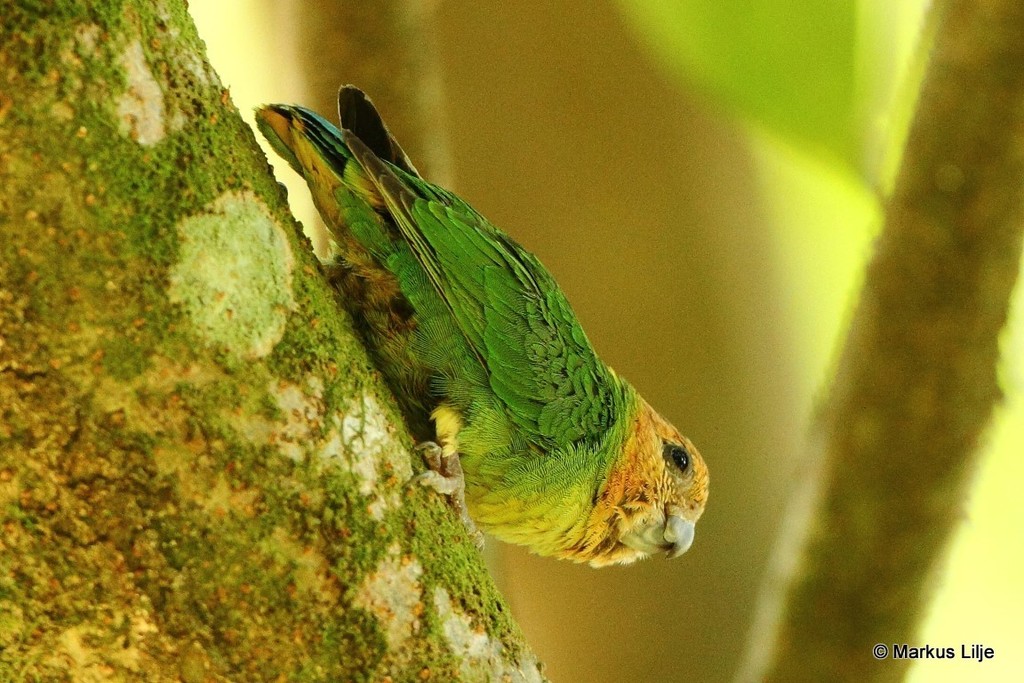
Buff-faced Pygmy-Parrot
Live sightings near you, the range map, bar charts of when it is seen, and Macaulay Library photos and recordings.
Buff-faced Pygmy-Parrot
Micropsitta pusio
The buff-faced pygmy parrot (Micropsitta pusio) is a very small green parrot found in subtropical or tropical moist lowland forests in New Britain and New Guinea.
From the article Buff-faced pygmy parrot on Wikipedia (CC BY-SA), quoted section by section
Description
Little-studied as an individual species, it is known mainly for being the world's smallest parrot, at 11.5 g (0.41 oz) and 8.6 cm (3.4 in). However, the average weight of six adults was surprisingly high at 14 g (0.49 oz), being slightly higher than two other pygmy parrots, the Geelvink and yellow-capped, both of which, nonetheless, have slightly longer total lengths. The male and female are similar in appearance; their plumage is mainly green with a yellowish tone on the underparts. The cheeks, face, and crown are buff (hence the common name). A dark blue patch is on the top of the head back to the occiput. Head markings are smaller in females, and facial colour is paler. The eyes are dark brown and the bill is grey, and legs are greyish with blue or pinkish tints. Immature birds lack the blue crown, replacing it with green, and the buff colour is less distinct.
Range & habitat
Buff-faced pygmy parrots are found across the northern lowlands of the island of New Guinea from the west to the southeastern tip up to an altitude around 800 m, as well as in the Bismarck Archipelago. They inhabit subtropical or tropical moist lowland forest in small groups up to six birds and are highly active, hopping around on tree trunks.
Conservation status. While its population size is unknown, the species occurs over a very wide range and is listed as least concern by the IUCN.
Wikipedia: “Distribution and habitat”
Listen
Looking for field recordings…
Where it lives
Recorded sightings
—
geo-referenced records in GBIF, from museums, herbaria and field observers.
Drag the globe to turn it. Dots are where records exist, not a range map; darker means more records.
In the stacks
Searching the stacks…
Every page naming Micropsitta pusio in the Biodiversity Heritage Library →
This page is assembled live from iNaturalist, GBIF, Wikipedia, the Source Library and the Internet Archive. It is not yet part of the hand-edited codex. iNaturalist taxon 19292.