On eBird ↗
Golden-plumed Parakeet
Live sightings near you, the range map, bar charts of when it is seen, and Macaulay Library photos and recordings.
Golden-plumed Parakeet
Leptosittaca branickii
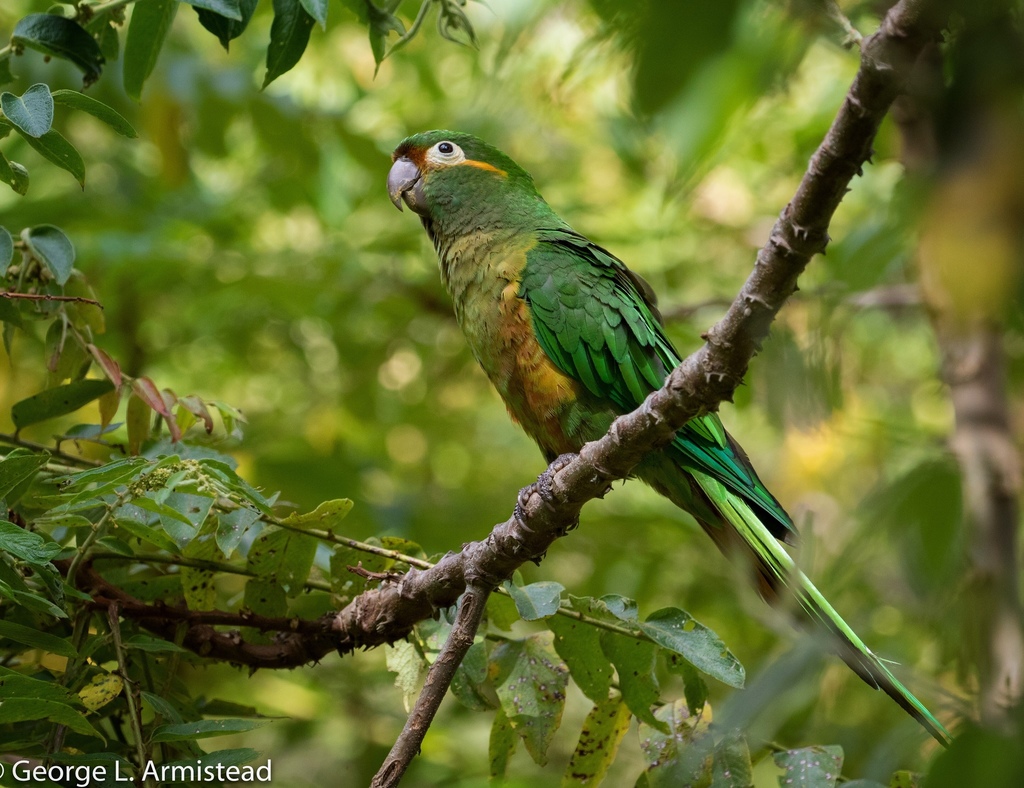
The golden-plumed parakeet (Leptosittaca branickii) is a Neotropical parrot species within the family Psittacidae, belonging to the monotypic genus Leptosittaca. This somewhat Aratinga-like species is found in humid temperate highland forests, especially with Podocarpus, on the east Andean slope in Colombia, Ecuador, and Peru. It is generally local and uncommon. It is threatened by habitat loss. Clearing of high-altitude forests for agricultural reasons have greatly impacted the loss of habitat for this parakeet species. Further reduction of such habitats will continue to diminish the number of golden-plumed parakeets left in South America. It is the only known parakeet species that can detect ultraviolet radiation.
From the article Golden-plumed parakeet on Wikipedia (CC BY-SA), quoted section by section
Description
The golden-plumed parakeet is a large and long tailed montane parakeet that resides in the Andean cloud forests of Colombia, Peru, and Ecuador. Adults are mostly bright green with orange-yellow lores and small golden yellow crests behind the eyes. Their bellies are a faded yellowish color with reddish orange feathers scattered about. Golden-plumed parakeets have yellowish flight feathers on their underside as well as strongly reddish color feathers on the underside of their tail. Juveniles strongly resemble the adults, but their bellies are a paler green, yellow, and orange color as well as having pale pink bills.
What it does
Golden-plumed parakeets usually abide in groups of 5-15 and can be seen in groups as large as 35-40 birds. The golden-plumed parakeet likely has a nomadic movement pattern, leaving the nest when the chicks have fledged and returning next breeding season. Also, they are usually on exposed branches and outer crowns of Wax palms and are very active callers. Their call is a shrill sound that is present in flight and while they are perched, and it can be heard all year and more frequently during nesting areas during the breeding season. During copulation, the males and females share the same perch and gradually approach each other. The male slowly mounts the female and they both raise their long tails, rub together their cloacas, and shake their tails literally for 1–2 minutes.
Wikipedia: “Behavior”
Listen
Looking for field recordings…
Where it lives
Recorded sightings
—
geo-referenced records in GBIF, from museums, herbaria and field observers.
Drag the globe to turn it. Dots are where records exist, not a range map; darker means more records.
In the stacks
Searching the stacks…
Every page naming Leptosittaca branickii in the Biodiversity Heritage Library →
This page is assembled live from iNaturalist, GBIF, Wikipedia, the Source Library and the Internet Archive. It is not yet part of the hand-edited codex. iNaturalist taxon 19298.