On eBird ↗
Maroon-fronted Parrot
Live sightings near you, the range map, bar charts of when it is seen, and Macaulay Library photos and recordings.
Maroon-fronted Parrot
Rhynchopsitta terrisi
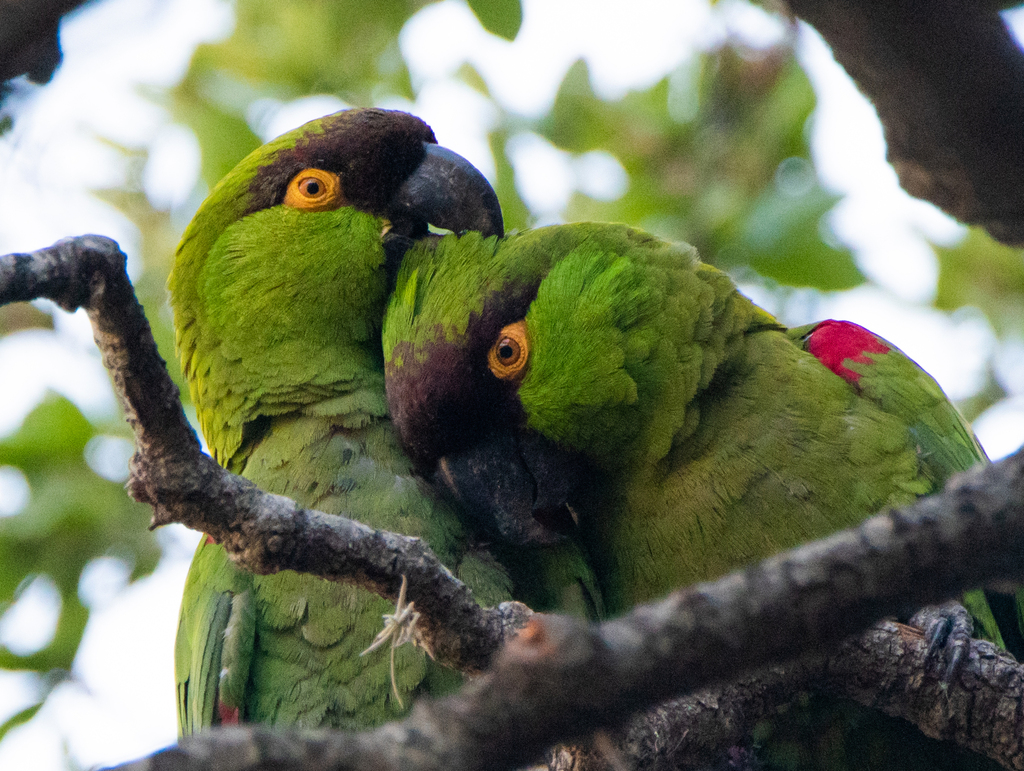
The maroon-fronted parrot (Rhynchopsitta terrisi) is a large, macaw-like parrot. It is dark green with a dark red shoulder and a maroon forehead and eye-stripe. Its underside of the wings and tail appear to be black when it is in flight. It makes a high, rolling cr-a ak sound. Groups sound similar to the acorn woodpecker if they are heard from a distance.
The species is endemic to northeastern Mexico, where only about 2500–3000 birds survive in the wild.
From the article Maroon-fronted parrot on Wikipedia (CC BY-SA), quoted section by section
Description
The maroon-fronted parrot is a large mostly green parrot which measures 40–45 cm (16–18 in) in length and weighs 390–470 g (14–17 oz). The adults have a dark maroon brow which extends over the rim of bare yellow skin that surrounds the eyes. They have a brighter red at the bend of the wing. The tail is long and pointed. The underside of the wings are blackish. The juvenile has a pale beak, whitish eye-rings, and lack the dark maroon stripe over each eye.
Range & habitat
Maroon-fronted parrots live in mature pine, mixed conifer, and pine-oak forests from 2000 to 3500 meters. This bird is endemic to the Sierra Madre Oriental in Nuevo León, Coahuila and Tamaulipas, Mexico.
Wikipedia: “Distribution and habitat”
What it does
They nest in limestone cliffs near moving water in large colonies. Breeding coincides with the fruition of pines, which is its main food source. They lay one to three eggs in July and the juveniles fledge around November. They migrate over short distances seasonally.
Wikipedia: “Behaviour”
Listen
Looking for field recordings…
Where it lives
Recorded sightings
—
geo-referenced records in GBIF, from museums, herbaria and field observers.
Drag the globe to turn it. Dots are where records exist, not a range map; darker means more records.
In the stacks
Searching the stacks…
Every page naming Rhynchopsitta terrisi in the Biodiversity Heritage Library →
This page is assembled live from iNaturalist, GBIF, Wikipedia, the Source Library and the Internet Archive. It is not yet part of the hand-edited codex. iNaturalist taxon 19317.