On eBird ↗
Spix's Macaw
Live sightings near you, the range map, bar charts of when it is seen, and Macaulay Library photos and recordings.
Spix's Macaw
Cyanopsitta spixii
Spix's macaw (Cyanopsitta spixii), also known as the little blue macaw, or simply blue macaw, is a macaw species that was endemic to Brazil. It is a member of tribe Arini in the subfamily Arinae (Neotropical parrots), part of the family Psittacidae (the true parrots). It was first described in 1638 by German naturalist Georg Marcgrave when he was working in Pernambuco in Dutch Brazil. It is named for German biologist Johann Baptist von Spix, who collected a specimen in 1819 on the bank of the São Francisco River near Juazeiro. This bird has been completely extirpated from its natural range, and following a several-year-long survey, the IUCN officially declared it extinct in the wild in 2019. However, after over 20 years of conservation efforts, 200 macaws have been bred from captive birds, and 52 individual birds have since been reintroduced into their natural environment in June 2022.
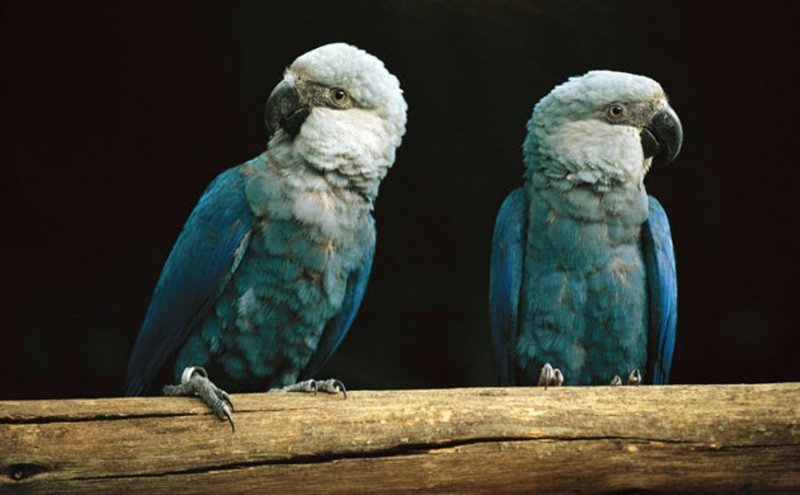
The bird is a medium-size parrot weighing about 300 grams (11 oz), smaller than most of the large macaws. Its appearance is various shades of blue, with a grey-blue head, light blue underparts, and vivid blue upperparts. Males and females are almost identical in appearance; however, the females are slightly smaller.
From the article Spix's macaw on Wikipedia (CC BY-SA), quoted section by section
Description
Spix's macaw is easy to identify being the only small blue macaw and also by the bare grey facial skin of its lores and eyerings. It is about 56 cm (22 in) long including tail length of 26–38 cm (10–15 in). It has a wing length of 24.7–30.0 cm (9.7–11.8 in). The external appearance of adult male and female are identical; however, the average weight of captive males is about 318 g (11.2 oz) and captive females average about 288 g (10.2 oz). Its plumage is grey-blue on the head, pale blue on the underparts, and vivid blue on the upperparts, wings and tail. The legs and feet are brownish-black. In adults the bare facial skin is grey, the beak is entirely dark grey, and the irises are yellow. Juveniles are similar to adults, but they have pale grey bare facial skin, brown irises, and a white stripe along the top-center of their beaks (along the culmen).
Range & habitat
Various accounts relate that the birds were more common in Pernambuco than in Bahia through the 1960s but not later. Spix's macaw was most recently (1974–1987) known in the Río São Francisco valley, in northeastern Brazil, principally in the basins on the south side of the river in the State of Bahia. In 1974, ornithologist Helmut Sick, based on information from traders and trappers, extended the possible range of the Spix's macaw to embrace the northeastern part of the state of Goias and the southern part of the state of Maranhão. Other ornithologists reporting the bird in various parts of the state of Piauí further extended the range to a vast area of the dry interior of northeast Brazil.
Study of the lone bird discovered at Melância creek in 1990 revealed substantive information about its habitat. It had been previously assumed that the Spix's macaw had a vast range in the interior of Brazil embracing several different habitat types, including buriti palm swamps, cerrado, and dry Caatinga. But the evidence collected in Melância Creek indicated that the Spix's macaw was a specially adapted inhabitant of the disappearing woodland galleries. …
Wikipedia: “Distribution and habitat”
What it does
In the wild, the most common seeds and nuts consumed by Spix's were from Pinhão (Jatropha pohliana var. mollissima) and Favela (Cnidoscolus phyllacanthus). However these trees are colonizers, not native to the bird's habitat, so they could not have been historical staples of the diet. Its diet also included seeds and nuts from Joazeiro (Ziziphus joazeiro), Baraúna (Schinopsis brasiliensis), Imburana (Commiphora leptophloeos or Bursera leptophloeos), Facheiro (Pilosocereus piauhyensis), Phoradendron species, Caraibeira (Tabebuia caraiba), Angico (Anadenanthera macrocarpa), Umbu (Spondias tuberosa) and Unha-de-gato (Acacia paniculata). Reports from previous Spix's macaw researchers seem to add another two plants to the list: Maytenus rigida and Geoffroea spinosa. Combretum leprosum may also be a possibility.
Wikipedia: “Diet”
In human culture
Spix's macaw was first described in 1638 by German naturalist Georg Marcgrave while he was working in Pernambuco in Dutch Brazil. He describes the species as follows:
MARACANA Brasiliensibus, avis Psittaco planè similis (cuius & species) sed maior, plumae totius ex gryseo subcoerulescunt, clamat ut Psittacus. Fructus amat, Murucuia imprimis. Brazilian parrot, bird very similar to Psittacus [grey parrot] but larger, the entire plumage is ashy-bluish, it calls like a parrot. It loves fruit, especially passion fruit.
Spix's macaw is named for German biologist Johann Baptist von Spix, who collected the first specimen in April 1819 near the São Francisco River in the vicinity of Juazeiro. Recent authorities cite the type locality as Curaca, but others say the locality can't be known with certainty. Spix wrote of the bird:
habitat gregarius, rarissimus licet, propre Joazeiro in campis riparüs fluminis St. Francisci, voce tenui insignis. it lives in flocks, although very rare, near Joazeiro in the region bordering the rio São Francisco, [and is] notable for its thin voice.
The next reported sighting of the bird was not for 84 years, in 1903 by Othmar Reiser of the Austrian Academy of Sciences, 400 kilometres (250 mi) west of Juazeiro at Lagoa de Parnaguá (lake at Parnagua) in the State of Piauí. …
Wikipedia: “History”
Listen
Looking for field recordings…
Where it lives
Recorded sightings
—
geo-referenced records in GBIF, from museums, herbaria and field observers.
Drag the globe to turn it. Dots are where records exist, not a range map; darker means more records.
In the stacks
Searching the stacks…
Every page naming Cyanopsitta spixii in the Biodiversity Heritage Library →
This page is assembled live from iNaturalist, GBIF, Wikipedia, the Source Library and the Internet Archive. It is not yet part of the hand-edited codex. iNaturalist taxon 19343.