On eBird ↗
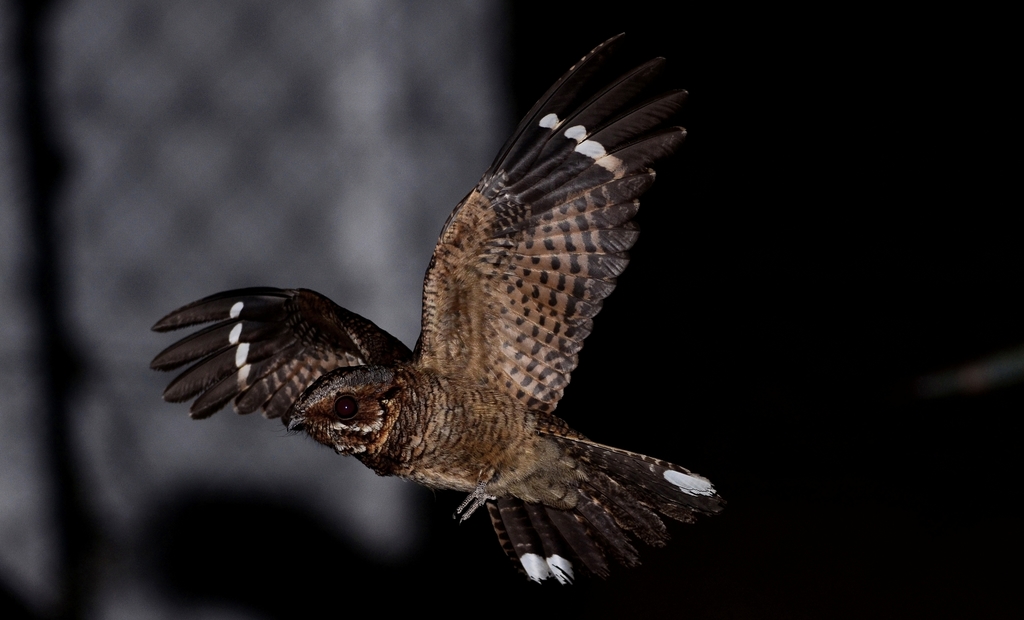
Fiery-necked Nightjar
Live sightings near you, the range map, bar charts of when it is seen, and Macaulay Library photos and recordings.
Fiery-necked Nightjar
Caprimulgus pectoralis
The fiery-necked nightjar (Caprimulgus pectoralis) is a species of nightjar in the family Caprimulgidae, which is found mostly in Africa south of the equator, though it has been spotted in a few countries north of the equator. It is most often found in woodland savannas or other deciduous woodlands. It is usually distinguished by its tawny coloured collar which gives the species its common name. It has a distinctive call that many have rendered as 'good-lord-deliver-us'. The fiery-necked nightjar is an insectivorous species that mostly eats butterflies, moths and other insects. The fiery-necked nightjar breeds after the dry season and typically produce two clutches with two eggs per clutch.
From the article Fiery-necked nightjar on Wikipedia (CC BY-SA), quoted section by section
Description
An adult fiery-necked nightjar is relatively small measuring between 23 and 25 centimeters. Their plumage is mostly a variegated grayish-brown and brownish-white colour. The fiery-necked nightjar has a distinct rufous collar, which are tawny coloured feathers located at the back of the neck, giving the species its common name. They have a large white throat patch. The feathers around their eyes and at their shoulders are chestnut brown. They have a light colored crown at the top of their head with a darker spot at the center. Black spots run down on either side the scapulas. Their under feathers are brown, speckled and barred brownish white. Their tail is roughly square-shaped. The fiery-necked nightjar's beak is darkly coloured and its eyes are entirely black. This species is also sexually dimorphic. The male has white spots on the four outermost wing feathers (the primaries) and white tips on the two outermost tail feathers. These white spots are much smaller and a bit more buff-coloured on the female. The fiery-necked nightjar have long rictal bristles (or stiff hair-like feathers) around their beak which is usually a distinguishing feature in nightjars. These rictal bristles can grow up to 20 mm long and the fiery-necked nightjar can have up to 8 of them on either side of their face. The rictal bristles take 18 days to grow on newly born chicks. …
Range & habitat
The fiery-necked nightjar is widely distributed across most of south-eastern Africa, namely South Sudan, Kenya, central Tanzania, Congo and the Democratic Republic of Congo, Angola, Namibia, Botswana and South Africa. It has also been seen in some central and west African countries like Gambia, Senegal, western Sierra Leone, Nigeria, and Cameroon. The fiery-necked nightjar always stays within the African continent. It will only migrate back to the same breeding location every year for breeding season, but it never strays too far from its homerange. It is a terrestrial bird species. It is usually found in forests, savannas, shrublands and grasslands. It is most common to encounter this nightjar species in Brachystegia dominated woodland savannas but also in other deciduous woodlands in southern Africa. It can also be found in scrublands with acacia and eucalyptus plantations and sometimes in suburban gardens surrounded by trees.
Wikipedia: “Distribution and habitat”
What it does
The fiery-necked nightjar is an insectivore, meaning it feeds on mostly insects. Species from almost every insect family have been recorded to be in their diet, however, there are certain insects they tend to prefer. In fact, butterflies, moths, beetles, cockroaches, termites and mantids were found most often when the fiery-necked nightjar diet was analyzed. To forage for these insects, the fiery-necked nightjar uses a technique called "hawking". This consists of the bird swooping off of a perch to catch an insect while in flight. When feeding their hatchlings, the parents only feed them when the chick grasps the parents beak.
Wikipedia: “Food and feeding”
Listen
Looking for field recordings…
Where it lives
Recorded sightings
—
geo-referenced records in GBIF, from museums, herbaria and field observers.
Drag the globe to turn it. Dots are where records exist, not a range map; darker means more records.
In the stacks
Searching the stacks…
Every page naming Caprimulgus pectoralis in the Biodiversity Heritage Library →
This page is assembled live from iNaturalist, GBIF, Wikipedia, the Source Library and the Internet Archive. It is not yet part of the hand-edited codex. iNaturalist taxon 19392.