On eBird ↗
Indian Nightjar
Live sightings near you, the range map, bar charts of when it is seen, and Macaulay Library photos and recordings.
Indian Nightjar
Caprimulgus asiaticus
The Indian nightjar (Caprimulgus asiaticus) is a small nightjar which is a resident breeder in open lands across South Asia and Southeast Asia. Like most nightjars it is crepuscular and is best detected from its characteristic calls at dawn and dusk that have been likened to a stone skipping on a frozen lake - a series of clicks that become shorter and more rapid. They are sometimes spotted on roads when their eyes gleam red in the spotlight of a vehicle. There is considerable plumage variation across its range and can be hard to differentiate from other nightjars in the region especially in the field.
From the article Indian nightjar on Wikipedia (CC BY-SA), quoted section by section
Description
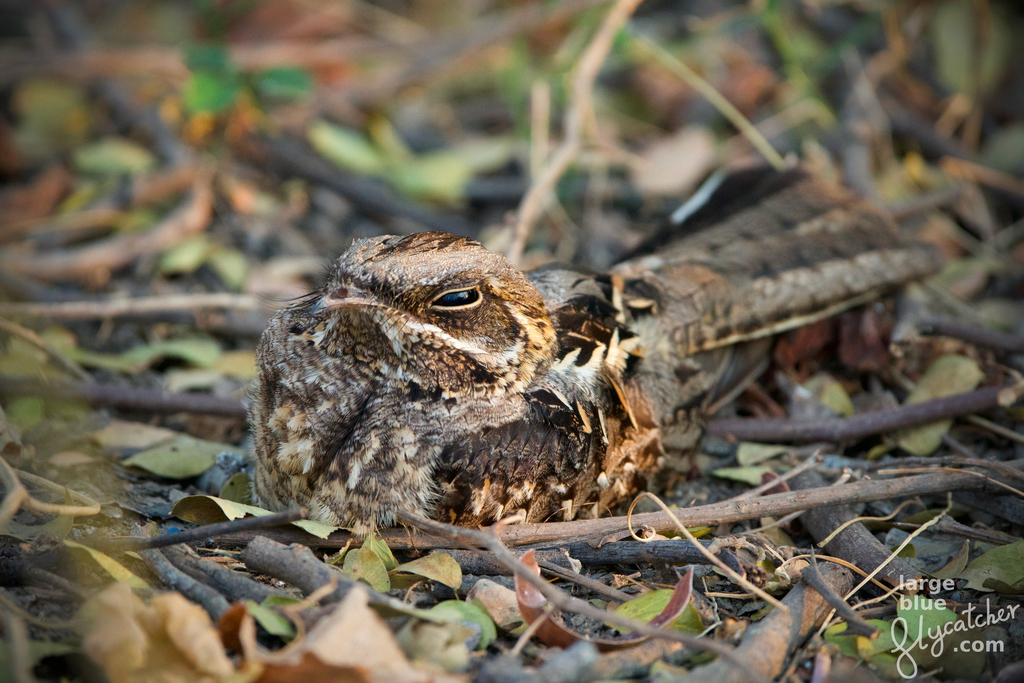
This nightjar is small and short-tailed with white corners to the tail, a golden nape and collar, dark cheeks and white patches on the sides of the throat. The crown is grey and the breast is finely barred in brown. The males have more white on the tail while the female is more heavily streaked on the crown. It is differentiated from Sykes's nightjar by the dark undertail and from Jerdon's nightjar by the shorter tail and white patches on the sides of the throat. The call is distinctive and has been likened to a stone skipped on a frozen lake (due to which it was also called the "ice-bird" in colonial India) or a ping-pong ball bouncing rapidly and coming to rest. It flies after sundown with an easy, silent moth-like flight. During the day, Indian nightjar lies still on the ground, concealed by its plumage; it is then difficult to detect, blending in with the soil.
Range & habitat
The species is found in open woodland, scrub, and cultivation. It usually sits on the ground or low trees and is not found on high perches. The species is found from northwestern India and adjoining parts of Pakistan but not found in the arid desert region. It is found south of the Himalayas in the low elevations east to Bangladesh, Myanmar and Vietnam. It is also found in Sri Lanka. No nest is made; the two beautifully marbled creamy pink eggs are placed upon the bare ground during February to September; the brooding bird, sitting closely, is well camouflaged. Eggs may be moved short distances. The newly hatched chick is covered in down with brown above and light rufous below. The eye is open on hatching and the chick can sit upright and make a weak sound.
Wikipedia: “Habitat and distribution”
What it does
Nightjars are most active, and mostly feed, near dawn and dusk (crepuscular - active during the twilight). At dusk, they often fly around livestock to feed on insects swarming around the animals. At night, they like to take advantage of insects swarming around street lamps or other artificial light sources. They are keeping their bills wide open as they fly through clouds of small insects. Nightjars may also forage under the canopy by flying from favored perches catching insects at foliage heights of 5 – 15 feet (~1.5 – 5 m). Larger insects are usually taken back to their favored feeding perches. While holding the insects in their bills, nightjars keep the head upright, shake and swallow the prey whole, or they may break the insects apart before eating. Insects may also be taken from the ground or foliage. Juvenile nightjars typically sit on the ground before making short jumps or flights to capture insects. The bulk of their diet consists of flying / swarming insects, such as mosquitoes, flies, beetles, locusts, winged ants, moths and grasshoppers, as well as plant lice and crickets. To a lesser extent, they will also eat larvae, nymphs and eggs. This common species frequently rests on roads during the night, sometimes capturing insects under street lights. Their bright reflective eye-shine makes them easy to spot in the beams of vehicle headlights. …
Wikipedia: “Feeding”
Listen
Looking for field recordings…
Where it lives
Recorded sightings
—
geo-referenced records in GBIF, from museums, herbaria and field observers.
Drag the globe to turn it. Dots are where records exist, not a range map; darker means more records.
In the stacks
Searching the stacks…
Every page naming Caprimulgus asiaticus in the Biodiversity Heritage Library →
This page is assembled live from iNaturalist, GBIF, Wikipedia, the Source Library and the Internet Archive. It is not yet part of the hand-edited codex. iNaturalist taxon 19455.