On eBird ↗
Savanna Nightjar
Live sightings near you, the range map, bar charts of when it is seen, and Macaulay Library photos and recordings.
Savanna Nightjar
Caprimulgus affinis
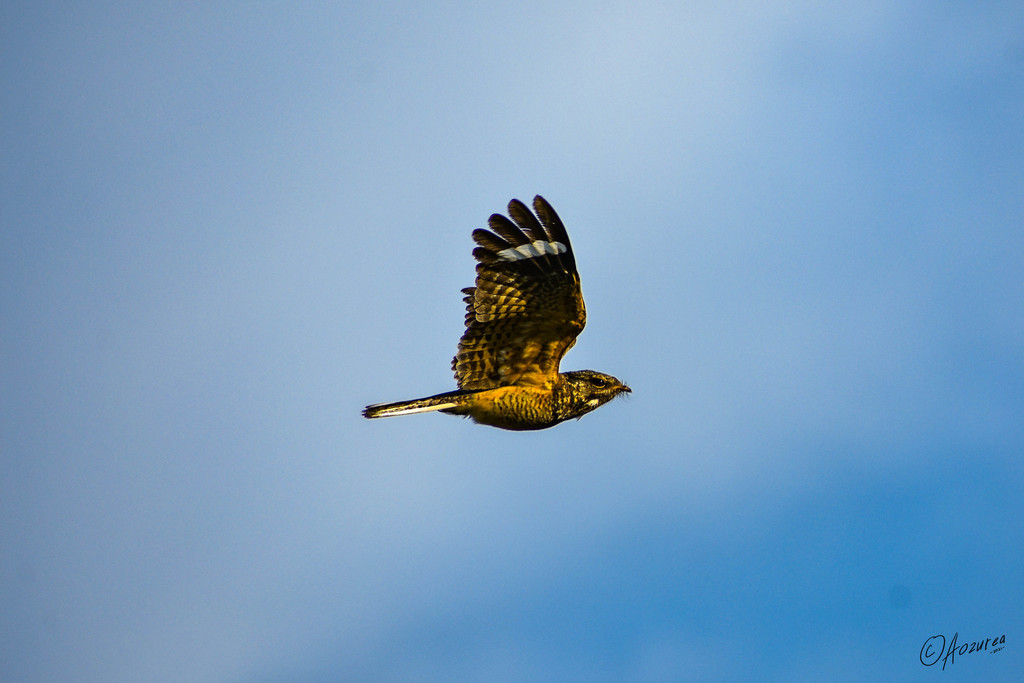
The savanna nightjar (Caprimulgus affinis), also known as allied nightjar or Franklin's nightjar, is a species of nightjar found in South and Southeast Asia. The IUCN Red List has assessed the species to be of least concern because it has a large range and its population trend is stable. As other nightjars, this nocturnal bird is characterised by its large eyes, gaping mouth and excellent camouflage. It can be distinguished from similar south Asian nightjar species, like the chirruping nightjar, by its unique vocalisations.
From the article Savanna nightjar on Wikipedia (CC BY-SA), quoted section by section
Description
The savanna nightjar measures 20-26cm in length, has a body weight of 54-110g, and a wingspan of 64cm, with size varying by subspecies, ranging from small to medium-large. Like other nightjars, they have long pointed wings and small legs and feet, indicating their reliance on flight over walking. The bill is wide, revealing a large gape when opened, and is surrounded by facial feathers, called rictal bristles. Their vermiculated grey-brown plumage, characteristic of all nightjars, makes them difficult to tell apart from other species based on sight alone. However, males and females do exhibit sexual dimorphism and can be distinguished based on the presence of white throat patches. Male savanna nightjars have distinct white patches on their throat, tail and wings. In comparison, females have subtle throat patches, a red tint to their feathers and a lack of white patches on the tail. Immature and juvenile savanna nightjars resemble adult females, they lack white patches and have mottled colouration.
Range & habitat
The savanna nightjar has a widespread range stretching from northern Pakistan to Indonesia, with different subspecies occupying different parts of the range. Populations are widely distributed in south China, Pakistan, India, Indonesia and Taiwan, where they occupy low-land open grasslands, sugar cane plantations, wheat fields, or rocky soils around rivers and streams. With the increase of urban development across southern Asia, the roofs of tall buildings have proven to be an ideal nesting site for savanna nightjars, a phenomenon observed in Indonesia and Taiwan. The migration of savanna nightjars is poorly understood, as different subspecies vary from nonmigratory to locally migratory. C. a. Monticolus migrates through the Punjab plains to northeastern Pakistan for summer breeding.
Wikipedia: “Habitat and distribution”
What it does
Breeding season of the savanna nightjar varies among subspecies, occurring from March–August in the western range and March–January in the eastern range. Typical of most nightjar species, the savanna nightjar nests in open and exposed places. Nests are not constructed, instead eggs are laid on the ground in low-elevation rocky soils or open spaces. 1–2 pale pink, blotched eggs are laid, which camouflage into the stones surrounding them. The eggs are incubated by the female, while the male parent guards the nest. Incubation time is unknown. Being precocial, savanna nightjar chicks are active and mobile 4 days after hatching. Parents defend their eggs and young by feigning injury, a behaviour which provides an advantage to birds nesting in open areas, where they are more vulnerable to predators than cavity nesters. To divert the attention of predators, savanna nightjar parents will act injured or crippled, luring the predators away from the nest at the risk of their own survival. As with adult savanna nightjars, the chicks exhibit excellent camouflage to provide them added protection.
Wikipedia: “Reproduction”
Listen
Looking for field recordings…
Where it lives
Recorded sightings
—
geo-referenced records in GBIF, from museums, herbaria and field observers.
Drag the globe to turn it. Dots are where records exist, not a range map; darker means more records.
In the stacks
Searching the stacks…
Every page naming Caprimulgus affinis in the Biodiversity Heritage Library →
This page is assembled live from iNaturalist, GBIF, Wikipedia, the Source Library and the Internet Archive. It is not yet part of the hand-edited codex. iNaturalist taxon 19466.