- Animals
- ›Chordates
- ›Vertebrates
- ›Ray-finned Fishes
- ›Spiny-rayed fishes
- ›Jacks, Flounders, Barracudas, and Allies
- ›Jacks, Remoras, and Allies
- ›Jacks
- ›Caranginae
- ›Trachurus
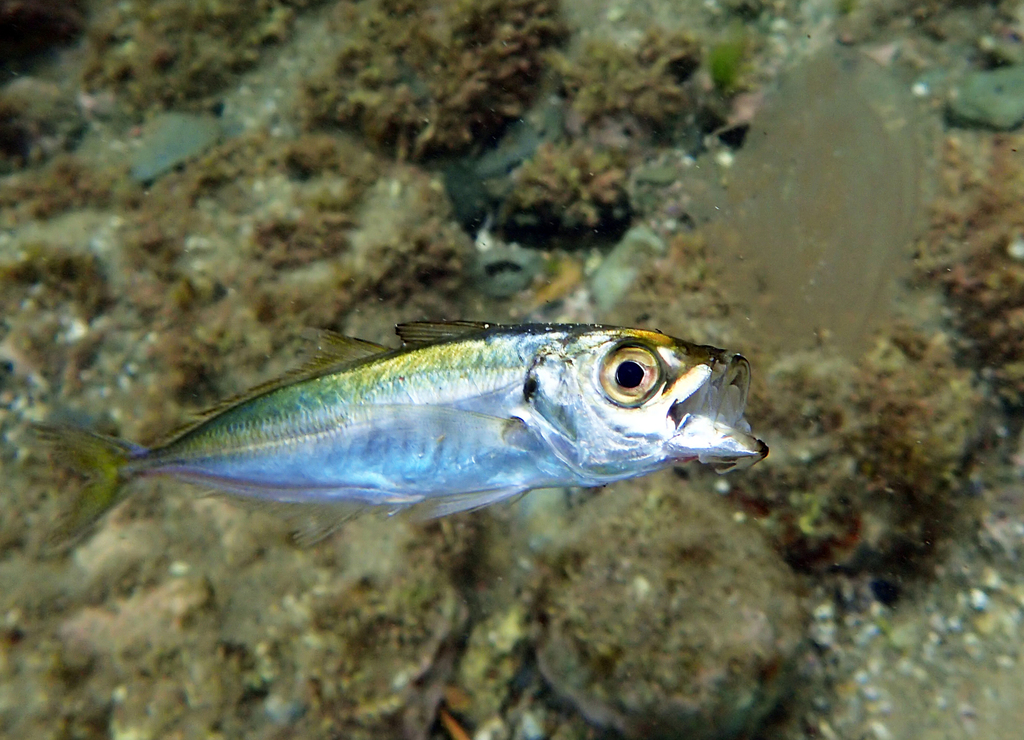
Japanese Horse Mackerel
Trachurus japonicus
The Japanese jack mackerel (Trachurus japonicus), also known as the Japanese horse mackerel or Japanese scad, is a species named after its resemblance to mackerel but which is in the family Carangidae, the jacks, pompanos, trevallies and scads. Their maximum reported length is 50 cm (20 in) with a common length of 35 cm (14 in). They have a maximum reported weight of 0.66 kg (1.5 lb) and a maximum reported age of 12 years. They are found around the coast of Japan, except Okinawa Island, usually on sandy bottoms of 50–275 m (164–902 ft) deep. They feed mainly on small crustaceans such as copepods, as well as shrimp and small fish. They are similar to the yellowtail horse mackerel around New Zealand and Australia, apart from having more gill rakers and larger eyes.
The Japanese name for the horse mackerel is aji (あじ) and by default generally implies the species Trachurus japonicus, which can be more specifically referred to as ma-aji (まあじ; lit. 'true aji'). The name is most commonly written in hiragana; although a kanji (鯵・鰺) does exist, it is not in common use. It is commonly deep fried or salt-grilled.
From the article Japanese jack mackerel on Wikipedia (CC BY-SA), quoted section by section
Description
The Japanese jack mackerel (Trachurus japonicus) is a small fish with an average length between 13 – 40 cm, and a maximum recorded size of 50 cm. It is greyish blue on its back, having a silver color on its underside, with a black blotch over the gills. The dorsal and pectoral fins are a dusky color whereas the pelvic and anal fins are pale. One of the main distinguishing features of the Japanese Jack Mackerel is its bright yellow caudal fin which stands out compared to the rest of the species' coloration. Its scales are common among other species in its family, being dense in a horizontal and coarse in a vertical direction with a bend in the midpoint of the scale to follow the curvature of the animal. Scales on anterior half of the species have this curve, while those on the posterior half are straight, with any scales in between these two sections being pointed. The spine of the species consists of 14 vertebrae connected to the dorsal fin, with another 10 vertebrae on the underside of the animal all with fine ridges lining them, common with other species in the family Trachurus. The dorsal fin is split into two sections, the front set consisting of eight bony spines, and the rear set having one bony spine and another 25 – 27 soft rays, depending on the size of the individual. All these fins are controlled by 3 muscles and many ligaments. …
Range & habitat
The Japanese jack mackerel generally lives in and around the East China Sea and Sea of Japan, in tropical regions between the coordinates of 46°N – 13°N and 105°E – 148°E. Although these are the main population grounds of the Japanese Jack Mackerel, they are also found in southern Japan, the Korean peninsula and in the Pacific Ocean off the coast of southeast Asia, primarily in Taiwan. These locations vary depending on the temperature of the water primarily, and thus vary with the seasons, with a higher density of Japanese Jack Mackerel in the southern and central china seas in the colder months. The ideal condition for the species ranges between 15 – 26 °C, with an ideal temperature of around 21 °C. With the temperature varying between the northern and southern areas of the East China Sea by around 3 – 5 °C, migration between these regions is a highly beneficial strategy for the species, especially during maturation [6]. There are many spawning grounds for the Japanese Jack Mackerel, all of which make use of the Kuroshio and Warm Tsushima Currents to migrate into the Japan or East China seas. The primary spawning grounds are along the warm coastal waters of Japan, with a large portion being around the region of Kyushu and southern Japan. …
Wikipedia: “Distribution and habitat”
What it does
The life cycle of the Japanese jack mackerel starts in the late winter and tend to spawn around late April to early July, as water temperatures begin to rise allowing larvae and juveniles to thrive. as an egg 0.87 – 0.9mm in diameter with a light brown oil globule 0.17 – 0.22mm in diameter which constitutes the yolk of the egg. The location for spawning is dictated by several factors including phytoplankton productivity and migrating ability, but primarily temperature. The eggs are Pelagic, therefore float freely through the open sea and continue to do so as larvae. Once hatched, the larvae are 2.3 – 2.5mm in length and continue to carry the yolk sack beyond the anterior margin of the head. This continues until the 4th day after hatching where the yolk sack is completely absorbed. Development continues for 29 days before reaching the juvenile stage where the dorsal, pelvic, and anal rays and fins are developed, and the body is elongated to around 10 – 13 cm. Throughout the juvenile stages, scutes and scales fully develop as well as rays on the pectoral and caudal fins until reaching full maturity at around 60 days after hatching and reaching an average length of around 35 cm.
Wikipedia: “Life cycle”
At the table
The Japanese jack mackerel is a fish predominantly caught using trawls, purse seines, traps, and on line gear. Due to the overfishing and exploitation of wild populations of Japanese Jack Mackerel and their major role in ocean ecosystems, annual catching limits have been applied since 1997. This limitation has seen a drastic decrease in Jack Mackerel yields from up to 550,000 tons/year down to between 210,000 – 330,000 tons/year. Most of the fish used commercially and for food globally is caught in the wild, with only a small percentage being bred through aquaculture productions. Aquaculture of the Japanese Jack Mackerel, similarly, capture production has dropped drastically over the year, with now less than 1000 tons/year being produced, compared to the 7000 tons produced in the early 1990s.
Japanese jack mackerel are used in a few ways once caught and are generally canned for use in various dishes or turned into fish meal. Some traditional Japanese dishes use jack mackerel as a key ingredient; it is commonly prepared as a form of furai (aji-furai あじフライ), salt-grilled (shioyaki-aji 塩焼きあじ), or used raw in sushi or as sashimi. In Korean cuisine, the jack mackerel is similarly used deep fried or grilled, and occasionally used in soups.
Wikipedia: “Food”
In human culture
Although not a strong cultural icon, the Japanese jack mackerel is used in a large portion of both Japanese and Korean dishes and are an important global export for Japanese fisheries. Additionally, due to the spawning grounds being tied to the Japanese coastal waters, efforts have been made by Japanese fisheries to prevent their exploitation.
Wikipedia: “Culture”
Where it lives
Recorded sightings
—
geo-referenced records in GBIF, from museums, herbaria and field observers.
Drag the globe to turn it. Dots are where records exist, not a range map; darker means more records.
In the stacks
Searching the stacks…
Every page naming Trachurus japonicus in the Biodiversity Heritage Library →
This page is assembled live from iNaturalist, GBIF, Wikipedia, the Source Library and the Internet Archive. It is not yet part of the hand-edited codex. iNaturalist taxon 194666.