- Animals
- ›Chordates
- ›Vertebrates
- ›Ray-finned Fishes
- ›Spiny-rayed fishes
- ›Jacks, Flounders, Barracudas, and Allies
- ›Jacks, Remoras, and Allies
- ›Jacks
- ›Naucratinae
- ›Seriola
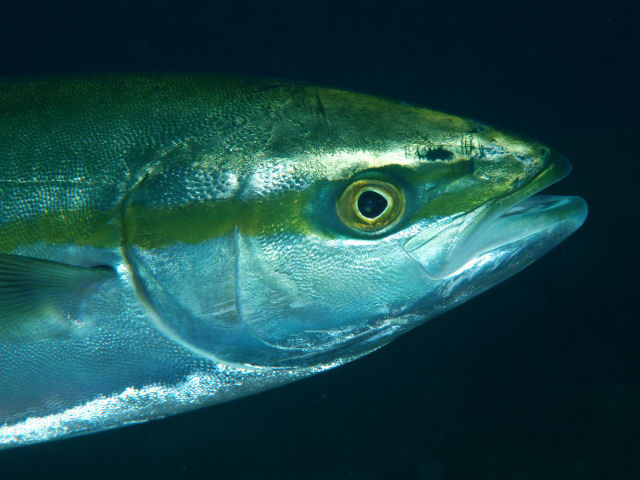
Japanese Amberjack
Seriola quinqueradiata
The Japanese amberjack or yellowtail, Seriola quinqueradiata, is a species of jack fish in the family Carangidae, native to the northwest Pacific Ocean. It is known as shiyu (鰤魚) in China, bang'eo (방어) in Korea, and buri (鰤) or hamachi (魬) in Japan.
Although it is frequently listed on menus as "yellowtail tuna", it is a fish of an entirely different family, the Carangidae, rather than the family Scombridae that includes tunas, mackerels, and bonitos.
From the article Japanese amberjack on Wikipedia (CC BY-SA), quoted section by section
Description
Japanese amberjack usually grows to around 1 meter in length, though some can reach 1.5 meters. They have a characteristic yellow band that runs horizontally along the length of the body, as well as a yellow tail, hence their name.
At the table
The fish is highly appreciated in Japan, where it is called hamachi or buri. They are eaten either cooked or raw and are a seasonal favourite in the colder months when the meat has a higher fat content. Amberjack is typically thought of as a winter delicacy of Toyama and the Hokuriku region. Some of the fish consumed are caught wild, but a substantial amount is farmed (about 120,000 tonnes per year). To populate the pens, every May, workers fish for the small wild fry (called mojako), which can be found under floating seaweed. They scoop out the seaweed together with the mojako and put the mojako in cages in the sea. The small fry grow until they reach 10 to 50 grams in mass; the fry are called inada in eastern Japan (Kantō). They are then sold to aquaculturists, who grow them until they reach 3 kilograms (youth, called hamachi) or 5 kilograms (adult, called buri).
Wikipedia: “As food”
Where it lives
Recorded sightings
—
geo-referenced records in GBIF, from museums, herbaria and field observers.
Drag the globe to turn it. Dots are where records exist, not a range map; darker means more records.
In the stacks
Searching the stacks…
Every page naming Seriola quinqueradiata in the Biodiversity Heritage Library →
This page is assembled live from iNaturalist, GBIF, Wikipedia, the Source Library and the Internet Archive. It is not yet part of the hand-edited codex. iNaturalist taxon 194667.