- Animals
- ›Chordates
- ›Vertebrates
- ›Ray-finned Fishes
- ›Spiny-rayed fishes
- ›Perches, Scorpionfishes, Sticklebacks, and Allies
- ›Icefishes and allies
- ›Cod Icefishes
- ›Pleuragrammatinae
- ›Dissostichus
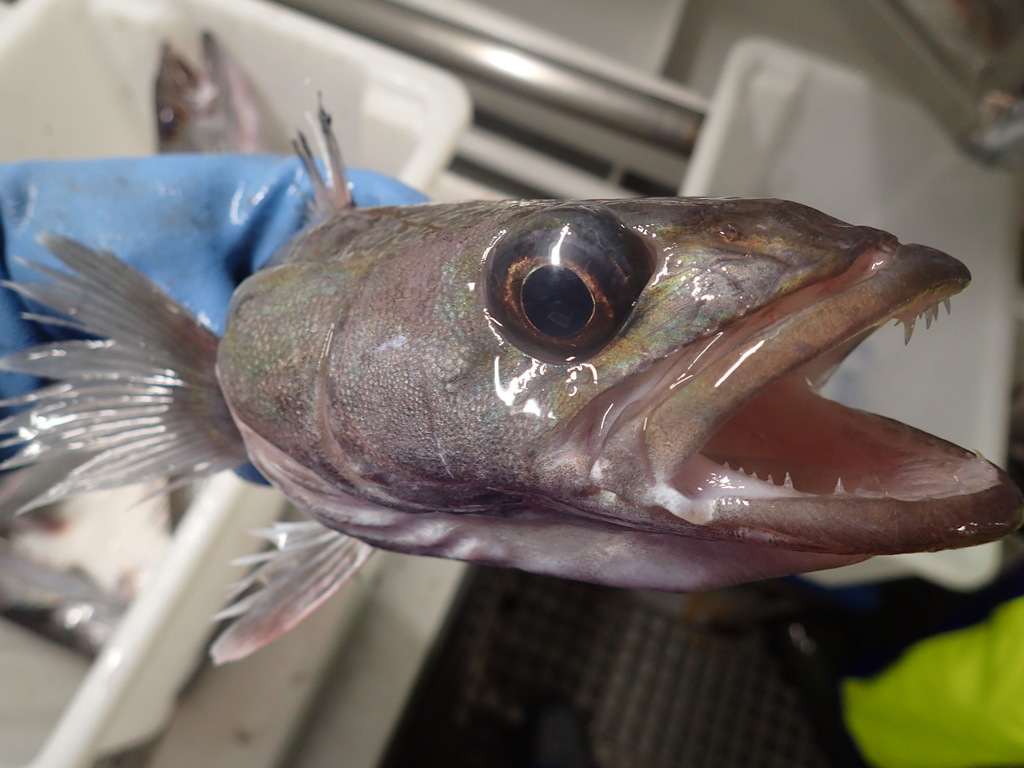
Patagonian Toothfish
Dissostichus eleginoides
The Patagonian toothfish (Dissostichus eleginoides), also known as Chilean sea bass and mero, is a species of notothen found in cold waters (1–4 °C or 34–39 °F) between depths of 45 and 3,850 m (150 and 12,630 ft) in the southern Atlantic, Pacific, and Indian Oceans and Southern Ocean on seamounts and continental shelves around most Subantarctic islands.
The average weight of a commercially caught Patagonian toothfish is 7–10 kg (15–22 lb), depending on the fishery, with large adults occasionally exceeding 100 kg (220 lb). They are thought to live up to 50 years and to reach a length up to 2.3 m (7.5 ft). Several commercial fisheries exist for Patagonian toothfish, which are detailed below.
From the article Patagonian toothfish on Wikipedia (CC BY-SA), quoted section by section
Description
The Patagonian toothfish has a streamlined, fusiform body that has a depth that fits into its standard length 5 to 6.4 times. It has a flattened head with a wide, flat area between the eyes. The snout is longer than the diameter of the eyes. The mouth is large, extending past the middle of the eye. There are two rows of teeth in the upper jaw, the teeth in the outer row being the larger and canine-like. The lower jaw has a row of spaced canine-like teeth. Additional canine-like teeth are found outside the teeth rows at the joint of the upper and lower jaws. There are two lateral lines; both made up of tubed scales, an upper one and another along the mid flanks. The upper lateral line has 88–104 scales while the lower line has 61–77 scales. The first dorsal fin has 8 to 10 spines; the second dorsal fin has 28 to 30 soft rays, while the anal fin also has 28–30 soft rays. The caudal fin is emarginate. The pectoral fins are large and shaped like fans. The head and body are covered in ctenoid scales except for the front of the head. This species attains a maximum total length of 215 cm (85 in) although 70 cm (28 in) is more typical, and a maximum published weight of 200 kg (440 lb). The overall colour is brownish-grey with darker blotches.
Range & habitat
The Patagonian toothfish is found in the southeastern Pacific and southwestern Atlantic Oceans. It occurs in southern Chile around the coast of Patagonia, in Argentina, and the Falkland Islands. It has also been recorded at Macquarie Island in the southwestern Pacific Ocean and the Southern Ocean at South Georgia and from the sub-Antarctic islands and seamounts of the Indian Sector. There is a single record of a vagrant from the Davis Strait in the northwestern Atlantic Ocean off Greenland, it is thought that this individual migrated over 10,000 km (6,200 mi) and that it transited across the tropical areas in deep, cold regions of the ocean. The juveniles are semi-pelagic, becoming demersal at depths between 150 and 400 m (490 and 1,310 ft). Adults move to deeper habitats, being found at depths in excess of 1,000 m (3,300 ft).
Wikipedia: “Distribution and habitat”
At the table
Patagonian toothfish is listed by the Monterey Bay Aquarium on its Seafood Watch list and pocket guides. In April 2013, Seafood Watch produced an updated report, indicating new ratings for some fisheries, which allocates about 78% of toothfish caught worldwide, which are:
Best Choice – Heard Island and McDonald Islands Fishery (Australia), Macquarie Island Fishery (Australia), Falkland Islands Fishery Good Alternative – South Georgia Fishery, Kerguelen Islands Fishery (France), Ross Sea Antarctic toothfish Fishery Avoid – Prince Edward & Marion Island Fishery (South Africa), Chile, Crozet Islands Fishery (France) Not Rated – Argentina In 2010, Greenpeace International added the Patagonian toothfish to its seafood red list. "The Greenpeace International seafood red list is a list of fish that are commonly sold in supermarkets around the world, and which have a very high risk of being sourced from unsustainable fisheries." Greenpeace have not updated their rating of toothfish since the 2013 Monterey Bay Aquarium review.
Wikipedia: “Seafood chooser organizations”
Where it lives
Recorded sightings
—
geo-referenced records in GBIF, from museums, herbaria and field observers.
Drag the globe to turn it. Dots are where records exist, not a range map; darker means more records.
In the stacks
Searching the stacks…
Every page naming Dissostichus eleginoides in the Biodiversity Heritage Library →
This page is assembled live from iNaturalist, GBIF, Wikipedia, the Source Library and the Internet Archive. It is not yet part of the hand-edited codex. iNaturalist taxon 194676.