- Animals
- ›Chordates
- ›Vertebrates
- ›Ray-finned Fishes
- ›Spiny-rayed fishes
- ›Jacks, Flounders, Barracudas, and Allies
- ›Jacks, Remoras, and Allies
- ›Jacks
- ›Caranginae
- ›Gnathanodon
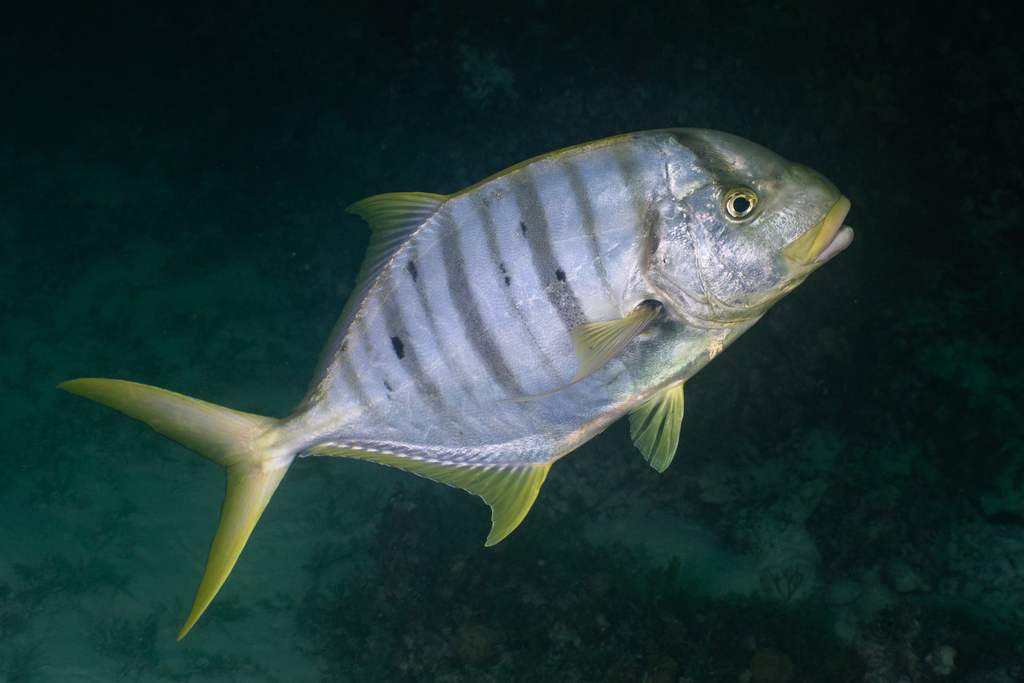
Golden Trevally
Gnathanodon speciosus
The golden trevally (Gnathanodon speciosus), also known as the golden kingfish, banded trevally or king trevally, is a species of large marine fish classified in the jack and horse mackerel family Carangidae, and the only member of the monospecific genus Gnathanodon. The golden trevally is widely distributed throughout the tropical and subtropical waters of the Indian and Pacific Oceans, ranging from South Africa in the west to Central America in the east, extending to Japan in the north and Australia in the south. The species predominantly occupies inshore waters where it inhabits both reef and sandy substrates.
The golden trevally is easily distinguished from its relatives by its fleshy, rubbery lips and unique colouration, which ranges from bright yellow with black bars as a juvenile to a golden-silvery colour as an adult. It is known to grow to 120 centimetres (47 in) in length and 15 kilograms (33 lb) in weight. The golden trevally schools as a juvenile, often closely following larger objects including sharks and jellyfish. The species uses its protractile jaws to suck out prey from the sand or reef, and consumes a variety of fish, crustaceans and molluscs. Spawning aggregations gather at night at different times of the year throughout its range. The golden trevally is a considerable constituent of several Middle Eastern fisheries and being of minor importance to many others, with a worldwide annual catch of 1,187 metric tons (1,168 long tons; 1,308 short tons) to 3,475 metric tons (3,420 long tons; 3,831 short tons) recorded between 2000 and 2010.
From the article Golden trevally on Wikipedia (CC BY-SA), quoted section by section
Description
The golden trevally is a relatively large fish, growing to a maximum recorded size of 120 cm (47 in) in length and 15.0 kg in weight. It is similar to most other trevallies and jacks in having a compressed, oblong body, with the dorsal profile slightly more convex than the ventral profile, particularly anteriorly. The species' mouth is one of its defining features; the mouth is highly protractile and fleshy, with specimens greater than 90 mm having no teeth on the jaws, vomer or tongue. Smaller individuals have a series of small villiform teeth in both jaws. The dorsal fin is in two parts, the first with 7 spines, the second with 1 spine and 18 to 20 soft rays. The anal fin has 2 detached spines followed by 1 spine and 15 to 17 soft rays, while the pelvic fin consists of 1 spine and 19 to 20 soft rays. The curved part of the lateral line is moderately arched; containing 62 to 73 scales, and approximately equal in length to the straight section containing 15 to 27 scales and 18 to 25 scutes. The breast is completely scaled. There are 27 to 30 gill rakers and 24 vertebrae in total. The golden trevally's colour is the species most prominent distinguishing feature, and for which it acquired its common names. Juveniles are a bright golden yellow colour over their entire body and all fins, with 7 to 11 black vertical crossbars all over their body. …
Range & habitat
The golden trevally is widely distributed throughout the tropical and subtropical waters of the Indian and Pacific Oceans. In the Indian Ocean, the species is distributed from South Africa along the east African coastline, including the Red Sea and Persian Gulf. Its distribution extends east along the Indian and South East Asian coastlines, and south through Indonesia and northern Australia. Golden trevally are recorded from many Indian Ocean islands including Madagascar, Seychelles and The Maldives. In the Pacific, the species is spread throughout the South East Asian and Indonesian archipelago north mainland China and Japan and south to eastern Australia and New Zealand. Golden trevally have been recorded from many central Pacific Islands, including Hawaii, with their distribution extending to Central America. Here its range extends from the Gulf of California in the north to Colombia in the south. The golden trevally predominantly occupies inshore waters of varying substrate, although is known to occur on deeper continental shelf reefs in Australia. In coastal areas the species inhabits rocky and coral reefs as well as open sand flats where it forages for food. A systematic study in northern Australia indicated it to be one of the only species to be approximately equally distributed in both reef and soft-bottom habitats. …
Wikipedia: “Distribution and habitat”
What it does
The golden trevally is found either as a solitary individual or in small schools as an adult. Juveniles tend to form larger schools which tend to congregate and follow ( or "pilot") larger fish such as groupers, sharks, and even jellyfish. This behaviour mimics that of the related pilot fish, Naucrates ductor, with their maneuverability protecting them from their hosts, which in turn provides them with protection from predation from other fish. This behaviour extends to scuba divers, with one diver reporting a single young individual obsessively stationing itself in front of his face plate.
Diet and feeding. The golden trevally is a diurnal foraging carnivore which, unlike other carangids, does not normally seek out individual prey items. The highly protractile mouth possessed by the species is used to form a tube to suck prey out of both reef- and algae-dominated habitats, as well as filtering organisms out of sandy substrates. In the latter case, both sand and any prey items are taken into the mouth and filtered through the gill rakers; sand is expelled, while small organisms are trapped and swallowed. The species takes a variety of prey including crustaceans such as shrimp, crabs, and amphipods, as well as molluscs, other fossorial invertebrates in the sand, and small fish. …
Wikipedia: “Biology and ecology”
Where it lives
Recorded sightings
—
geo-referenced records in GBIF, from museums, herbaria and field observers.
Drag the globe to turn it. Dots are where records exist, not a range map; darker means more records.
In the stacks
Searching the stacks…
Every page naming Gnathanodon speciosus in the Biodiversity Heritage Library →
This page is assembled live from iNaturalist, GBIF, Wikipedia, the Source Library and the Internet Archive. It is not yet part of the hand-edited codex. iNaturalist taxon 194896.