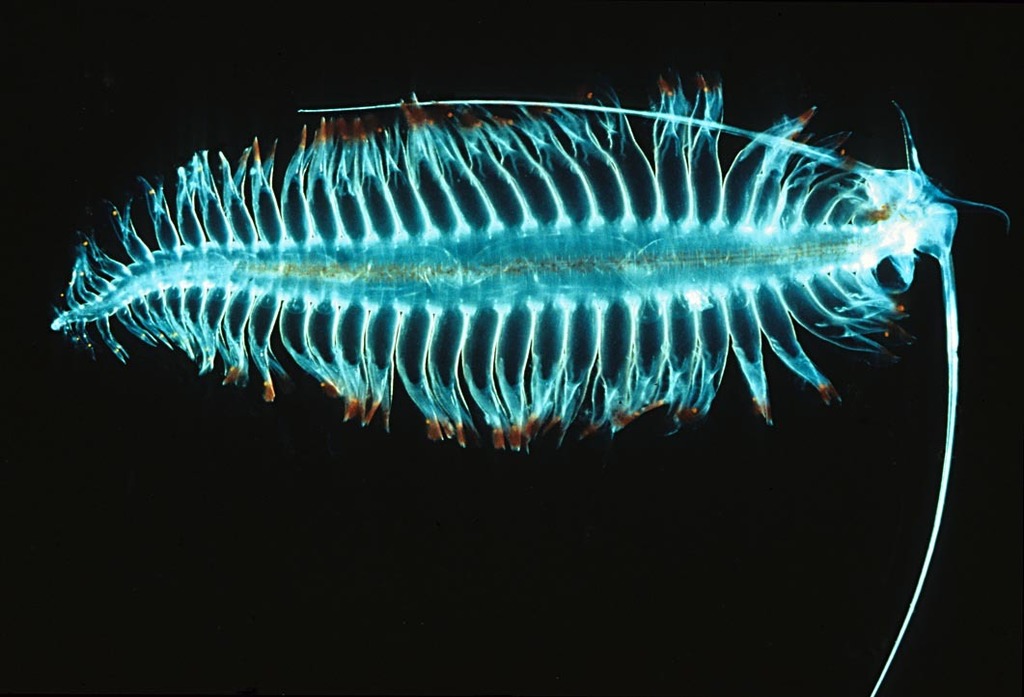
Tomopteridae
Tomopteridae is a family of holopelagic polychaetes belonging to the order Phyllodocida. The genus Tomopteris consist of about 70 species, and the three other genera of one known species each. Length varies from just 1-2 cm to 30 cm. These are very active swimmers, and have some of the highest metabolic rate among annelids. To increase buoyancy they have a large body cavity (coelom) filled with body fluid of a density similar to seawater. With the coelom taking up much of the inner space, the muscular system has been reduced to a mesh just below the epidermis. The circulatory system has been lost, and the coelomic fluid has taken over the role of transporting oxygen, nutrients and gametes. Instead of a heart the inner surface of the worm is covered with cilia that moves the fluid around inside the body. The absence of septa between the segments makes the circulation more efficient. A series of extretory organs called metanephridia consists of ciliated funnels which opens to the coleomic cavity and connects with the exterior though a nephridiopore. Some species are bioluminescent, and produce a yellow light.
Their sperm differ from other annelids in having two tails. Females produce gelatinous egg cases that floats in the water column.
2 branches of this family, most-observed first
See this branch on the Wheel of Life →
Where it lives
Recorded sightings
—
geo-referenced records in GBIF, from museums, herbaria and field observers.
Drag the globe to turn it. Dots are where records exist, not a range map; darker means more records.
In the stacks
Searching the stacks…
Every page naming Tomopteridae in the Biodiversity Heritage Library →
This page is assembled live from iNaturalist, GBIF, Wikipedia, the Source Library and the Internet Archive. It is not yet part of the hand-edited codex. iNaturalist taxon 195012.