On eBird ↗
Bates's Nightjar
Live sightings near you, the range map, bar charts of when it is seen, and Macaulay Library photos and recordings.
Bates's Nightjar
Caprimulgus batesi
The Bates's nightjar or Forest nightjar (Caprimulgus batesi) is a species of nightjar in the family Caprimulgidae, which is found in the rainforests of western Sub-Saharan Africa.
From the article Bates's nightjar on Wikipedia (CC BY-SA), quoted section by section
Description
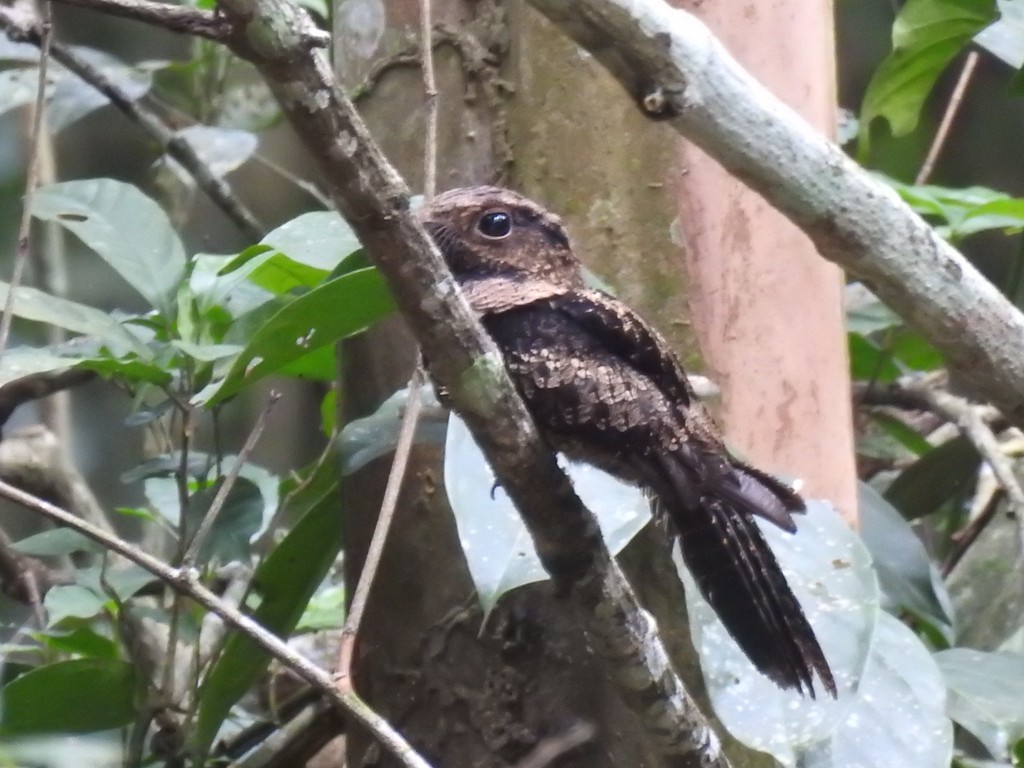
Bates's nightjar is a large, dark nightjar. At rest looks large headed and long tailed. The upperparts and wing coverts are dark brown marked with black and buff streaks and spots, with a normally indistinct buff collar on the hindneck which may be more obvious on some individuals. The underparts are blackish brown with buff speckling on the breast, becoming barred on the belly, the throat is whitish. In flight the male shows a small white spot towards the wingtip and white tips to the two outer tail feathers. The female is paler and lack white spots on the wings or outer tail. They measure 29–31 cm in length and weigh 89–112g.
Voice. The song of Bates's nightjar is a loud "whow whowwhowwhowwhow" in which following the first note there is a pause then a repeated series of notes.
Range & habitat
Bates's nightjar has a fragmented distribution, one population is found in southern Cameroon, another in western Cameroon, Gabon, southern Central African Republic and western Congo, a third slightly separate in the western Congo, with another in eastern Congo and north-western Democratic Republic of the Congo, a fifth population ranges across the Democratic Republic of the Congo and into eastern Uganda in the Bwamba Forest while the last population is in the central Democratic Republic of the Congo.
Wikipedia: “Distribution”
What it does
Like most nightjars, Bates's nightjar is crepuscular and nocturnal. It roosts on the ground, in clearings or on paths, or several metres up perched on a liana. Forages for prey such as mantises, crickets, grasshopper, beetles and moths over and within the forest canopy, over clearings and along the edges of riverine forest. It does not build a nest and the single egg is laid directly onto the bare ground or among the leaf litter, nest site are sometimes on paths or trails. The breeding season is December to January in Gabon and potentially all tear in Democratic Republic of Congo.
Wikipedia: “Behaviour”
Listen
Looking for field recordings…
Where it lives
Recorded sightings
—
geo-referenced records in GBIF, from museums, herbaria and field observers.
Drag the globe to turn it. Dots are where records exist, not a range map; darker means more records.
In the stacks
Searching the stacks…
Every page naming Caprimulgus batesi in the Biodiversity Heritage Library →
This page is assembled live from iNaturalist, GBIF, Wikipedia, the Source Library and the Internet Archive. It is not yet part of the hand-edited codex. iNaturalist taxon 19529.