On eBird ↗
Diabolical Nightjar
Live sightings near you, the range map, bar charts of when it is seen, and Macaulay Library photos and recordings.
Diabolical Nightjar
Eurostopodus diabolicus
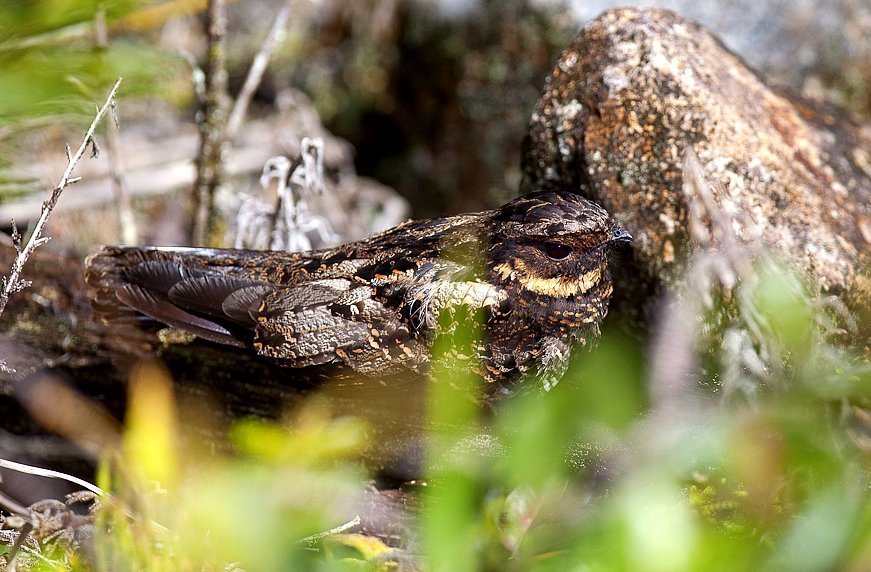
The Satanic nightjar (Eurostopodus diabolicus), also Heinrich's nightjar, satanic eared-nightjar, Sulawesi eared-nightjar, Satanic goatsucker or diabolical nightjar is a mid-sized, spotted, dark brown nightjar endemic to the Indonesian island of Sulawesi. The species was discovered in 1931 by Gerd Heinrich, a German natural historian who collected a single female holotype from Mount Klabat on the Minahasa peninsula of Northern Sulawesi.
In the following decades, there were a few unconfirmed reports of sightings and calls of the bird, but it did not officially resurface until 1996 when David Bishop and Jared Diamond positively identified it in Lore Lindu National Park by its sound. This made the visible rediscovery available for multiple people in the tour group including poet and writer Jan Zwaaneveld. This increased the bird's estimated range by 750 km (470 mi). It has since been observed and described in literature multiple times.
From the article Satanic nightjar on Wikipedia (CC BY-SA), quoted section by section
Description
The Satanic nightjar measures about 27 cm (11 in) long. It has a white to buff-colored collar at its throat, blackish head, greyish-brown back, barred brown belly, and white spots on its 3rd and 4th outer primaries. It can be distinguished from other nightjars in the area by its dark color and the absence of ear tufts, white tail, and wing patches.
Range & habitat
The Satanic nightjar is restricted to Sulawesi, Indonesia. It inhabits lowland and mountain rainforests of the region from 250 to 2,300 metres (820 to 7,550 ft) above sea level. It seems to favour edge habitats with low canopies and groves of palms and rattans. It can be found in forest clearings, as well as open spaces created by roads and trails in old-growth forests. While it has mostly been sighted in the north and central parts of the island, its range could extend over all of Sulawesi.
Wikipedia: “Distribution and habitat”
What it does
Like other nightjars, this bird preys on insects while flying. It hunts along the forest edge, active near dusk and dawn. However, little is known about its diet. It is thought to feed primarily on nocturnal insects such as moths.
Wikipedia: “Diet”
In human culture
The Satanic nightjar's common and Latin name originate from interpretations of its vocalizations. Some authors report that in flight, the bird makes a "plip-plop" call like dripping water, which locals have also likened to the sound of the bird pulling out a person's eye. However, this description may be wrongly attributed to this species as it does not agree with more recent accounts of the bird's call. It is also sometimes called Heinrich's nightjar, the diabolical nightjar, the devilish nightjar, the Sulawesi nightjar and other names. These last three names have largely fallen out of use. Its common names sometimes also include the word "eared" despite its lack of ear tufts. Some of this bird's advocates prefer the name "Satanic", believing it will draw more attention and conservation interest to the little-known nightjar.
Wikipedia: “Etymology”
Listen
Looking for field recordings…
Where it lives
Recorded sightings
—
geo-referenced records in GBIF, from museums, herbaria and field observers.
Drag the globe to turn it. Dots are where records exist, not a range map; darker means more records.
In the stacks
Searching the stacks…
Every page naming Eurostopodus diabolicus in the Biodiversity Heritage Library →
This page is assembled live from iNaturalist, GBIF, Wikipedia, the Source Library and the Internet Archive. It is not yet part of the hand-edited codex. iNaturalist taxon 19555.