- Animals
- ›Echinoderms
- ›Sea Stars and Brittle Stars
- ›Sea Stars
- ›Valvatacean Sea Stars
- ›Paxillosidan Sea Stars
- ›Comb Stars
- ›Astropecten
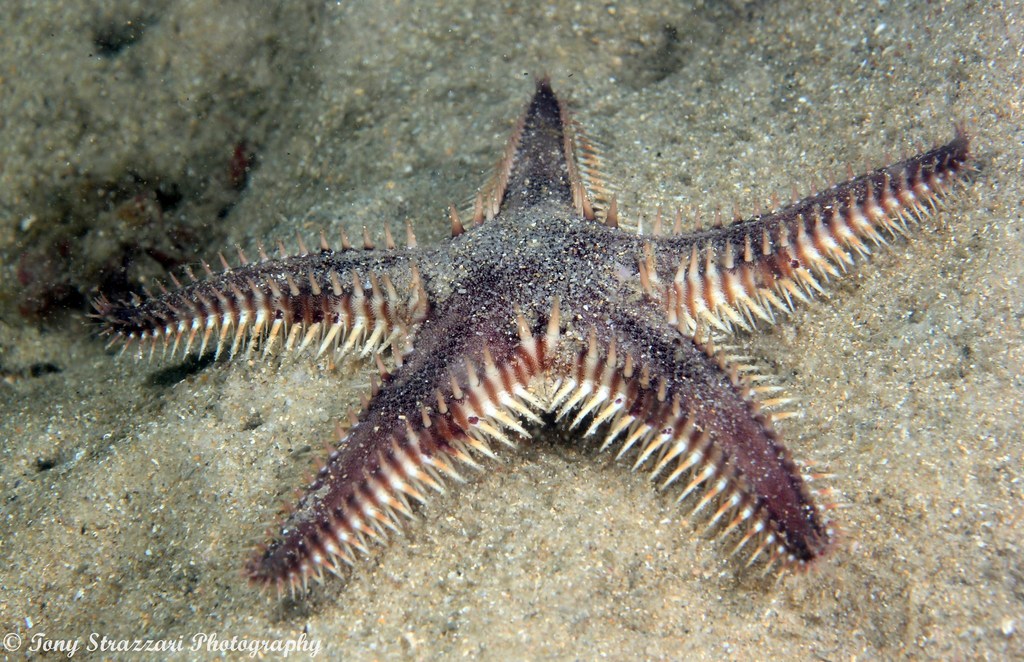
Indo-Pacific Comb Star
Astropecten polyacanthus
Astropecten polyacanthus, the sand sifting starfish or Comb sea star, is a sea star of the family Astropectinidae. It is the most widespread species in the Astropecten genus, found throughout the Indo-Pacific region. The armspread is up to 20 cm (8 in). The specific epithet "polyacanthus" comes from the Latin meaning "many thorned".
From the article Astropecten polyacanthus on Wikipedia (CC BY-SA), quoted section by section
Description
The upper surface of the comb star is a dark purplish colour, while the underside is orange. On the upper surface paxillae (Latin, "little stakes"), little pillars with flattened summits, are cream, grey or brown, the colours sometimes making a chevron pattern. Along the edges of the five arms there is a fringe of long, sharp marginal spines, usually with brown bases and pale tips. The arms are fairly broad and have a maximum length of 9 centimetres (3.5 in). The tube feet are pointed rather than having suckers, an arrangement that is more suitable for digging. Astropecten polyacanthus can be confused with Archaster spp. which look similar because both have developed features to enable them to dig through sand through convergent evolution. Archaster has spines that are flat and blunt and on its upper surface has parallel, radial rows of plates while Astropecten polyacanthus does not.
Range & habitat
The comb star is found in shallow tropical and sub-tropical seas throughout the Indo-Pacific region from the Red Sea and Zanzibar to Hawaii, and from Japan to Australia and New Zealand. In Australia the range extends from Cape Naturaliste in the west, round the north coast to Sydney in the east. It is often found on silty sand bottoms in harbours and estuaries. It is found at depths down to about 185 metres (607 ft).
Wikipedia: “Distribution”
Where it lives
Recorded sightings
—
geo-referenced records in GBIF, from museums, herbaria and field observers.
Drag the globe to turn it. Dots are where records exist, not a range map; darker means more records.
In the stacks
Searching the stacks…
Every page naming Astropecten polyacanthus in the Biodiversity Heritage Library →
This page is assembled live from iNaturalist, GBIF, Wikipedia, the Source Library and the Internet Archive. It is not yet part of the hand-edited codex. iNaturalist taxon 195876.