On eBird ↗
Black-billed Cuckoo
Live sightings near you, the range map, bar charts of when it is seen, and Macaulay Library photos and recordings.
Black-billed Cuckoo
Coccyzus erythropthalmus
The black-billed cuckoo (Coccyzus erythropthalmus) is a New World species in the Cuculidae (cuckoo) family. The scientific name is from Ancient Greek. The genus name, kokkuzo, means to call like a common cuckoo, and erythropthalmus is from eruthros, "red" and ophthalmos, "eye".
It is very similar to, and overlaps in range with, the closely related yellow-billed cuckoo. A distinguishing characteristic of the family Cuculidae is laying eggs in the nests of other birds. Although many cuckoos are obligate brood parasites, C. erythropthalmus often incubate their own chicks.
From the article Black-billed cuckoo on Wikipedia (CC BY-SA), quoted section by section
Description
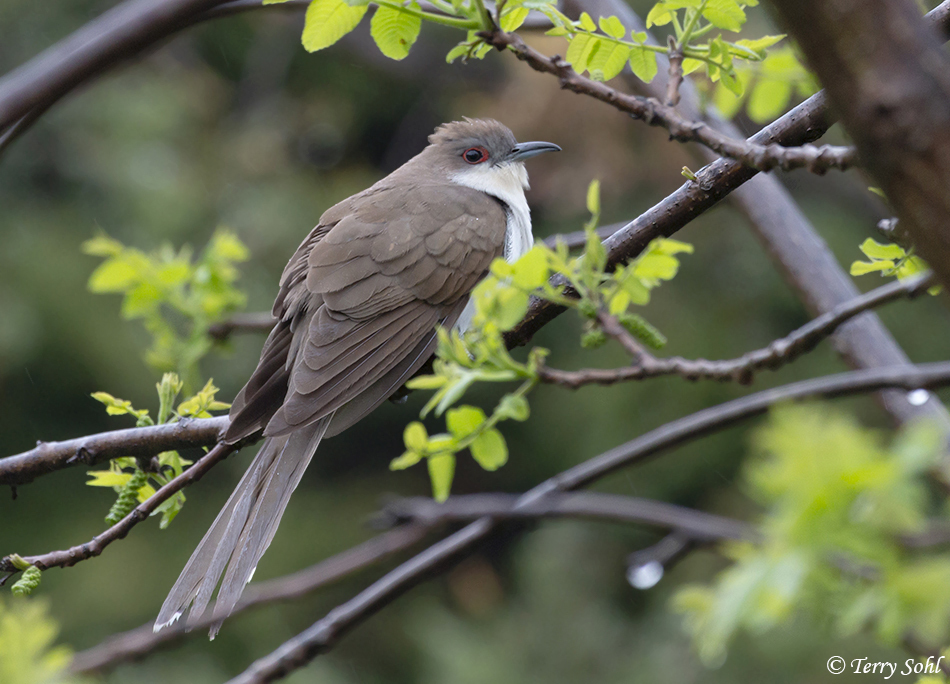
Adults have a long, graduated brown tail and a black, slightly downcurved bill. The head and upper parts are brown and the underparts are white. The feet are zygodactylous. Juveniles are drabber and may contain some rufous coloration on the wing. The adults have a narrow, red orbital ring while the juveniles' is yellow. Black-billed cuckoo chicks have white, sparsely distributed, sheath-like down that contrasts heavily with their black skin. They also have complex, creamy-colored structures on their mouth and tongue, which may appear like warts or some type of parasitic infection however they are normal for the species.
Range & habitat
C. erythropthalmus may be found in a variety of habitats. They are most commonly found around the edges of mature deciduous or mixed forests and much less frequently in coniferous forests. They can also be found in much younger-growth forests with a lot of shrubs and thickets. Wetlands with a lot of alder and willow are another prime location to see them. Lastly, they can also inhabit more open areas such as abandoned farmland, golf courses, and residential parks. Whatever the habitat may be, they are usually quite well hidden and tend to stick to the edges of these habitats. The chosen habitat must also have a water source nearby such as a lake, river, marsh, or pond. On their wintering grounds in South America, they can inhabit tropical rainforests, deciduous or semi open woodlands as well as scrub forests.
Wikipedia: “Habitat”
What it does
These birds forage in shrubs or trees. They mainly eat insects, especially tent caterpillars, but also some snails, eggs of other birds, and berries. It is known to beat caterpillars against a branch before consuming them to remove some of the indigestible hairs. The remaining hairs accumulate in the stomach until the bird sheds the stomach lining and disgorges a pellet in a manner similar to owls. Invasive spongy moths may also serve as an important food source for black-billed cuckoos. Most birds cannot consume spongy moth caterpillars because of their hair-like setae however, cuckoos can consume them because of their ability to shed their abdominal lining. During outbreak years of these insects, the abundance of black-billed cuckoos increased on Breeding Bird Survey (BBS) routes. This increase is not due to a higher reproductive rate because then the black-billed cuckoo populations would only increase the next year. The abundance is higher because the cuckoos flock towards the outbreak areas. This is supported by the fact that cuckoo abundance is actually lower than average in the areas surrounding the outbreaks, suggesting a large influx of the birds towards the outbreaks. They are able to find these areas due to post-migratory nomadic behavior. …
Wikipedia: “Feeding”
Listen
Looking for field recordings…
Where it lives
Recorded sightings
—
geo-referenced records in GBIF, from museums, herbaria and field observers.
Drag the globe to turn it. Dots are where records exist, not a range map; darker means more records.
In the stacks
Searching the stacks…
Every page naming Coccyzus erythropthalmus in the Biodiversity Heritage Library →
This page is assembled live from iNaturalist, GBIF, Wikipedia, the Source Library and the Internet Archive. It is not yet part of the hand-edited codex. iNaturalist taxon 1960.