On eBird ↗
Common Poorwill
Live sightings near you, the range map, bar charts of when it is seen, and Macaulay Library photos and recordings.
Common Poorwill
Phalaenoptilus nuttallii
The common poorwill (Phalaenoptilus nuttallii) is a nocturnal bird of the family Caprimulgidae, the nightjars. It is found from British Columbia and southeastern Alberta, through the western United States to northern Mexico. The bird's habitat is dry, open areas with grasses or shrubs, and even stony desert slopes with very little vegetation.
Many northern birds migrate to winter within the breeding range in central and western Mexico, though some remain further north. The common poorwill is the only bird known to go into torpor for extended periods (weeks to months). This happens on the southern edge of its range in the United States, where it spends much of the winter inactive, concealed in piles of rocks. Such an extended period of torpor is close to a state of hibernation and is not known among other birds.
From the article Common poorwill on Wikipedia (CC BY-SA), quoted section by section
Description
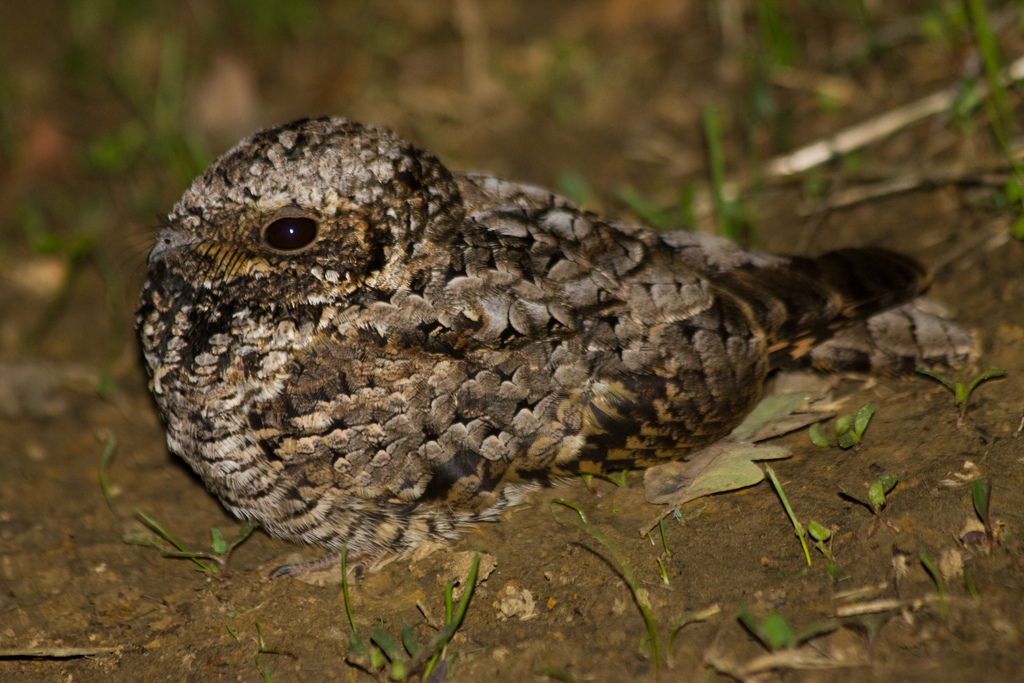
This is the smallest North American nightjar, about 18 centimetres (7.1 in) in length, with a wingspan of approximately 30 centimetres (12 in). It weighs 36–58 grams (1.3–2.0 oz). The sexes are similar, both gray and black patterned above. The outer tail-feathers are tipped with white, the markings slightly more prominent in the male. The common poorwill is told from similar nightjars by its small size, short bill, rounded wings with tips that reach the end of the short tail at rest, and pale gray coloration. Like many other nightjars, the common name derives from its call, a monotonous poor-will given from dusk to dawn. At close range a third syllable of the call may be heard, resulting in a poor-will-low. It also gives a chuck note in flight.
What it does
The common poorwill is the only bird known to go into torpor for extended periods (weeks to months). This happens on the southern edge of its range in the United States, where it spends much of the winter inactive, concealed in piles of rocks. This behavior has been reported in California and New Mexico. Such an extended period of torpor is close to a state of hibernation, not known among other birds. It was described definitively by Dr. Edmund Jaeger in 1948 based on a poorwill he discovered hibernating in the Chuckwalla Mountains of California in 1946.
In 1804, Meriwether Lewis observed hibernating common poorwills in North Dakota during the Lewis and Clark Expedition. Though these observations were recorded carefully in Lewis's journal, their significance was not understood. This was at least in part because the common poorwill was not then recognized as a species distinct from the whip-poor-will of eastern North America. Native Americans of the Hopi tribe were likely aware of the poorwill's behavior even earlier — the Hopílavayi name of this bird, hölchko, means "The Sleeping One".
Breeding. Breeding is from March to August in the south of the range, and late May to September further north. The nest of the common poorwill is a shallow scrape on the ground, often at the base of a hill and frequently shaded partly by a bush or clump of grass. …
Wikipedia: “Behavior”
Listen
Looking for field recordings…
Where it lives
Recorded sightings
—
geo-referenced records in GBIF, from museums, herbaria and field observers.
Drag the globe to turn it. Dots are where records exist, not a range map; darker means more records.
In the stacks
Searching the stacks…
Every page naming Phalaenoptilus nuttallii in the Biodiversity Heritage Library →
This page is assembled live from iNaturalist, GBIF, Wikipedia, the Source Library and the Internet Archive. It is not yet part of the hand-edited codex. iNaturalist taxon 19609.